
Count the days between now and the Australian AMC and you get about a month. Count the days you can actually use and the number falls sharply. The paper is sat on Sunday 11 October 2026; registration closes on Monday 28 September; and National Day falls on Thursday 1 October, which puts a public-holiday block directly across the final stretch. Plan the calendar before you plan the maths.
The month is four blocks, not thirty days
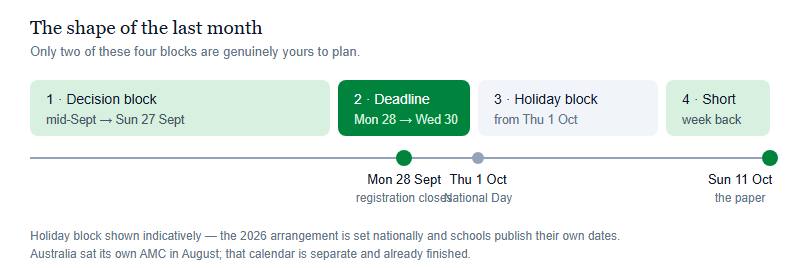
From mid-September to the sitting is roughly thirty days on paper. In practice it is four blocks with completely different properties, and treating them as one undifferentiated month is the most common planning error we see in the China region. Two of the four blocks are largely spoken for before you start.
| Block | Dates | What it is realistically for | What ruins it |
|---|---|---|---|
| 1 · The decision block | Now to Sun 27 Sept | Settling the level letter and delivery mode, and taking one honest timed baseline | Studying before the entry decision is made, so the practice is aimed at the wrong paper |
| 2 · The deadline days | Mon 28 – Wed 30 Sept | Registration closes; last normal school days before the break | Discovering an unanswered ASDAN question on the day the window shuts |
| 3 · The holiday block | The National Day period, from Thu 1 Oct | The only large uninterrupted stretch in the whole month | Travel, or an over-ambitious plan that collapses by day three |
| 4 · The short week back | Return from the break to Sun 11 Oct | Light rehearsal, sleep reset, logistics | School's own post-holiday catch-up assessments landing in the same days |
One qualification on block three: the exact 2026 mainland holiday arrangement is set nationally each year and schools publish their own version of it, including any adjusted working days. Do not plan from last year's pattern or from a half-remembered one — open your school's published calendar and read the actual dates before you allocate anything.
And one warning while you are searching. Australia sat its own AMC in August, and that season is finished. If you find AMC advice online this month that talks about results, reflections or “what to do next year”, it is almost certainly written for the Australian calendar and is not describing your sitting. The China-region date is 11 October.
The holiday block fails in both directions
Every family we work with either loses the National Day week or over-invests in it, and the two failures look nothing alike.
The travel version. The trip was booked in July, long before anyone connected it to a maths competition. The week simply disappears, and because it was mentally filed as “the week we'll get everything done”, nothing was scheduled before it either. These families arrive at 8 October with a paper three days away and a plan that never started. The fix is not to cancel the trip. It is to notice now, in mid-September, that block three is gone, and to move the honest timed practice into block one where it still fits.
The over-planning version. The family stays home and builds a seven-day intensive: two past papers a day, full topic review, the works. It survives about seventy-two hours. By day four the student is refusing, the parent is frustrated, and the last usable stretch of the season has become an argument. The block is genuinely the largest uninterrupted run of time in the month — which is exactly why it should be planned at a sustainable intensity rather than a heroic one.
Our own coaching read, offered as an observation rather than a rule: across a seven-day break, three properly-conditioned timed papers with real review afterwards do more than seven rushed ones. The review is where the marks are, and review takes longer than the paper does. A student who sits a paper and does not rework the questions they missed has spent an hour or more to learn their current score, which they mostly knew already.
The short week back is where school takes its time returned
This is the block families never model, and it is the one that bites. Students come back from a national holiday into a school week that is itself compressed: units that stalled before the break resume at pace, and the assessments that were postponed to “after the holiday” arrive in exactly those days. Then the AMC lands on the Sunday at the end of it.
Two consequences worth building into the plan now.
- Do not schedule anything ambitious in the return week. Whatever heavy practice is going to happen must happen before the holiday ends. The final days are for light familiar work, sleep, and logistics — not for opening a new topic because a weakness has just been noticed.
- Reset the body clock deliberately. In our own coaching a week of holiday tends to push a student's bedtime noticeably later, and that shift rarely corrects itself in the last few days on its own, and the AMC is a Sunday, which is precisely the day a teenager on holiday time is least awake. Start moving bedtime back before the holiday ends, not after.
The audit: count sessions, not days
Do this once, this weekend, with the school calendar open. It takes fifteen minutes and it is the single most useful planning act available to you, because it replaces a vague sense of “we have a month” with a number.
The rule is that a session is an uninterrupted block long enough to sit a full timed paper and review it — call it ninety minutes to two hours. Anything shorter is useful for practice questions but cannot host a full rehearsal. Count only the sessions that genuinely exist: not the ones that would exist if the student gave up football, and not the ones on a travel day.
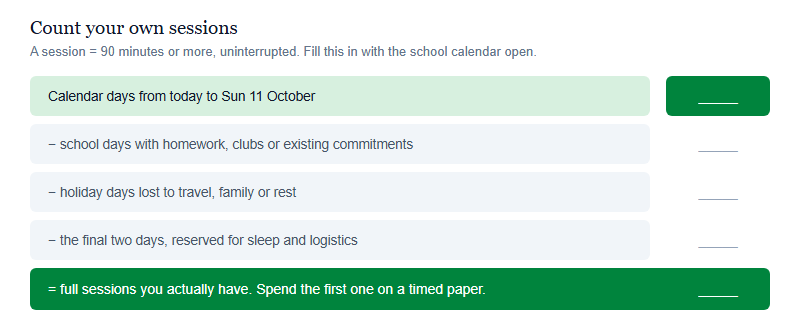
Once you have the number, allocate it in this order: one timed paper first, so everything after it is informed; then review sessions on what that paper exposed; then one full rehearsal in the registered delivery mode; and keep the last session light. If the number came out at three, you are not doing a topic tour — you are doing one diagnostic, one repair, one rehearsal. That is a legitimate plan, and it is far better than a nine-week plan compressed into a fortnight. If you are still deciding whether to enter at all, our overview of the competition and its six levels is the right place to settle that first.
Because it is a Sunday
The China-region sitting is on a Sunday, and that is not a neutral detail. Every timed practice a student has done this term has probably been on a weekday evening, tired, after school. The paper will be sat on a weekend, at a session time set by the venue — confirm the start time and arrival window with ASDAN, because it is the one logistical fact families most often assume rather than check.
Whatever that hour turns out to be, run at least one rehearsal on a Sunday at the same time of day, in the same delivery mode you registered for, with the timer set to the duration confirmed for your level. AMT publishes 60 minutes for its primary divisions and 75 for its secondary ones, but the six China-region letters are banded differently from AMT's Australian divisions, so the duration for your seat is an ASDAN question rather than something to read across.
If you are travelling over the holiday, three things are worth confirming before the trip rather than from an airport: the venue address and how long the journey takes on a Sunday morning; whether the session time you were given is final; and what the student needs to bring. Booking a return flight that lands late on Saturday 10 October is a decision that looks harmless in September and expensive on the day. The competition itself is the same 30 questions and 135 marks whatever the month has thrown at you — the calendar only decides how much of the student turns up to meet it. Our guide to what the Australian AMC is sets out the structure that stays constant underneath all of this.
Frequently asked questions
What day of the week is the 2026 China-region sitting?
Sunday 11 October 2026. The session start time is set by the venue, so confirm it with ASDAN rather than assuming a morning slot.
How does the National Day holiday affect preparation?
National Day falls on Thursday 1 October, putting a holiday block just before the paper. The exact dates are set nationally — check your school calendar.
Should we do intensive practice during the holiday week?
Plan it sustainably. In our experience three timed papers with proper review beat seven rushed ones, and review takes longer than the paper.
Is Australian AMC advice we find online right now relevant to us?
Often not. Australia sat its own AMC in August, so much of that content describes a finished season on a different calendar.
Published by the Australian AMC editorial desk, operated by Hanlin Education for China-based international-school students. The Australian Mathematics Competition is run by the Australian Maths Trust (AMT), with the China region administered by ASDAN. Official rules are set by the competition and change yearly — confirm current details on amt.edu.au. Errors are corrected within 7 working days.