
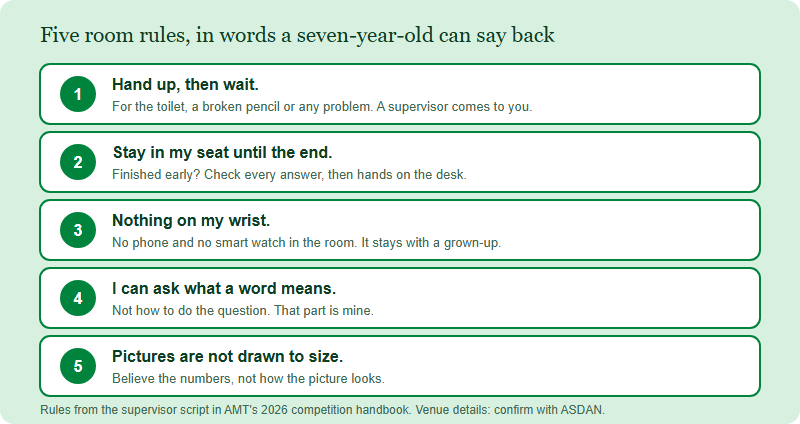
For a child in Grades 1 to 5, sitting day is mostly about the room rather than the maths. The supervisor script in AMT's 2026 competition handbook asks every student to stay seated until the competition finishes, to raise a hand and wait before leaving the room, and to hand over any phone or smart watch. A supervisor can explain what a word means, but not how to solve a question. Rehearse those habits at home before Sunday 11 October.
The script your child will hear
AMT prints the instructions its supervisors read aloud before a paper starts in its Competition handbook for coordinators and supervisors, last updated in January 2026 and published on amt.edu.au. In the China region the sitting is administered by ASDAN, with the papers and standards remaining AMT's, so the arrangements at a particular venue are ASDAN's to confirm. But these are the rules AMT writes for the room, and very few of them are about mathematics.
| Rule | What AMT's script says, in brief | What it means at six to ten | How to rehearse it at home |
|---|---|---|---|
| Silence | Students stay quiet for the whole competition | No reading questions out loud and no chatting to the next desk | A fifteen-minute silent puzzle session with a clock on the wall |
| Waiting to start | The paper stays closed until the supervisor says to begin | Hands off the paper until the start is announced | Lay the practice sheet face down and begin only on a spoken word |
| Phones and watches | No phone or smart watch may be kept during the competition; supervisors collect and store them | A child's phone-watch counts, so it stays with a parent | One practice session with nothing on the wrist |
| Staying seated | Students remain in their seats until the competition ends | Finishing early means sitting quietly, not leaving | The finish-early routine described below |
| The toilet | A student who needs to leave raises a hand, waits, and goes with a supervisor | Go just before the start; if needed, hand up and wait | Practise raising a hand and waiting without calling out |
| Equipment | Borrowing anything needs a supervisor's permission | A broken pencil is a hand-up moment, not a swap with a neighbour | Pack two pencils and an eraser, and practise asking |
| Words | A supervisor may explain what a word on the paper means | A word can be explained; the question itself cannot | Role-play the two kinds of question |
| Pictures | “Diagrams are NOT drawn to scale.” | Do not answer from how a picture looks | The wrong-looking picture game described below |
The same script tells students that the questions have been checked carefully and that nothing beyond the meaning of a word will be explained. Children used to a teacher rephrasing a question on request need to hear that in advance; otherwise the first “I can't explain that” from a supervisor can feel like being told off. If your child sits on printed paper, AMT's script also asks for answers in pencil and for mistakes to be rubbed out completely — confirm with ASDAN how answers are recorded at your child's level.
Three rules that catch young children
Finishing early. Young children often finish the questions they can do well before the end. What happens next is where the trouble starts: turning round, humming, packing up, asking to go. AMT instructs its supervisors to keep students in their seats until the last student has finished, so give the spare minutes a job. Our finish-early routine is four steps a seven-year-old can remember:
- Check that every multiple-choice question has an answer. AMT applies no penalty for a wrong answer, so an answer always beats a blank.
- Go back to any question you marked to come back to.
- On a printed paper, check that each answer sits on the right line — AMT's script asks students to make sure every answer lines up with the question it belongs to.
- Put the pencil down, rest your hands on the desk, and wait quietly.
The watch on the wrist. In our experience many primary-age children in China wear a phone-watch every day and glance at it without thinking. Under AMT's rules it cannot come into the competition, and for a printed-paper sitting AMT's room checklist calls for a clock or timer that every student can see. A child who has only ever tracked time on a wrist has to practise looking up at a wall clock instead. Ask your venue how time is shown in the room, and take the watch off before the door.
The picture that looks right. Young children answer with their eyes: the longer-looking line must be longer, the bigger-looking angle must be bigger. AMT's script warns that the diagrams are not drawn to scale and are there only to help. Play a two-minute game at home: draw a shape that is obviously a long, thin rectangle, label all four sides 5, and ask what shape the labels say it is. The habit you are building is simple to say and hard to keep under pressure — believe the numbers, not the picture.
Planning the Sunday
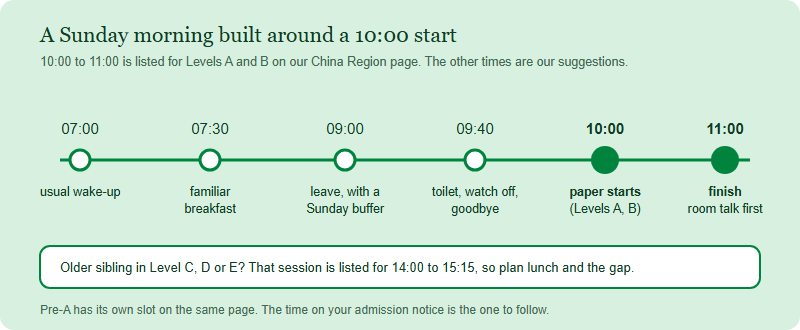
The timetable on our China Region page lists Levels A and B for 10:00 to 11:00 on Sunday 11 October, with Levels C, D and E in the afternoon from 14:00 to 15:15; Pre-A's slot is listed on the same page. Treat the time on your child's admission notice or venue instructions as the one to plan around.
- The Saturday before is a working day for some schools. Under the State Council's 2026 holiday notice, Saturday 10 October is a make-up working day after the National Day break. Schools that follow the national calendar may hold lessons; many international schools publish their own calendar, so check yours and plan an early night either way.
- Parents wait outside. AMT's handbook says supervisors must be teachers or other staff members, and that parents and other students may not supervise. Agree a meeting point before you arrive, and tell your child exactly what to do if they come out and cannot see you.
- Toilet, watch off, goodbye. In that order, at the door, with no rush. A child who arrives flustered spends the first questions calming down.
- Breakfast that is familiar, not special. A new food on a nervous morning is a gamble nobody needs.
- If ASDAN confirms an online seat rather than a venue, AMT's online script carries the same room rules. Ask ASDAN ahead of time what the device and supervision arrangements are, and where an adult may be during the sitting.
- A family with an older child in Levels C to E has two sessions in one day. Plan lunch, and decide where the older child spends the morning; a teenager's last calm hours should not become a corridor wait.
Pre-A: listening to a question read aloud
Per our operator briefing, the Pre-A papers for Grades 1 and 2 are picture-led and text-light, with a read-aloud facility so that children whose reading is still developing can take part fairly; our overview of the Australian AMC shows where Pre-A sits among the six levels. At home, the voice reading practice questions is almost always a parent's. On the day it will not be yours, and how the read-aloud is delivered is for ASDAN to confirm.
- Run at least one practice in which a different adult reads each question once, at an even pace, while your child points to the part of the picture that matters.
- Ask ASDAN before the day whether questions can be repeated and how a Pre-A child records an answer. Do not guess at the format; build practice around the answer you are given.
- AMT's rules allow teaching aids such as counters in its primary divisions, but Pre-A is not one of AMT's Australian divisions. Do not pack counters unless ASDAN has confirmed them, and practise without.
If you find a Years 1–2 paper on AMT's website. AMT's AMC page advertises a free pilot of an Early Primary AMC paper for Years 1 and 2, running from 12 to 23 October. It describes that pilot as online only and open to schools in Australia and New Zealand: 25 questions, of which 20 are multiple choice and 5 need an integer answer, over 50 minutes, with one sitting per student. AMT adds that Early Primary becomes part of its standard AMC line-up from 2027. That is an Australian pilot on an Australian calendar. None of those figures is a Pre-A figure, so do not plan your child's morning on 11 October from them.
After the paper
Do not expect the paper to come home. Under AMT's printed-paper procedure, supervisors collect papers and answer sheets, and they are not handed back to students until the solutions have been released. Ask ASDAN how this works for your child's sitting, but plan the conversation without the paper in your hand.
The first question you ask sets the tone for next year. We suggest starting with the room rather than the result:
- “Did you finish early? What did you do with the time?”
- “Was there a picture that tried to trick you?”
- “Which question would you like to try again?”
Leave “how many did you get?” alone. A young child cannot answer it accurately, and the paper climbs in difficulty by design: AMT says its problems are newly written each year to challenge and extend students, and it gives the later questions more marks. A child who says the end was too hard has described the paper correctly. AMT also states that every student receives an award, with Participation as the floor, so every child who sits has something to show for the morning.
One clarity point for anything you read afterwards: this is the Australian AMC, run by the Australian Maths Trust. A results page or message that mentions the MAA (which runs the American AMC) or SIMCC (which runs AMO) belongs to a different competition. If your child is new to all of this and you want the whole structure in one place, start with what the Australian AMC is.
Frequently asked questions
Can my child go to the toilet during the Australian AMC?
Under AMT's rules a student raises a hand and is accompanied by a supervisor to leave the room. Use the toilet just before the start.
Can a young child wear a smart watch into the room?
No. Under AMT's supervisor script, phones and smart watches are collected before the competition, and a child's phone-watch counts.
What happens if my child finishes early?
They stay seated. AMT's rules keep students in their seats until the competition finishes, so rehearse a quiet checking routine for the spare minutes.
Can the supervisor help my child understand a question?
Only a word. AMT's script allows a supervisor to explain what a word means, but not to explain a question any further.
Published by the Australian AMC editorial desk, operated by Hanlin Education for China-based international-school students. The Australian Mathematics Competition is run by the Australian Maths Trust (AMT), with the China region administered by ASDAN. Official rules are set by the competition and change yearly — confirm current details on amt.edu.au. Errors are corrected within 7 working days.