
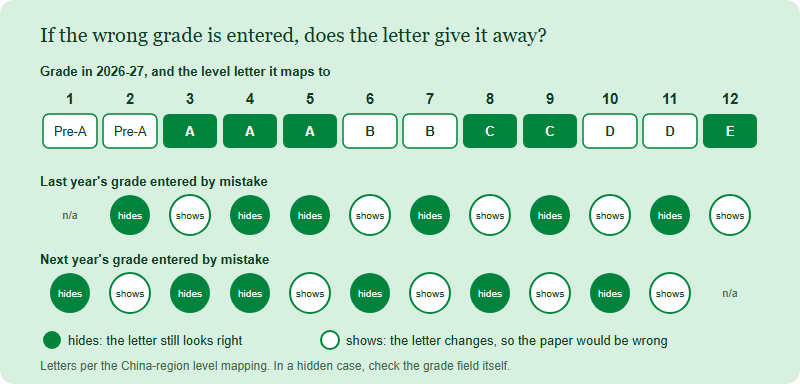
Check the grade on your child's Australian AMC entry, not just the level letter. The letter decides which paper arrives; the grade decides who your child is ranked against, because AMT compares students “in the same year level and region”. For Grades 2, 4, 5, 7, 9 and 11, an entry made with last year's grade still shows the right letter, so a letter-only check waves the mistake through. Entries close on Monday 28 September.
The letter picks the paper; the grade picks the ranking
In the China region, six levels cover Grades 1 to 12: Pre-A for Grades 1–2, A for Grades 3–5, B for Grades 6–7, C for Grades 8–9, D for Grades 10–11 and E for Grade 12, with each child entered by the grade they are in at the time of the competition. Families rightly check that mapping, and our overview of the Australian AMC sets it out in full. What gets far less attention is the second number on the entry.
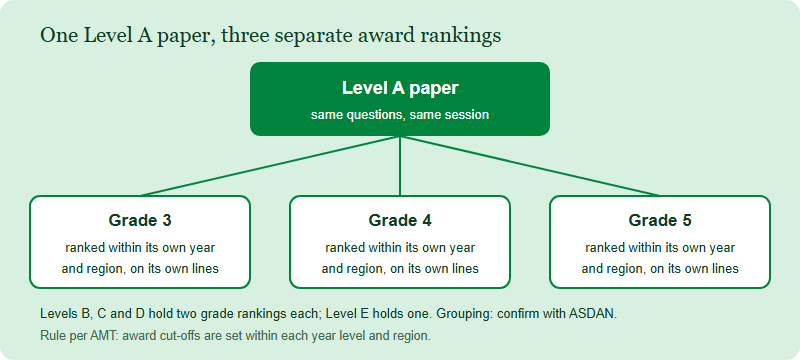
AMT writes its award criteria around the year, not the paper. On its AMC page, a Credit goes to the top 55% of students in their year and region, a Distinction to the top 20% and a High Distinction to the top 3%, with wider bands at the senior end, while Prizes are generally limited to about one student in every 300 in a region and year group. AMT also explains that cut-off scores come from comparing each student with others of the same year level in the same region, and that small regions may have year levels combined. The China-region cut-off tables published on our awards and cut-offs page follow that logic, setting out their lines grade by grade inside each level.
Put those rules together and a single paper can carry several rankings at once. A Level A paper is sat by Grades 3, 4 and 5 together — the same questions in the same session — but each grade is measured against its own year. Levels B, C and D each hold two grades; Level E holds one. How any season's grades are grouped in the China region is ASDAN's to confirm, and Pre-A, in its first year, is worth asking about in its own right.
Why last year's grade slips through in half the grades
Grade errors are rarely careless in the ordinary sense. An entry gets made from the report card on the kitchen table, which still shows last year's grade; or from an older sibling's form; or from a class list compiled before the summer promotion. AMT's own handbook for coordinators is blunt about how common this is: it lists choosing the wrong year level among the most frequent entry errors, alongside typos, spacing mistakes and missing capital letters in names.
The usual slip is one grade low. Run that slip through the level mapping and something awkward appears.
| Grade in 2026–27 | Correct level | If last year's grade is entered | What a letter-only check shows |
|---|---|---|---|
| 1 | Pre-A | No lower grade on the ladder | — |
| 2 | Pre-A | Grade 1 → still Pre-A | Looks correct: the error hides |
| 3 | A | Grade 2 → Pre-A | Wrong letter: the error shows |
| 4 | A | Grade 3 → still A | Looks correct: the error hides |
| 5 | A | Grade 4 → still A | Looks correct: the error hides |
| 6 | B | Grade 5 → A | Wrong letter: the error shows |
| 7 | B | Grade 6 → still B | Looks correct: the error hides |
| 8 | C | Grade 7 → B | Wrong letter: the error shows |
| 9 | C | Grade 8 → still C | Looks correct: the error hides |
| 10 | D | Grade 9 → C | Wrong letter: the error shows |
| 11 | D | Grade 10 → still D | Looks correct: the error hides |
| 12 | E | Grade 11 → D | Wrong letter: the error shows |
Where the letter changes, the mistake produces the wrong paper, and a careful family usually catches it. Where it does not, the paper is right and the comparison group is wrong — and nothing on a letter-only check will show it. The reverse slip, one grade too high, hides in Grades 1, 3, 4, 6, 8 and 10. Grade 4 is the only grade where a slip in either direction still produces the correct letter, because it sits in the middle of the three-grade Level A.
What a wrong grade changes, and what it does not
- It changes the comparison group. Under AMT's rule the award is decided against students of the recorded year level. A Grade 4 child entered as Grade 3 is measured against the wrong year, even though every question in front of them is the right one.
- It changes the record. AMT's handbook says the certificate each participant receives shows their name, school, year level, division and award. Ask ASDAN exactly what the China-region certificate shows, but expect the year level to matter.
- It is not something to fix quietly later. AMT tells its own coordinators to contact AMT about any year-level change after the competition rather than make it themselves, because the change affects results. The time to correct an entry is before the list closes.
- It does not change the paper in the hidden cases, how it is marked, or the fact that AMT applies no penalty for an incorrect response. That is exactly why nobody notices.
One more point, because families occasionally ask it the other way round. The grade on an entry is a statement of fact about the student, not a setting to optimise. AMT's rules allow each student one sitting, in one division only, and the only right grade is the one the school records.
Is it a problem to be the youngest grade on the paper?
This is a question we hear every September, usually from parents of children in Grades 3, 6, 8 or 10 — the youngest grade inside their level. The year-level rule answers most of it. A Grade 3 child sitting a Level A paper alongside Grades 4 and 5 is not competing with those older students for awards; the result is ranked within the child's own year and region.
What the rule does not change is the paper. Questions are pitched for the whole band, so in our coaching experience the youngest grade meets more unfamiliar material than the oldest, and a raw score often looks lower than an older sibling remembers from the same letter. That is expected, and on its own it is not a reason to hold a child back a year. The more useful readiness question is practical: can the child work through the opening questions of a paper at their level without freezing? If so, the ranking takes care of the comparison. If you want the six levels and the paper laid out before deciding, our guide to what the Australian AMC is covers them.
The ten-minute check before 28 September
This check compares two records — what the school says and what was submitted — field by field.
| Check | Where to look | What counts as a match |
|---|---|---|
| The grade the school records for 2026–27 | The latest school report or the school office | A grade number, converted first if your school uses Year labels |
| The grade on the entry | Your registration confirmation, or the school coordinator for a group entry | The same number as the row above — not merely the same letter |
| The level letter | The same confirmation | The letter that grade maps to on the six-level ladder |
| The paper language | The same confirmation | The language your child reads most comfortably |
- If the child is in Grade 2, 4, 5, 7, 9 or 11, read the grade field on its own. Those are the grades where last year's number hides behind a correct letter.
- For a school group entry, ask the coordinator to read back both the grade and the letter. “Is she in Level A?” gets a yes even when the grade underneath is wrong.
- Put genuinely unusual cases to ASDAN in writing — a skipped or repeated year, a mid-year transfer, or a school calendar that does not line up with the grade numbering.
- Teach your child their grade number. AMT's supervisor script has students on paper check the name and year level printed on their answer sheet, because those details go onto the certificate, and online students confirm their school year when they log in. A child can only check a number they know.
Do it before the Mid-Autumn Festival holiday, which runs from Friday 25 to Sunday 27 September under the State Council's 2026 holiday notice. The last weekend before the deadline is not a working weekend for schools or offices that follow the national calendar.
Why the year level matters after the results, too
A result is eventually read by people who were not in the room. An admissions reader looking at a maths profile checks an award against the transcript, the activity list and the student's own account in an essay, and several results across one file corroborate each other — that cross-checking is what makes the record believable. A certificate whose year level does not match the transcript for that year does not undo the achievement, but it adds friction to a process whose whole job is matching things up. No single award decides an application; the point is that an accurate entry costs ten minutes now and keeps the record easy to verify later.
When a result is listed anywhere, write the competition out in full: the Australian Mathematics Competition, run by the Australian Maths Trust. The American AMC, run by the MAA, and AMO, run by SIMCC, are separate competitions with separate records, and a reader should never have to guess which “AMC” is meant.
Frequently asked questions
Does the Australian AMC rank awards by level or by grade?
By grade. AMT sets award cut-offs within each year level and region, so a single level paper can hold several separate rankings.
Which grades can hide a wrong-grade entry behind the right letter?
Grades 2, 4, 5, 7, 9 and 11. Entered with last year's grade, they still map to the correct level, so check the grade field itself.
Is a Grade 3 student competing with Grade 5s for Level A awards?
Not for awards. They sit the same Level A paper, but AMT ranks awards within year level and region. The questions are pitched for the whole band.
What should we do if the grade on the entry is wrong?
Contact ASDAN before entries close on 28 September. AMT routes year-level changes after a sitting through the organiser, as they affect results.
Published by the Australian AMC editorial desk, operated by Hanlin Education for China-based international-school students. The Australian Mathematics Competition is run by the Australian Maths Trust (AMT), with the China region administered by ASDAN. Official rules are set by the competition and change yearly — confirm current details on amt.edu.au. Errors are corrected within 7 working days.