
For many students preparing for the Australian Mathematics Competition, geometry questions involving paper folding present a unique challenge. Unlike standard geometry problems where shapes are static, folding introduces dynamic transformations that can obscure which measurements remain constant. The core difficulty lies not in complex calculation, but in correctly tracking invariants—specifically, which lengths and angles stay equal after a fold.
This article addresses that specific reasoning failure. While broad preparation guides cover general strategies, this piece focuses exclusively on the mechanics of folding problems through two fully worked teaching illustrations and a diagnostic approach to avoid common errors. These are original teaching illustrations, not official past-paper questions or claimed marking criteria.
The Core Principle: Isometry and Invariants
A fold is an isometric transformation. This means it preserves distances and angles within the folded portion of the paper. When you fold a corner of a square onto another point, the segment connecting the original corner to any point on the fold line is congruent to the segment connecting the new position to that same point on the fold line. Similarly, any angle formed by edges meeting at the folded vertex remains unchanged in magnitude, though its orientation shifts.
It is crucial to understand that reflection preserves midpoints of a wholly reflected segment. However, if a segment straddles the crease (partially folded), each piece must be tracked separately. Furthermore, the statement holds true only when is on the crease; for points not on the crease, the crease is the perpendicular bisector of the segment joining the point to its image, but the point itself moves.
The mistake often made is assuming that the entire shape’s properties remain obvious. For instance, if a rectangle is folded such that one corner touches the opposite side, the resulting triangle might look like a right-angled triangle, but verifying the angles requires tracing the original perpendicularity. If the original corner was 90 degrees, the folded image of that corner must also be 90 degrees relative to the adjacent folded edges.
Teaching Illustration 1: The Simple Corner Fold
This is an original teaching illustration, not an official Australian AMC problem.
Consider a square with side length 4. Point is the midpoint of . The square is folded along a line passing through such that point lands exactly on point .
Step-by-Step Reasoning:
- Identify Invariants: Since maps to , and lies on the fold line (the axis of reflection), the distance from to must equal the distance from to . This is because points on the axis are fixed, so is required by isometry.
- Check Consistency: In the original square, . In triangle , we have and (since is the midpoint). By the Pythagorean theorem, .
- Detect the Contradiction: We have and . Since , the condition fails. Therefore, no such fold through can map to . This check is deliberately impossible to demonstrate the power of invariant verification before attempting construction.
The Lesson: Before calculating anything, verify that the proposed fold is geometrically possible. The invariant distances from points on the axis to corresponding original and image points must match. This trap appears frequently when students assume any two points can be related by a fold through a third.
Adjusted Feasible Case: Let us modify to a solvable problem. Same square with side 4. Fold so that vertex touches the center of the square. The crease intersects at and at . Find the length of .
Solution:
- Place at the origin: , , , . Then center .
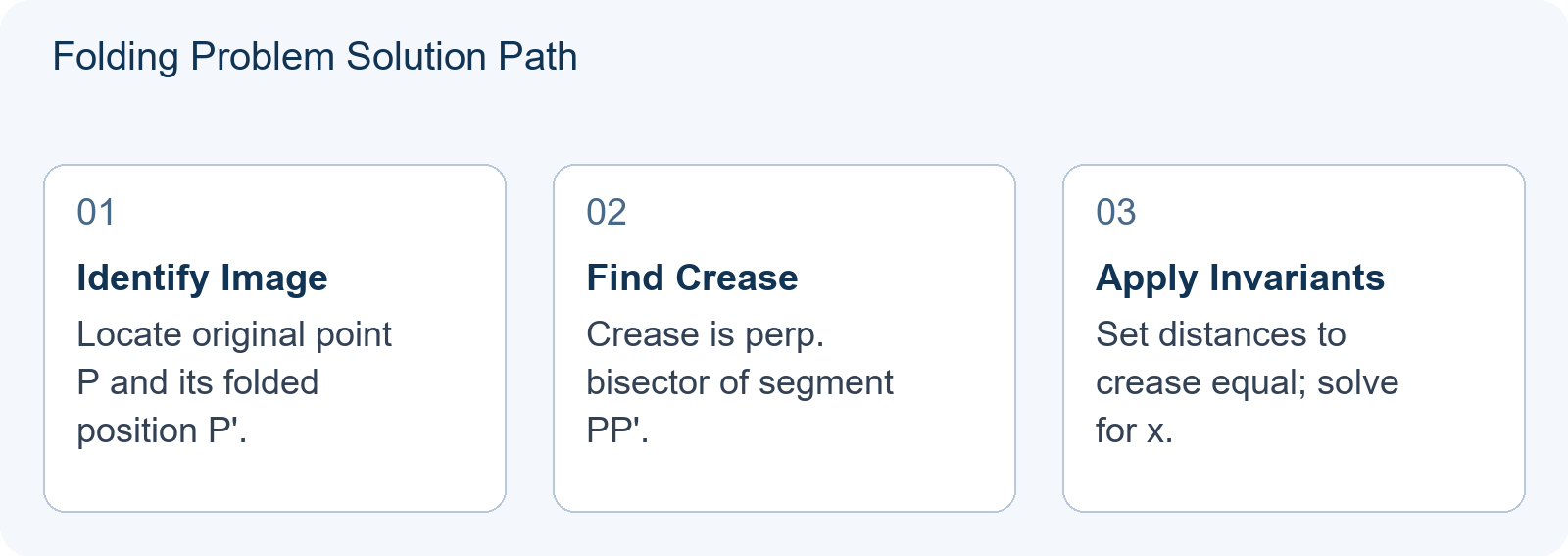
- For any point on the crease, its distance to equals its distance to . Thus the crease is the perpendicular bisector of segment .
- Midpoint of : .
- Slope of : . Perpendicular slope: .
- Crease equation: , so .
- Find on (where ): , so . Thus .
- Find on (where ): , so , thus . Thus .
- Therefore .
Verification of Invariants: By construction, and . Check: ✓. And ✓. Also (original corner), so (preserved angle) ✓.
Teaching Illustration 2: Where the Shortcut Fails
This is an original teaching illustration, not an official Australian AMC problem.
A rectangular strip has width and length very large. Point is on the bottom edge such that , where is the bottom-left corner. The strip is folded so that touches . A student guesses the crease angle is from visual appearance. Show this is wrong and find the correct crease angle.
Correct Analysis:
- Set up coordinates: Let , so . The crease is the perpendicular bisector of .
- Find the crease: Midpoint of is . Since is horizontal, the perpendicular bisector is the vertical line .
- Determine the crease angle: The crease is vertical, so it makes a angle with the bottom edge (which runs along the x-axis).
- Expose the error: The student merely guesses from appearance, assuming symmetry about the diagonal or angle bisector. However, with and , angle has vertex at with rays along (vertical) and (to ), so it is not and the crease does not pass through . The actual crease is at to the base. With along the left edge, , which is not on .
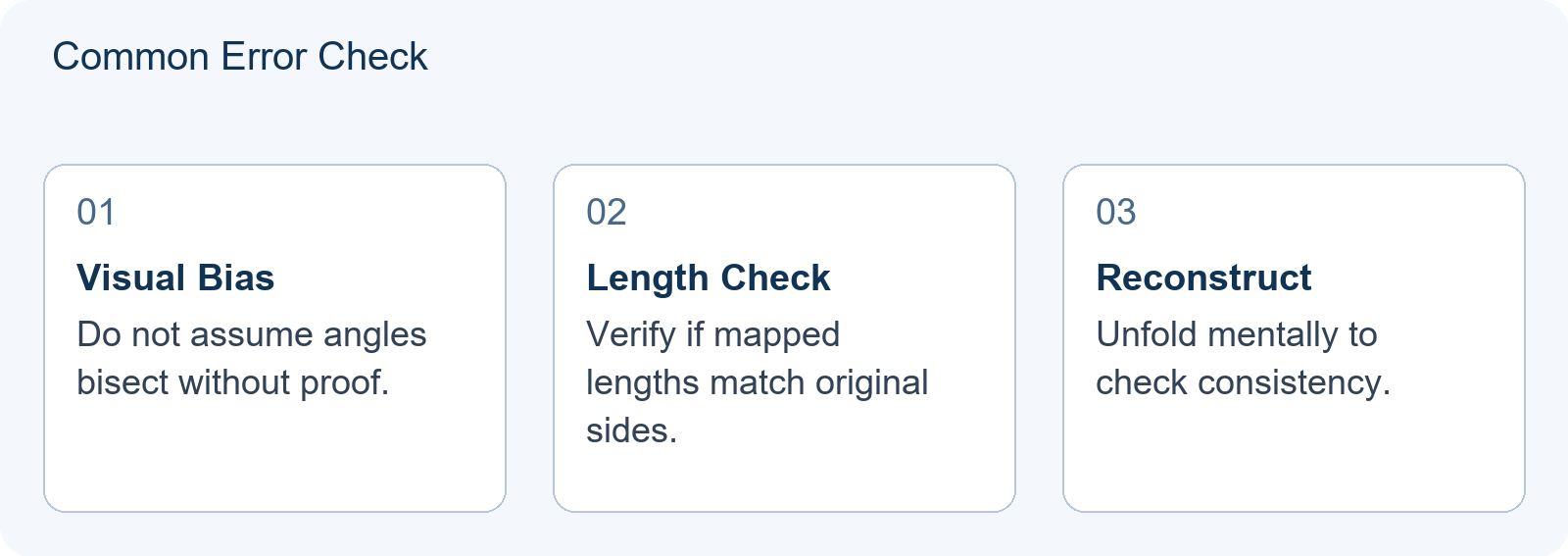
The Lesson: The crease is the perpendicular bisector of the segment joining a point to its image—not the angle bisector at an unrelated vertex. Visual symmetry assumptions are dangerous. Always construct the perpendicular bisector explicitly.
Diagnostic Table: Common Mistakes in Folding Problems
| Mistake | Why It Happens | Correction Strategy |
|---|---|---|
| Assuming midpoints map to midpoints incorrectly | Reflection preserves midpoints of a wholly reflected segment, but a segment straddling the crease needs each piece tracked separately. | Calculate actual distances using Pythagoras or similar triangles for partial segments. |
| Ignoring preserved angles | Focusing only on lengths; forgetting that corners retain their internal angle measure. | Mark all original right angles or known angles on the folded diagram. |
| Confusing crease with angle bisector | Thinking the crease always bisects the angle between original and final positions. | Remember: The crease is the perpendicular bisector of the segment connecting a point to its image. |
Targeted Practice Sequence
To master these problems, follow this sequence:
- Paper Experimentation: Physically fold paper to see how vertices move. Mark the crease and the image points.
- Geometric Construction: Draw the original shape. Identify the point being moved () and its image (). Construct the perpendicular bisector of . This is the crease.
- Invariant Listing: Before calculating, list all equal lengths (for any point on the crease, where is the image of ) and angles ( for angles within the folded portion).
- Algebraic Setup: Assign variables to unknown segments. Use the Pythagorean theorem on the right triangles formed by the crease and the edges.
For broader context on general preparation strategies and identifying skill gaps beyond standard school mathematics, review our guides on Australian AMC Tutoring: Which Gaps Need Support Beyond School Maths? and The Maths Isn’t the Hard Part: Extracting the Condition from Australian AMC Word Problems (2026).
Related Reading
For results and administrative timelines, see Australian AMC 2026 China Results: The 6–8 Week Window, Score Report and Who to Ask.
Demonstrating Competence
A learner should be able to demonstrate next: Given a diagram of a folded polygon, they can instantly identify the perpendicular bisector relationship between a point and its image, and use that to set up an equation for an unknown length without relying on visual approximation. This skill transforms folding problems from puzzles into solvable algebraic exercises.
Frequently Asked Questions
Does the fold line always pass through a vertex?
No. The fold line can intersect any two edges of the polygon. It is defined by the requirement that one part of the paper maps onto another, not necessarily anchored at a corner.
How do I know if a folding problem is solvable?
Check if the distance from any point on the proposed crease to the original point equals the distance to its image. For a point on the proposed axis, its distance to the original must equal its distance to the image. This condition is necessary but not sufficient by itself to satisfy all other geometric constraints; if it fails for any point on the proposed crease, the fold is geometrically impossible.
Why does the crease act as a perpendicular bisector rather than an angle bisector?
The crease is the set of points equidistant from the original point and its image. For any point on the crease, its distances to and are equal. The crease is specifically the perpendicular bisector of segment because reflection requires every point on the crease to be equidistant from and while also lying on the line perpendicular to at its midpoint. Equal distances from a single fixed point on the crease are necessary but not sufficient without the perpendicular bisector condition.