
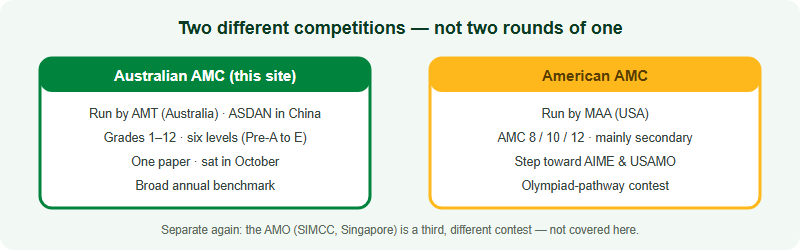
The Australian AMC and the American AMC are two different competitions that only sound alike. The Australian Mathematics Competition is set by the Australian Maths Trust (AMT), administered in China by ASDAN (阿思丹), runs six levels across Grades 1-12, and is sat on Sunday 11 October 2026. The American AMC 8/10/12 is run by the MAA in the USA for secondary students, on a separate calendar and feeding the AIME path. A strong result in one does not transfer to the other.
Two competitions, one confusing letter: why families mix them up
Both are abbreviated “AMC,” both involve maths, and both are well known — so it is easy to assume they are the same event or two rounds of one thing. They are not. The Australian Mathematics Competition has been set by the Australian Maths Trust (AMT) since 1978 and is described as Australia's largest school maths competition; for students in China and Asia it is administered by ASDAN (阿思丹), who handle registration, the exam day and certificates. The American AMC — the AMC 8, AMC 10 and AMC 12 — is run by the Mathematical Association of America (MAA) in the United States, and is the well-known first step on the American olympiad ladder toward the AIME and USAMO.
There is also a third lookalike worth naming so you do not trip over it: the AMO (American Mathematics Olympiad) is a separate contest run by SIMCC in Singapore — despite the word “American” in its title, it is neither the Australian AMC nor the American AMC. This article is strictly about the first two. On this site, “AMC” always means the Australian Mathematics Competition; if you are still placing it, start with What Is the Australian AMC.
The side-by-side: how they actually differ
The cleanest way to compare them is to put the two next to each other on the things parents actually plan around — who can enter, when, what the paper looks like, and what the result is for. For the Australian AMC the figures below are the verified 2026 China-region facts you can plan around. For the American AMC, the broad shape (its 8/10/12 structure and olympiad pathway) is well known, but exact specifics are set by the MAA and can change, so confirm those on the MAA's own channels — confirm on the official site.
| Dimension | Australian AMC (this site) | American AMC (for contrast) |
| Who sets it | Australian Maths Trust (AMT), founded 1978; ASDAN (阿思丹) in China/Asia | Mathematical Association of America (MAA), USA |
| Grade span | Grades 1–12 across six levels: Pre-A (1–2, new 2026), A (3–5), B (6–7), C (8–9), D (10–11), E (12) | Mainly secondary: AMC 8 (lower secondary), AMC 10 & AMC 12 (upper secondary) |
| China exam day | Sunday 11 October 2026 · register by 28 September 2026 | Separate calendar set by the MAA |
| Paper shape | 30 questions (25 multiple-choice + 5 integer) · 135 marks · 45–75 min by level | Multiple-choice paper(s); exact counts/marks set by the MAA |
| Wrong-answer penalty | None — attempt every question | Set by the MAA |
| Languages (China) | English & Chinese | Set by the MAA |
| What the result is for | Broad annual benchmark; award by national percentile; certificate for every entrant | Entry point to a defined olympiad pathway (toward AIME, then USAMO) |
We have deliberately left the American AMC's exact counts, dates and rules as “set by the MAA” rather than printing numbers we cannot verify here — its details are the MAA's to state and they do change. The Australian AMC figures, by contrast, are the confirmed 2026 China-region facts.
The two biggest practical differences for a China family
Reading a table is one thing; knowing which differences actually change your decision is another. For a family in China, two stand out.
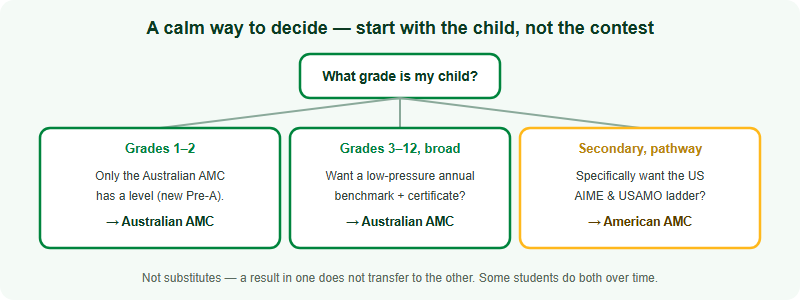
1. Grade span. The Australian AMC has a paper for every grade from 1 to 12 — and from 2026 a brand-new Pre-A level for Grades 1-2. That means a Grade 2 child and a Grade 11 student can sit the same competition (at different, age-appropriate levels) on the same day. The American AMC is built for secondary students: there is no equivalent primary entry point. So if your child is in primary school, or you are planning across several children at different ages, the Australian AMC simply has somewhere for everyone to start; the American AMC, for now, does not.
2. What the result means. The Australian AMC is designed as a broad benchmark — every entrant gets a certificate, awards are by national percentile, and there is no penalty for a wrong answer, so the day is low-pressure and the result reads as “how my child did, relative to peers at the same level, this year.” The American AMC is a pathway contest: its main purpose is to identify and progress students up the US olympiad ladder. Neither purpose is better — but they answer different questions, and a family should know which one it is buying into. If you want an honest read on what either result does (and does not) signal for admissions, see Is the Australian AMC Worth It? An Honest Look for Admissions.
The one mistake to avoid: assuming a result transfers
This is the heart of the comparison, so it is worth stating plainly: a strong result in one of these competitions does not carry over to the other. They are run by different organisations, use different papers, and recognise achievement in their own ways. A High Distinction in the Australian AMC is a real, recognisable result on its own terms — but it is not an American AMC score, does not qualify a student for the AIME, and is not “the same as” doing well in the MAA contest. The reverse is equally true.
Why does this matter so much in practice? Because families occasionally enter the wrong contest believing it is the one a particular programme or pathway asks for, or assume that preparing for one automatically prepares a child for the other's specific format. The mathematical thinking certainly transfers — problem-solving is problem-solving — but the credential does not. When you register, read the organiser name carefully: Australian Maths Trust / ASDAN for the Australian AMC on this site; MAA for the American AMC. Getting that one detail right saves the most common, and most avoidable, source of confusion.
Can a student do both? Yes — and how to think about it
Because the two contests serve different purposes, they are complementary rather than competing, and many students engage with more than one across their school years. A reasonable way to think about sequencing, for a family in China:
- The Australian AMC works well as a wide-net, annual contest. With levels from Grade 1 to 12 and a no-penalty, finish-everything paper, a child can sit it every year from primary school onward — building a habit of problem-solving and a year-on-year line of progress. The new Pre-A level makes an early, gentle start possible; for what changed in 2026, see What's New in the 2026 Australian AMC: The Pre-A Level & More.
- The American AMC suits a secondary student aiming at the US pathway. If, later, a student already enjoys contest maths and is specifically pursuing the AIME-and-beyond route, the American AMC is the contest built for that aim — on its own calendar and its own rules.
There are no guaranteed outcomes in any competition, and neither contest is a shortcut to admission anywhere. The honest framing is simple: pick the contest that fits your child this year, do it for the right reason (growth and a fair benchmark), and add another later if it genuinely serves a goal — not because the names sound similar.
Quick recap: the differences that matter
If you remember only a few things from this side-by-side: the Australian AMC is set by the Australian Maths Trust, run in China by ASDAN, spans Grades 1-12 across six levels, is sat on 11 October 2026, uses a 30-question / 135-mark / no-penalty paper in English and Chinese, and is a broad annual benchmark with a certificate for every entrant. The American AMC is a separate MAA contest for secondary students that opens the US olympiad pathway. They are different competitions, a result in one does not transfer, and the only real mistake is confusing the two at registration.
Frequently asked questions
Is the Australian AMC the same as the American AMC?
No. The Australian AMC is set by the Australian Maths Trust (ASDAN in China); the American AMC is a separate MAA contest in the USA. Two different competitions.
Does a result in one count for the other?
No. A result in the Australian AMC does not transfer to the American AMC (or qualify for the AIME), and the reverse is true too. The thinking transfers; the credential does not.
Which one can a primary-school child in China enter?
The Australian AMC — it covers Grades 1-12, including a new Pre-A level for Grades 1-2 in 2026. The American AMC is mainly for secondary students.
Can a student do both competitions?
Yes. They are complementary, not substitutes. Many students use the Australian AMC as a broad annual benchmark and add the American AMC later if pursuing the US pathway.
This is the editorial desk for the Australian Mathematics Competition (AMC) China region. The competition is run by the Australian Maths Trust (AMT) and administered in China and Asia by ASDAN (阿思丹); this content desk is operated by Hanlin Education for students in China. Dates, fees, levels and rules are set by the AMT and ASDAN and can change each year — always confirm current details on the official channels (amt.edu.au and the ASDAN China-region channels). Confirmed errors are corrected within 7 working days.