
Is the Australian Mathematics Competition (AMC) worth it? For most students in China, yes — but not as a shortcut to admission. Its honest value is as a low-pressure, no-penalty benchmark of mathematical thinking that suits a very wide range of students (Grades 1-12), gives every entrant a certificate, and adds a recognisable national line to an academic record. It signals genuine problem-solving, not a guaranteed result. This guide explains what it really says — and how to make it count.
What an AMC result actually signals (and what it doesn't)
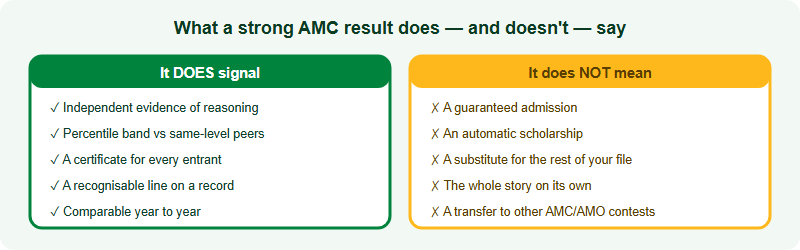
Let's be honest up front, because this is where families either over- or under-value the AMC. A strong Australian AMC result is a credible, independent signal of mathematical reasoning: it shows a student can read an unfamiliar problem, choose an approach, and work under modest time pressure — sitting the same paper as peers worldwide and being scored against them. Because awards are reported by national percentile, a band like Distinction or High Distinction describes how a student did relative to others at the same level, which is easy for a reader to interpret and naturally comparable from one year to the next.
What it is not: a guarantee of admission anywhere, an automatic scholarship, or a substitute for the rest of an application. No single contest does that, and any site that promises it is misleading you. The Australian AMC is run by the Australian Maths Trust (AMT) and administered in China and Asia by ASDAN (阿思丹); it is a respected academic benchmark, not an admissions ticket. Think of a good result as one solid, verifiable data point among many — evidence that supports a story about a student's mathematical curiosity, rather than the story itself. Used that way, it is genuinely worth the modest effort. Treated as a magic key, it will disappoint.
Why the no-penalty design suits a wide range of students
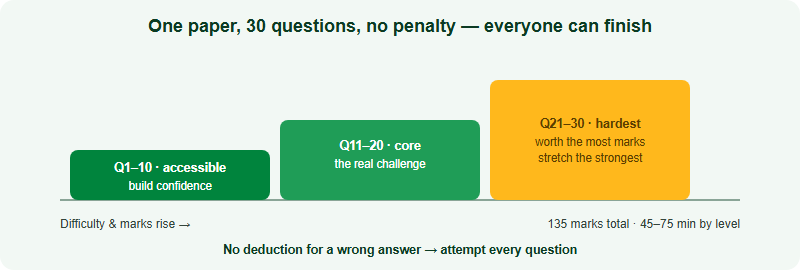
The single feature that makes the Australian AMC worth it for so many different students is its format. Every level sits the same shape of paper: 30 questions — 25 multiple-choice plus 5 integer-answer — worth 135 marks, with time ranging from about 45 minutes at the youngest level to 75 minutes at senior secondary, in English and Chinese. Crucially, there is no penalty for a wrong answer. Nothing is deducted for a guess that doesn't land.
That one rule changes the experience. Because a wrong answer costs nothing, every student can attempt every question and finish the paper — there is no defensive strategy of leaving questions blank to protect a score. Questions rise in difficulty (and in marks: the early ones are worth fewer points, the hardest are worth the most), so a nervous beginner can build momentum on the opening questions while a confident student is genuinely stretched by the closing ones. The same paper rewards a Grade 3 child finding their feet and a Grade 11 student reaching for the top band. For more on the structure, see What Is the Australian AMC.
This is why the contest is unusually low-pressure for what it measures. It does not punish a student for trying. It is forgiving of test-day nerves. And it sets a bar that almost any motivated student can engage with, while still leaving room at the top for real difficulty. For families weighing whether the effort is justified, that broad, encouraging design is a large part of the answer.
Who is it worth it for? An honest fit check
"Worth it" depends on the student. The Australian AMC is not the right next step for everyone in the same way, so here is a candid look at who tends to gain the most — and who might prioritise something else first.
| Student profile | Is the AMC worth it? | Why |
| Curious beginner, never done a contest | Yes — strong fit | No-penalty design and accessible opening questions make a gentle, encouraging first contest. A certificate for finishing builds confidence. |
| Solid student wanting an annual benchmark | Yes — strong fit | Percentile bands track progress year on year across Grades 1-12; a recognisable line on the record without high stakes. |
| Strong, contest-keen student | Yes — worth it | The hardest closing questions are genuinely demanding; High Distinction / Prize bands are meaningful, and a perfect score can earn the O'Halloran Award. |
| Younger child (Grades 1-2) | Yes — newly possible | The new Pre-A level (Grades 1-2) for 2026 gives an age-appropriate paper where there wasn't one before. |
| Student already deep in a specific olympiad track | Maybe — as a complement | Still a useful broad benchmark, but it complements rather than replaces a specialised pathway; don't expect it to substitute for that track. |
The pattern is clear: the AMC is most worth it as a wide-net, return-every-year contest — a reliable way to measure and encourage mathematical thinking from primary right through to Grade 12. It is least likely to be the single most valuable thing for a student who is already several steps down a narrow, advanced competition path, though even then it can sit alongside that work. Honesty about fit is part of using it well.
How to make it count, honestly
If you decide it's worth doing, a little intention turns a result from a line item into something meaningful — without any hype or guarantees. None of this changes the rules of the competition; it's simply how to get real value from participating.
- Enter at the right level and for the right reason. Register by the student's grade at the time of the competition, and treat the goal as "engage well and reason carefully", not "win or it was pointless". The percentile design means meaningful recognition exists well below the very top.
- Prepare with understanding, not tricks. Work through reasoning-based practice across the topic spread, focusing on why an approach works. Because the paper rewards thinking over memorised speed, building genuine understanding is both the most effective preparation and the most honest.
- Use the no-penalty rule deliberately. Coach the simple, true strategy: attempt every question, because a blank scores the same as a wrong answer — zero — while a reasoned attempt can earn marks. This removes test-day fear rather than adding pressure.
- Frame the result accurately afterwards. A band or a percentile is a clear, verifiable fact about mathematical reasoning. Present it as exactly that — independent evidence — alongside the rest of a student's record. Do not inflate it into a claim it can't support.
- Make it a habit, not a one-off. Much of the long-term value comes from sitting the AMC each year and watching reasoning mature. The record then shows a trajectory, which is far more persuasive than a single data point.
Done this way, the answer to "is it worth it?" is a confident yes for most students — because the value is real, modest, and honestly framed. For the exact 2026 logistics, including the new level and the dates, see 2026 Australian AMC China: Registration & the October Exam, Explained, and for what's new this year, What Changed for the 2026 Australian AMC.
Key 2026 facts to plan around
Whatever you decide, plan around the verified 2026 China-region details rather than Australia's home schedule (which differs). The competition sits on a single Sunday, with one earlier registration deadline — both comfortably within a normal school term.
| Item | 2026 China region |
| Exam date | Sunday, 11 October 2026 |
| Register by | 28 September 2026 |
| Levels | Six: Pre-A (Grades 1-2, new) / A (3-5) / B (6-7) / C (8-9) / D (10-11) / E (Grade 12) |
| Paper | 30 questions (25 multiple-choice + 5 integer) · 135 marks · no wrong-answer penalty |
| Time | 45-75 minutes by level · English & Chinese |
| Recognition | By national percentile: Prize / High Distinction / Distinction / Credit / Proficiency; a certificate for every entrant; O'Halloran Award for a perfect score |
| Entry fee & exact cut-offs | Confirm on the official site |
A reminder that matters for planning: the Australian AMC (AMT / ASDAN) is not the American AMC (run by the MAA in the USA) and not the AMO (run by SIMCC in Singapore). Three separate competitions with similar names — a result in one does not carry to the others, so register for the right one.
Frequently asked questions
Does the Australian AMC guarantee better admissions?
No. It is a respected, independent benchmark of maths reasoning and a verifiable line on a record, but it is not a guarantee of admission or a scholarship.
Is it worth it for an average student?
Often yes. The no-penalty design and accessible opening questions make it a low-pressure, confidence-building benchmark, and percentile bands give meaningful recognition below the very top.
Why is there no penalty for wrong answers?
So every student can attempt every question and finish the paper. A blank and a wrong answer both score zero, so a reasoned attempt only helps.
Is this the same as the American AMC or the AMO?
No. The Australian AMC is run by AMT (ASDAN in China). The American AMC is a separate MAA contest, and the AMO is a separate SIMCC contest.
This is the editorial desk for the Australian Mathematics Competition (AMC) China region. The competition is run by the Australian Maths Trust (AMT) and administered in China and Asia by ASDAN (阿思丹); this content desk is operated by Hanlin Education. Dates, fees, levels and rules are set by the AMT and ASDAN and can change each year — always confirm current details on the official channels (amt.edu.au and the ASDAN China-region channels). Confirmed errors are corrected within 7 working days.