
To prepare for the Australian Mathematics Competition (AMC), start by knowing your level (Pre-A to E), then build reasoning through past papers rather than memorising formulas. Work in three phases — untimed practice, timed mock papers, then targeted review of weak question types. Because there is no penalty for wrong answers, the final skill to rehearse is leaving no question blank. The 2026 paper runs Sunday 11 October.
First, find your level — the roadmap depends on it
The Australian AMC in the China region has six levels, each mapped to a school-year band. Preparation that ignores the level is the most common mistake we see: a Grade 8 student grinding through Pre-A material learns nothing new, while a Grade 4 student attempting Level D problems simply loses confidence. New for 2026 is Pre-A, opening the competition to Grades 1–2 for the first time. The paper format is shared across levels — 30 questions (25 multiple-choice plus 5 integer-answer), 135 marks, no penalty for wrong answers — but the time limit and difficulty rise as the level climbs.
For a fuller breakdown of how marks and the difficulty curve work, see our companion piece on the Australian AMC 30-question difficulty curve & 135-mark scoring. If you are still deciding whether to enter, our overview of what the Australian AMC is is the best starting point.
| Level | Grades (China region) | Time (approx.) | Roadmap focus |
|---|---|---|---|
| Pre-A (new 2026) | Grades 1–2 | ~45 min | Number sense, counting, simple patterns; reading the question aloud |
| A | Grades 3–5 | ~60 min | Arithmetic fluency, basic geometry, logical “story” problems |
| B | Grades 6–7 | ~60 min | Fractions/ratios, area & perimeter, organised counting |
| C | Grades 8–9 | ~75 min | Algebraic reasoning, multi-step word problems, number theory basics |
| D | Grades 10–11 | ~75 min | Functions, combinatorics, harder geometry, proof-style thinking |
| E | Grade 12 | ~75 min | Advanced problem-solving, speed on the back-half “stretch” questions |
A simple four-stage roadmap that works at every level
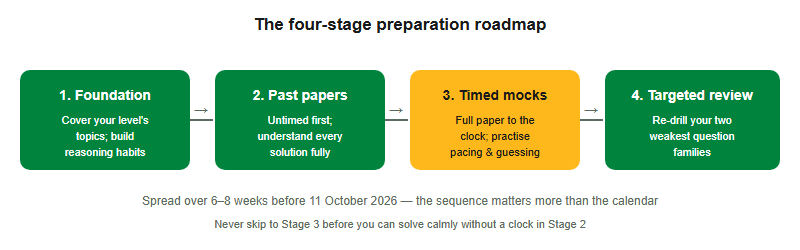
Whatever the level, effective preparation follows the same shape. The content gets harder; the method does not. We recommend four stages, ideally spread over six to eight weeks before the October exam, but compressible into three to four weeks if you start late. The point is the sequence, not the calendar — never jump straight to timed mock papers before you can solve the problems calmly without a clock.
How to actually use past papers (the three-phase method)
Past papers are the single most useful resource, but most students misuse them by treating every attempt as a timed test from day one. That trains anxiety, not skill. We recommend running each paper through three phases, and only moving a paper to the next phase once the current one is genuinely comfortable.
- Phase 1 — Untimed and honest. Solve the paper with no clock. When you finish, do not just check answers: read the full worked solution for every question you got wrong or guessed, and write one sentence on why the correct method works. Understanding beats scoring here.
- Phase 2 — Timed and complete. Now sit the paper to your level’s time limit in one quiet block. The goal is to finish a full paper under realistic pressure and to practise where you spend your minutes — easy marks first, hard questions last.
- Phase 3 — Targeted and surgical. Stop doing whole papers. Instead, pull only the question types you keep missing (say, organised counting or coordinate geometry) from several papers and drill those together until the pattern clicks.
A practical note: the Australian AMC orders questions roughly from easier to harder, with the last several deliberately demanding. So in Phase 2, banking the early questions accurately is worth more than heroics on the final problems. Our difficulty-curve guide shows exactly how those 30 questions and 135 marks are weighted.
Build reasoning, not memorisation
The Australian AMC is a problem-solving competition, not a recall test. There is no syllabus of formulas to cram, and a student who has memorised a hundred tricks but cannot reason through an unfamiliar situation will stall on the middle and back portions of the paper. The competition rewards students who can read a novel problem, model it, and reason step by step.
In practice, this means changing how you review. When a problem is hard, the valuable question is not “what is the answer?” but “what was the one idea that unlocked it?” Train these reasoning habits deliberately:
- Restate the problem in your own words before touching numbers — many AMC questions are easy once the wording is decoded.
- Try a smaller case. If a problem asks about a 10×10 grid, work out the 2×2 and 3×3 cases first and look for the pattern. (Illustrative example, not a real past problem.)
- Estimate before solving multiple-choice questions — a rough bound often eliminates two or three options instantly.
- Keep an “idea log,” not an error log: one line per problem capturing the key insight, so you build a personal library of reasoning moves rather than memorised answers.
This is also why we discourage rushing younger students into higher levels. A Grade 6 student at Level B who learns to reason patiently will, within a year or two, comfortably handle Level C — whereas one who was pushed early often memorises shortcuts that collapse under unfamiliar problems.
The no-penalty rule: a strategy you should rehearse
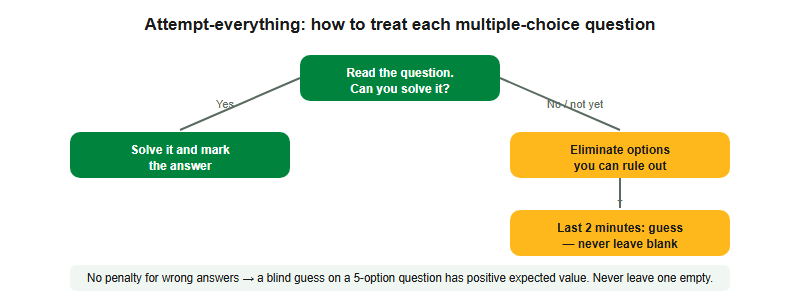
Here is a feature of the Australian AMC that genuinely changes how you should sit the paper: there is no penalty for a wrong answer. A blank multiple-choice question and a wrong one both score zero, so an unanswered multiple-choice question is a wasted opportunity. The strategy that follows is simple — never leave a multiple-choice question blank — but it has to be rehearsed in your timed mocks, not discovered on exam day.
The arithmetic makes the case plainly. On a multiple-choice question with five options, a pure blind guess has a one-in-five chance of being right and costs nothing if wrong — so its expected value is positive. The diagram below shows the discipline we teach: solve what you can, eliminate options on what you partly understand, and in the last two minutes guess every multiple-choice question still empty. (The five integer-answer questions are not multiple choice, so a guess there is far less likely to land — spend your final seconds on the MCQs first.)
One more habit worth building: every entrant receives a certificate and is ranked by national percentile, with bands from Proficiency up through Credit, Distinction, High Distinction and Prize (and the O’Halloran Award for perfect scores). That structure means progress is measured against students nationally, not against a fixed pass mark — so a calm, complete paper that banks every available mark is exactly what the design rewards. Exact cut-off scores vary year to year; confirm current details on the official site.
Putting it on the calendar for 2026
The 2026 exam is on Sunday 11 October, with registration closing 28 September 2026. A comfortable plan starts foundation work in August, moves to untimed past papers through mid-September, runs timed mocks in late September, and reserves the final ten days for targeted review of weak question types plus light, confidence-building practice. If you are starting later than that, keep the four stages in order but shorten each — do not skip straight to timed papers. For the full set of dates and the registration window, see our 2026 Australian AMC key dates guide.
Frequently asked questions
How early should we start preparing for the Australian AMC?
Six to eight weeks of steady practice before the 11 October 2026 exam is plenty. The sequence — foundation, past papers, timed mocks, review — matters more than total hours.
Should I guess if I run out of time?
Yes, on multiple-choice questions. There is no penalty for wrong answers, so a guess can only help. Never leave a multiple-choice box blank; rehearse this in timed mocks.
My child is borderline between two levels — which should they sit?
Levels follow school year (Pre-A Grades 1–2 up to E Grade 12). Enter at the year-appropriate level; pushing younger students up early usually builds anxiety, not skill. Confirm placement on the official site.
Do I need to memorise lots of formulas?
No. The Australian AMC tests reasoning on unfamiliar problems, not recall. Time is far better spent learning to model, estimate and reason step by step than memorising tricks.
This is the editorial desk for the Australian Mathematics Competition (AMC) China region. The competition is run by the Australian Maths Trust (AMT) and administered in China and Asia by ASDAN (阿思丹); this content desk is operated by Hanlin Education. Dates, fees, levels and rules are set by the AMT and ASDAN and can change each year — always confirm current details on the official channels (amt.edu.au and the ASDAN China-region channels). Confirmed errors are corrected within 7 working days. Note: the Australian AMC (AMT / ASDAN) is a different competition from the American AMC (MAA, USA) and the AMO (SIMCC, Singapore).