
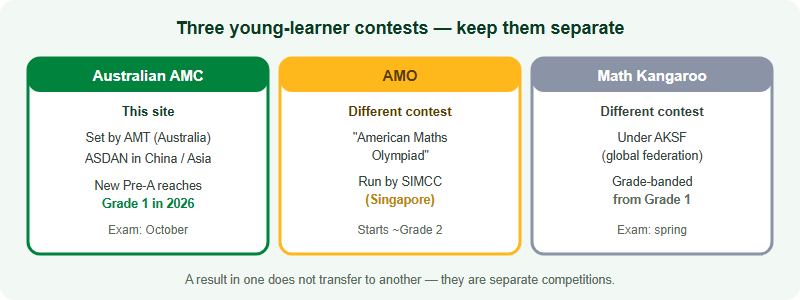
If you are choosing a first maths contest for a younger child in China, three names come up most: the Australian AMC, the AMO, and Math Kangaroo. They are run by three different organisations and they are complementary, not either/or. The Australian AMC — set by the Australian Maths Trust (AMT) and administered in China by ASDAN (阿思丹) — now opens at a brand-new Pre-A level for Grades 1-2 in 2026. This guide explains what each contest is, who runs it, and which suits a young starter.
The short answer for parents of a young child
For an early-primary child, all three of these contests are designed to be encouraging rather than intimidating — they reward curiosity and clear thinking over speed or memorisation. The practical differences that matter to a younger family are: how early you can start, when in the year the exam falls, and what the day feels like. The Australian AMC stands out on the first point in 2026 because its new Pre-A level reaches Grades 1-2, where many contests begin a little later. None of the three is a substitute for the others, and a young child can comfortably grow through more than one over the years.
| Contest | Who runs it | Youngest entry (typical) | Best read as |
| Australian AMC (this site) | Australian Maths Trust (AMT), Australia · ASDAN in China/Asia | Grade 1 — new Pre-A level (Grades 1-2) for 2026 | A gentle, broad annual benchmark of mathematical thinking |
| AMO (American Mathematics Olympiad) | SIMCC, Singapore | Around Grade 2 (Grades 2-12 overall) | A separate Singapore-run contest with its own progression |
| Math Kangaroo | Under AKSF (Association Kangourou sans Frontières) | Grade 1 (grade-banded, Grades 1-2 division) | A famously playful, story-led introduction to problem-solving |
Entry ages, divisions, dates and fees are set by each organiser and can change — the figures above are a planning guide. For the Australian AMC’s exact China-region details, see below; for AMO and Math Kangaroo specifics, confirm on each official site.
First, the name trap — three “American/Australian”-sounding contests
Before anything else, untangle the names, because this is where young-learner planning most often goes wrong. The Australian AMC (this site) is not the American AMC (the AMC 8/10/12 run by the MAA in the USA), and it is not the AMO, the “American Mathematics Olympiad,” which is actually run from Singapore by SIMCC. So the word “American” appears in two different contests that have nothing to do with each other, and “AMC” alone is ambiguous. On this site, “AMC” always means the Australian Mathematics Competition, set by the Australian Maths Trust. Keeping these straight from day one saves a great deal of confusion at registration. If you are still working out exactly what the Australian AMC is, start with What Is the Australian AMC.
What each contest is — and who it suits
Here is a plain, honest profile of each, written with a younger child in mind. None is “the best”; each simply leans a slightly different way.
Australian AMC (AMT · ASDAN in China). The Australian Mathematics Competition has been run by the Australian Maths Trust since 1978 and is Australia’s largest school maths competition. Its design is unusually friendly for young starters: a single paper per grade band, fresh problems each year, marks that rise as questions get harder, and — importantly — no penalty for a wrong answer, so a child can attempt every question without fear. For 2026 the China region adds a new Pre-A level for Grades 1-2, the youngest band the AMC has offered, which makes it a natural first contest. It suits a child who is curious and benefits from a low-pressure, “have-a-go” format and a certificate that recognises effort. To see how to ease a beginner in, read Is the Australian AMC Good for Beginners? A Gentle Start in Competition Maths.
AMO — American Mathematics Olympiad (SIMCC, Singapore). Despite the “American” in its name, the AMO is organised by SIMCC in Singapore and spans roughly Grades 2-12, so its youngest band sits a little above the AMC’s new Pre-A. It is a separate contest with its own structure and its own progression, and is one of several Singapore-system olympiads families in Asia consider. It suits a child who has already enjoyed a first taste of contest maths and a family comfortable navigating a distinct, separate event. For the AMO’s exact youngest age, format and dates, confirm on the official site — we do not restate another organiser’s specifics here.
Math Kangaroo (under AKSF). Math Kangaroo is one of the most widely sat school maths contests in the world, organised under the AKSF (Association Kangourou sans Frontières) federation, with grade-banded divisions starting at the Grades 1-2 level. Its hallmark is a deliberately playful, story-led, multiple-choice style designed to make problem-solving feel like fun — which is exactly why it is so often a child’s very first contest. It suits a young learner who lights up at puzzles and word-pictures more than at formal sums. Exact China-region divisions, dates and entry details are set by the organiser, so confirm on the official site.
The one fact that decides it for a young family: where can my child actually start?
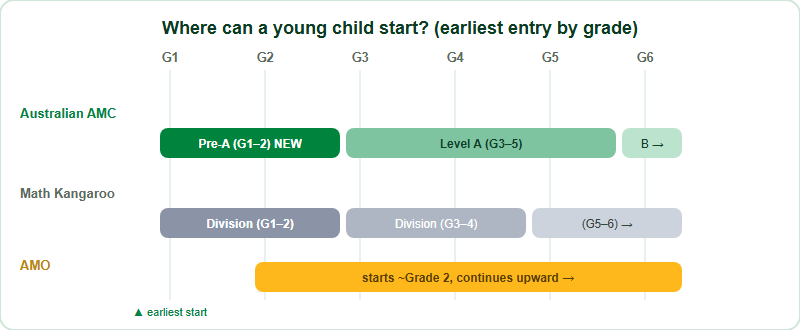
For a parent of a 6-8-year-old, the most useful single question is not “which is hardest?” but “which one even has a paper for my child this year?” The diagram below maps the typical earliest entry point of each contest against school stage. The headline for 2026 is simple: the Australian AMC’s new Pre-A level opens the door at Grade 1, Math Kangaroo also reaches Grade 1 in its lowest division, and the AMO’s youngest band sits around Grade 2. If your child is in the first year or two of primary, the Australian AMC and Math Kangaroo are the two that reliably have a starting paper.
When they run — so two contests rarely collide
A frequent worry is that entering more than one contest means a clash. In practice they tend to sit at different points in the school year, which is part of why they work so well as a sequence rather than a choice. For the 2026 China region, the Australian AMC exam is on Sunday 11 October 2026, with registration by 28 September 2026. Math Kangaroo is typically a spring event (with results released around the start of May), and the AMO sets its own calendar. Because the AMC sits in autumn and Kangaroo in spring, a child can comfortably do both in one school year without the preparation windows overlapping. (Note too that Australia’s home AMC runs in August with a different level structure — this site is the China region, so the date to plan around is October.)
| Contest | Typical time of year | 2026 China-region dates |
| Australian AMC (this site) | Autumn (China region) | Exam Sun 11 Oct 2026 · register by 28 Sep 2026 |
| Math Kangaroo | Spring | Set by organiser — confirm on the official site |
| AMO (SIMCC) | Set by organiser | Set by organiser — confirm on the official site |
Only the Australian AMC China-region dates are stated here as verified; for the other two, the calendars belong to their organisers and we deliberately do not invent them.
What the Australian AMC paper looks like for a young starter
Because the Australian AMC is the contest this site can speak to with verified detail, here is exactly what a young child’s paper involves — useful for setting expectations. Every level, Pre-A included, sits a 30-question paper (25 multiple-choice and 5 integer-answer) worth 135 marks, with time ranging from about 45 minutes at the youngest level up to 75 minutes at senior secondary. Questions climb in difficulty, the marks climb with them, and there is no penalty for a wrong answer — the single most reassuring feature for a nervous first-timer, because there is simply no downside to having a go. China-region papers are available in English and Chinese, so language is not a barrier. For a level-by-level study path, see How to Prepare for the Australian AMC: A Study Roadmap by Level.
On recognition, the Australian AMC gives every entrant a certificate, with national awards by percentile — Proficiency, Credit, Distinction, High Distinction and Prize — and a perfect score can earn the O’Halloran Award. For a young child, that “certificate for everyone” approach means the day ends on a positive note regardless of the score, which is precisely the tone you want for a first contest.
A calm way to choose for a younger child
You do not need to crown a single winner. A sensible approach for an early-primary family is: pick the one with the gentlest on-ramp this year, and layer others in as your child grows. If the child is in Grade 1-2, the Australian AMC’s new Pre-A and Math Kangaroo are the two that have a starting paper, and the choice between them often comes down to temperament — Kangaroo’s playful, story-led puzzles versus the AMC’s broad, climb-in-difficulty paper and percentile certificate. By Grade 2-3, the AMO becomes available as a third, separate option. Across the whole journey, the Australian AMC works well as the steady annual anchor because it has a level for every grade from 1 to 12, with others added for variety. The only genuine mistake to avoid is the name trap: at registration, confirm you are signing up for the Australian AMC — not the American AMC, and not the AMO. For a broader contest comparison across all ages, see What Is the Australian AMC as your starting point.
Frequently asked questions
Which maths contest can my Grade 1 child start with?
In 2026 the Australian AMC opens at its new Pre-A level (Grades 1-2), and Math Kangaroo also has a Grades 1-2 division. The AMO typically starts around Grade 2.
Is the Australian AMC the same as the AMO or Math Kangaroo?
No. The Australian AMC is set by the Australian Maths Trust (ASDAN in China). The AMO is run by SIMCC in Singapore, and Math Kangaroo runs under the AKSF federation — three separate contests.
Can a young child enter more than one of these?
Yes. They are complementary and usually run at different times — the Australian AMC in autumn (11 Oct 2026 in China) and Math Kangaroo in spring — so a child can do both in one year.
Will a wrong answer hurt my child’s Australian AMC score?
No. The Australian AMC has no penalty for wrong answers, so a young child can attempt every question without losing marks for a guess.
This is the editorial desk for the Australian Mathematics Competition (AMC) China region. The competition is run by the Australian Maths Trust (AMT) and administered in China and Asia by ASDAN (阿思丹); this content desk is operated by Hanlin Education for students in China. Dates, fees, levels and rules — for the Australian AMC and for the other contests named here (AMO, Math Kangaroo) — are set by their respective organisers and can change, so always confirm current details on the official channels (amt.edu.au and the ASDAN China-region channels, and each contest’s own official site). Confirmed errors are corrected within 7 working days.