
The Australian Mathematics Competition (AMC) paper is a single, carefully shaped object: 30 questions — 25 multiple-choice plus 5 integer-answer — worth 135 marks in total, with no penalty for a wrong answer and 45–75 minutes depending on level. Marks rise as the questions get harder, so the score is back-weighted toward the end. This 2026 guide decodes that difficulty curve — where the marks actually sit, how the no-penalty rule changes your choices, and how to pace the paper by level.
The shape of the paper: 30 questions, 135 marks, rising value
Set by the Australian Maths Trust (AMT) since 1978 and administered for the China and Asia region by ASDAN (阿思丹), the AMC gives every level the same architecture: 30 questions in a fixed difficulty gradient. The first questions are gentle warm-ups; the paper then climbs steadily to a hard tail. The two answer formats sit in that gradient too — the 25 multiple-choice questions come first, followed by 5 integer-answer questions where you supply a whole number rather than pick from options, and which fall at the demanding end.
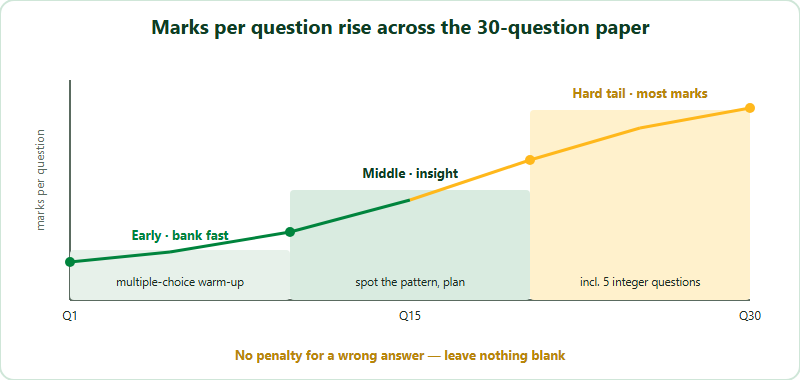
The total is fixed at 135 marks, but those marks are not spread evenly. Easy early questions are worth fewer marks each; the hardest questions at the back are worth the most. That single design choice — marks rising with difficulty — is what makes the paper reward both reliability at the front and ambition at the back. If you are new to the competition itself, our overview of what the Australian AMC is covers the six levels, dates and award structure first; this article zooms in on how the 135 marks are built and won.
| Paper element | Detail (2026 China region) |
| Questions | 30 total — 25 multiple-choice + 5 integer-answer |
| Total marks | 135, rising with difficulty (back-weighted) |
| Wrong-answer penalty | None — a blank and a wrong answer both score the same on that question |
| Time | 45–75 minutes depending on level |
| Levels | Six: Pre-A (Gr 1–2, new for 2026), A (3–5), B (6–7), C (8–9), D (10–11), E (Gr 12) |
| Languages | English & Chinese |
| Perfect paper | 135/135 → eligible for the Peter O'Halloran Award |
| Exact mark-per-question values | Set by AMT each year — confirm on the official site |
One honest caveat before the strategy: the exact number of marks attached to each individual question is set by the AMT and is not something we publish as a fixed figure. What is reliable and stated officially is the structure — 30 questions, 135 marks, marks rising with difficulty, no penalty. The pacing below is built on that structure, not on invented per-question point values.
Reading the difficulty curve: three bands, one rising line
It helps to read the 30 questions as three rough bands rather than thirty separate hurdles. The early band is about banking marks cleanly and fast; the middle band is about insight and a clear plan; the final band — including those 5 integer questions — is about multi-step reasoning and stamina, and carries the heaviest marks per question. Because the value climbs as you go, the back of the paper is where the gap between a Credit and a Distinction is usually decided.
The strategic implication is counter-intuitive for many families: the goal is not to spend equal time on every question. A mark banked in twenty seconds at the front is worth exactly as much per point as a mark fought for over four minutes at the back — so the most efficient student secures the early marks quickly and reliably, then invests the saved time where the marks are richest. Rushing the front to “get to the hard ones” usually backfires, because a careless slip there costs a sure mark you can never recover.
The no-penalty rule: why you should never leave a multiple-choice blank
This is the single most under-used fact about the AMC, so it is worth being precise. There is no penalty for a wrong answer — on any given question, a blank and an incorrect answer earn exactly the same: zero. Nothing is subtracted for guessing. That changes the maths of decision-making completely compared with contests that do deduct marks.
Consider the 25 multiple-choice questions. Each offers five options. If you have absolutely no idea and pick at random, you have a 1-in-5 chance of being right and a 4-in-5 chance of being wrong — but because being wrong costs nothing beyond the zero you already had, a guess can only help your expected score, never hurt it. The moment you can eliminate even one obviously-wrong option, your odds improve to 1-in-4; eliminate two and it is 1-in-3. On this paper, an informed guess is always mathematically worth making, and a blank multiple-choice answer is simply a mark you chose to forfeit.
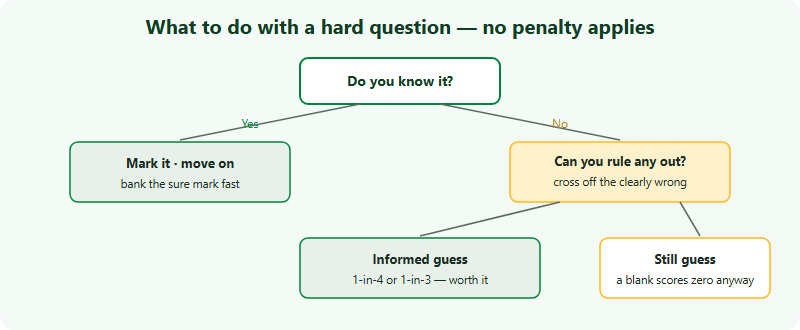
A note of honesty and discipline, though: “guess everything” is a last-five-minutes tactic, not a substitute for thinking. The integer-answer questions reward a genuine whole-number attempt, and even on multiple-choice, eliminating wrong options first is what turns a coin-flip into a favourable bet. The rule does not make the maths easier — it just means you should never hand back a mark you could have gambled for. For a fuller tour of the kinds of problems you will be reasoning through, see Australian AMC Problem Types: What the Paper Actually Tests.
Pacing by level: turning 45–75 minutes into a plan
Time on the AMC is not the same for everyone — it runs from 45 to 75 minutes depending on level, with the youngest levels given the shorter sittings and the senior levels the longer ones. Whatever the length, the same principle holds: protect the early marks, then pour the remaining time into the back half, and ring-fence the final few minutes to make sure no multiple-choice question is left blank.
The table below is a planning illustration, not an official instruction. It splits each sitting into three phases so a student knows roughly when to stop polishing the easy questions and commit to the hard tail. Treat the minute figures as a starting rhythm to rehearse in practice, then adjust to your own pace. The exact time limit for your specific level is set by AMT and ASDAN — confirm it on the official site.
| Sitting length (by level) | Phase 1 · bank the front | Phase 2 · work the tail | Phase 3 · sweep & guess |
| ~45 min (younger levels) | First ~20 min on the early, surer questions | Next ~20 min on the harder middle/back | Last ~5 min: check, fill every blank |
| ~60 min (middle levels) | First ~25 min banking the front cleanly | Next ~28 min on insight + integer questions | Last ~7 min: review, guess remaining MC |
| ~75 min (senior levels) | First ~30 min, fast and accurate up front | Next ~35 min on the heavy hard tail | Last ~10 min: verify, leave nothing blank |
Two pacing habits matter more than the exact minutes. First, set a personal “move-on” rule: if a question has stalled for too long, mark it, leave a best guess, and come back — never let one hard question eat the time of three you could have answered. Second, always finish with a deliberate sweep: in the last phase, the single highest-value action is converting blanks into informed guesses, because each one is a free shot at marks with nothing to lose. For what the exam morning itself looks like — arrival, materials and how the sitting runs — see Australian AMC Exam Day: What to Expect & How It Runs.
Where the marks are actually won — an honest summary
Put the pieces together and a simple, low-pressure strategy emerges. Reliability at the front, ambition at the back, and never a blank. The early questions are where most students should be scoring close to full marks — not because those marks are “easy” in some dismissive sense, but because they are the most controllable. The hard tail is where the strongest students separate, and where the back-weighted marks make a few extra correct answers count for a lot.
It is worth saying plainly what this paper does not do. It does not reward speed at the cost of accuracy, it does not punish a wrong guess, and a strong result — recognised by national percentile against your own grade band — is a genuine achievement but is not a guarantee of admission to any school or programme, and we make no such claim. The aim is to read the paper's design clearly and play to it, not to chase a number.
For 2026, the China-region paper is sat on Sunday 11 October 2026, with registration closing 28 September 2026. Those dates, the entry fee and the registration steps are set by AMT and ASDAN and can change — confirm current details on the official channels before you plan around them.
Keeping three look-alike "AMC" contests straight
Because several maths contests share the letters "AMC" (or sit beside one called the AMO), it is easy to apply the wrong scoring rules to the wrong paper. The structure decoded above — 30 questions, 135 marks, no penalty — belongs to the Australian AMC only. The table keeps the three apart so a parent comparing options is never caught out.
| Competition | Run by | Paper & scoring (in brief) |
| Australian AMC (this site) | Australian Maths Trust (AMT); ASDAN in China/Asia | 30 questions (25 MC + 5 integer), 135 marks, no penalty, 45–75 min |
| American AMC | MAA, USA | A different structure and scoring (e.g. its own pathway to AIME) — not covered here |
| AMO | SIMCC, Singapore | A separate competition with its own paper and medal scheme |
If a results page or advert mentions the MAA, AIME or SIMCC, it is not the Australian AMC, and the 135-mark/no-penalty rules here do not apply to it. When unsure which contest a paper or score belongs to, check the official source for that specific competition.
Frequently asked questions
How many questions and marks are on the Australian AMC?
Thirty questions — 25 multiple-choice plus 5 integer-answer — worth 135 marks in total, with marks rising as the questions get harder.
Is there a penalty for a wrong answer on the Australian AMC?
No. A blank and a wrong answer score the same on that question, so an informed guess can only help — never leave a multiple-choice question blank.
How long is the AMC and does it differ by level?
Yes. The sitting runs 45–75 minutes depending on level, with younger levels shorter and senior levels longer. Confirm your exact time on the official site.
How many marks is each question worth?
Marks rise with difficulty, so harder questions are worth more, but the exact per-question values are set by AMT each year — confirm on the official site.
This is the editorial desk for the Australian Mathematics Competition (AMC) China region. The competition is run by the Australian Maths Trust (AMT) and administered in China and Asia by ASDAN (阿思丹); this content desk is operated by Hanlin Education for students in China. Dates, fees, levels, rules and the exact marks attached to each question are set by the AMT and ASDAN and can change each year — always confirm current details on the official channels (amt.edu.au and the ASDAN China-region channels). Confirmed errors are corrected within 7 working days.