
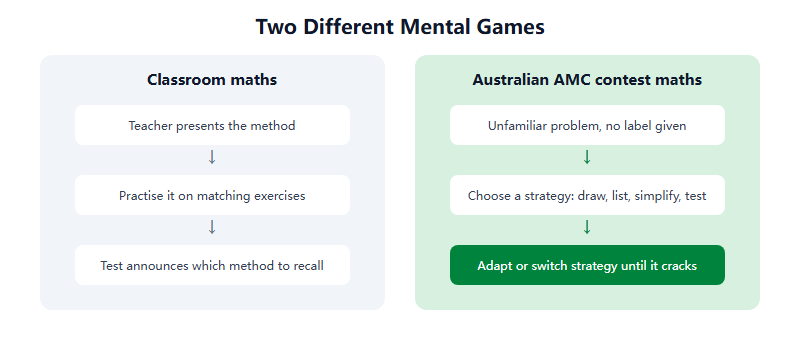
An A in school maths does not automatically translate into a high Australian AMC score — and that surprises many families in China every October. Classroom maths tests whether you can apply a method you were just taught; the Australian AMC tests whether you can find a method when nobody tells you which one to use. This guide explains exactly where the gap lies, what transfers from school, and a weekly routine that bridges the difference before 11 October 2026.
Why Strong School Results Don't Guarantee Contest Results
School maths, whether your child follows an IB, IGCSE, American or bilingual-school curriculum, is organised around units: you study a technique for two weeks, then sit a test on that technique. The question on the page essentially announces its own method — if the chapter was on linear equations, the test questions are linear equations. The Australian Mathematics Competition, run by AMT (the Australian Maths Trust) since 1978 and delivered in China through ASDAN, deliberately removes that scaffolding. A question gives you no label, no chapter reference and often no familiar shape at all; identifying what kind of problem this even is becomes part of the challenge.
This is not a flaw — it is the point. The competition is designed so that its later questions reward mathematical thinking rather than curriculum recall, which is exactly why the credential carries signal. But it means preparation must add a layer on top of school maths, not just revise it harder. (If you have not yet read about the format, levels and awards, start with What Is the Australian AMC? and come back.)
The Format Differences, Side by Side
| Dimension | Typical school maths test | Australian AMC (China sitting, 2026) |
|---|---|---|
| Method selection | Announced by the unit/chapter being tested | Never announced — spotting the approach is half the problem |
| Structure | Varies; often long-form with partial credit for working | 30 questions: 25 multiple-choice + 5 integer-answer; the answer alone scores |
| Scoring | Percentage against a class standard | Maximum 135; no negative marking; recognition is percentile-based across all candidates |
| Difficulty shape | Mostly uniform, matched to recent teaching | A deliberate ramp — early questions are accessible, the final stretch is designed to challenge nearly everyone |
| Time pressure | Usually generous for the question count | One continuous sitting of roughly 45–75 minutes depending on level (confirm your division's timing when registering) |
| Language | Your school's language of instruction | Bilingual paper in China — a reading-comprehension layer on top of the maths |
| Cohort | Your class or year group | Candidates across Grades 1–12 in six levels (Pre-A to E), benchmarked internationally |
Two of these rows deserve special attention. No partial credit changes how you must work: elegant reasoning that ends in an arithmetic slip scores exactly zero on that question, so checking habits matter more than in school. And no negative marking changes strategy in the other direction: on a school test a wild guess is embarrassing; on this paper an unanswered question is simply a wasted opportunity.
What Transfers From School — and What You Must Add
The good news: school maths is not wasted. Three things transfer directly and form the floor of your contest score:
- Arithmetic fluency. Fast, accurate mental and written calculation is the engine under every contest question, especially with no calculator crutch to lean on (check current rules on permitted materials with amt.edu.au or your test centre).
- Core curriculum content. Number properties, fractions, percentages, basic geometry and simple algebra — the raw materials of the accessible early questions — are all standard school territory at each grade band.
- Careful reading. Students trained on word problems at school already have a head start on the competition's story-style questions, and the bilingual China paper lets you cross-check understanding across languages.
What school rarely teaches — and what you must deliberately add — is a strategy toolkit for unfamiliar problems. The classic moves that competition students train until they are reflexes:
- Try small cases. When a problem looks abstract, compute the situation for n = 1, 2, 3 and look for the pattern.
- Draw it. A sketch, number line or table turns many “impossible” questions into visible ones.
- Work backwards. Especially powerful for multiple-choice: start from the five options and test which one satisfies the conditions.
- Eliminate the impossible. Parity, size estimates and units often kill three of five options in seconds — turning a blind guess into a coin flip or better, which matters on a paper with no penalty for guessing.
- Simplify, then rebuild. Solve an easier version of the problem first, then reintroduce the complication.
A Weekly Bridge Routine (That Fits Around Homework)
You do not need to abandon school maths to prepare — you need about two focused hours a week layered on top of it. Between now and the 11 October exam (and remember, registration in China closes 28 September 2026), a sustainable weekly shape looks like this:
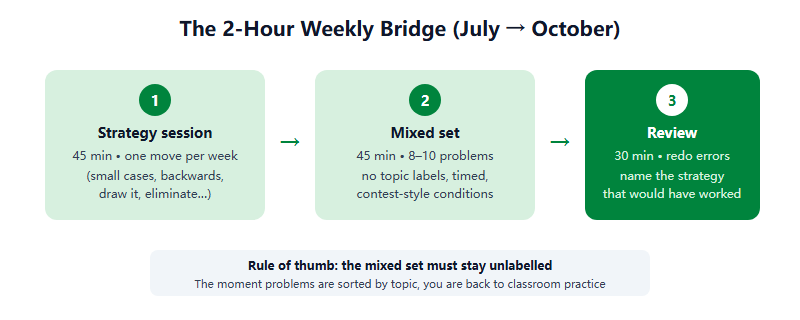
Three execution notes. First, keep the mixed set genuinely mixed: the whole value of the session collapses if problems arrive pre-sorted by topic, because then the method is announced again — exactly the crutch you are trying to remove. Second, in the review session, name the strategy, not just the answer. “I should have tried small cases” is a transferable lesson; “the answer was 42” is not. Third, every three or four weeks, replace the week's sessions with one full timed paper to check that the skills hold under exam conditions across the whole 30-question curve.
A Note on Age: The Bridge Is Shorter for Younger Levels
Parents of Pre-A and A candidates (Grades 1–5) sometimes worry their child needs “competition training” in some heavyweight sense. At the younger levels the gap between school and contest is narrower: early-paper questions lean on careful reading, counting, patterns and playfulness more than on formal technique. A young child who enjoys puzzles, reads questions twice and is comfortable trying things that might not work is already most of the way across the bridge. The formal strategy toolkit matters progressively more from level B upward, and by levels D and E (Grades 10–12) it is the main event. Whatever the level, the entry logistics are identical — registration through ASDAN's China channels by 28 September, exam on Sunday 11 October — and the level structure is laid out in our foundation guide to the competition.
FAQ
My child gets top grades in school maths. Will the Australian AMC feel easy?
The early questions will feel comfortable; the later ones probably won't. The paper deliberately ramps beyond curriculum recall, so even strong students should train unfamiliar-problem strategies before October.
Does contest prep hurt school performance?
Usually the opposite. Strategy skills like drawing diagrams, testing cases and estimating transfer back into school work. Two focused hours a week is enough and fits alongside homework.
Is the Australian AMC based on the Australian school curriculum?
It is set by AMT in Australia, but its accessible-to-challenging design is aimed at students internationally across Grades 1–12. Check the current syllabus guidance on amt.edu.au for your level.
What matters more: learning new topics or new strategies?
For most school-strong candidates, strategies. Knowledge gaps cost some marks; not knowing how to start an unfamiliar problem costs far more across a 30-question paper.
Published by the Australian AMC editorial desk, operated by Hanlin Education for China-based international-school students. Official rules, syllabus guidance and timings are set by the competition organisers and can change each year — always confirm current details on amt.edu.au and with your ASDAN registration channel. If you spot an error, we correct it within 7 working days.