
The 2026 China-region sitting on 11 October hands you an unusually long runway — roughly eight weeks from mid-August. That is a gift and a trap. Eight weeks is enough to build genuine range, but it is also long enough for August work to quietly decay before exam day. This plan splits the runway into four phases so that your sharpest week is the week of 11 October, not the third week of September.
Why an October sitting is a planning problem, not just a later date
The Australian AMC is run by the Australian Maths Trust, which has held the competition since 1978; in China the sitting is operated by ASDAN. The China-region exam falls on 11 October 2026, with entries closing 28 September. If you are new to the competition and want the full picture of levels, format and marking before you plan, start with our overview of what the Australian AMC is.
Moving the China sitting into October did something genuinely useful: it took the exam out of the collision zone with the start of the school year and handed families the whole of July and August as clean preparation time. Nobody is now trying to revise for a maths competition in the same fortnight they are meeting new teachers and settling into a new timetable.
The flip side is the part almost nobody plans for. A three-month runway is a retention problem, not just a workload problem. The natural human pattern is to work hard while motivation is high — which for most students means the summer — and then to coast once term restarts and homework reappears. Students who do that arrive on 11 October having genuinely learned a great deal in August and being able to execute rather little of it. The plan below exists to stop exactly that.
The four-phase shape of eight weeks
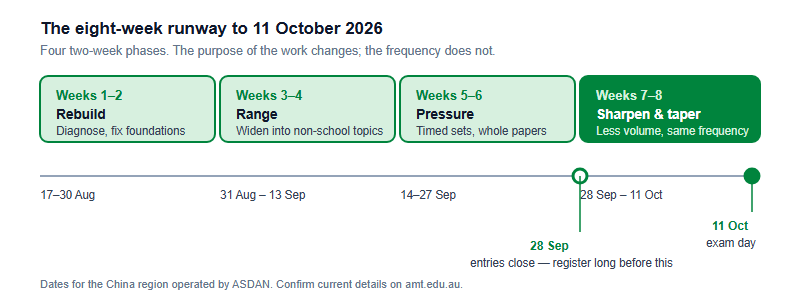
Eight weeks should not be eight identical weeks. The purpose of the work changes as the exam approaches: early on you are building capability, late on you are protecting it and learning to deploy it under time pressure. Treat the runway as four two-week blocks.
| Phase | Dates | The one job | What you should be producing |
|---|---|---|---|
| 1. Rebuild | 17–30 Aug | Find out what is actually weak | One honest untimed diagnostic and a written list of your three worst topics |
| 2. Range | 31 Aug – 13 Sep | Cover what school does not | Worked notes on counting, spatial and figure work, and number puzzles |
| 3. Pressure | 14–27 Sep | Learn to deploy under a clock | Two full timed papers plus timed 10-question sets |
| 4. Sharpen & taper | 28 Sep – 11 Oct | Protect what you have | Short daily contact, error-book review, no new topics |
The most commonly botched phase is the fourth. Students treat the last fortnight as the moment to finally get serious and start cramming unfamiliar material, which is precisely the wrong move. New topics learned in the final ten days are the least stable things in your head on exam morning, and the time spent acquiring them is stolen from rehearsing what you already know.
A weekly rhythm you can sustain for eight weeks
Eight weeks is a long time to hold an intense schedule together, and an over-ambitious plan collapses in week three. Three to four contacts per week, sustained, beats six sessions per week for a fortnight followed by nothing. Frequency is what keeps material alive; duration is what builds it in the first place.
- Session A — new or weak material (45–60 min). One topic only. Work slowly and untimed. The goal is understanding, not speed.
- Session B — mixed review (30–40 min). Deliberately jumbled questions from topics you covered one, two and four weeks ago. Mixing is uncomfortable and that discomfort is the point: it forces you to identify the problem type before you can solve it, which is exactly what the real paper demands.
- Session C — timed set (matched to your level). From phase 3 onwards, a block of questions against a clock. Check your level's exact paper length on amt.edu.au and rehearse against that.
- Session D — error review (15–20 min). The shortest session and the highest yield. Re-attempt questions you got wrong two weeks ago, from a blank page.
If a week goes badly and something has to be cut, cut Session A. Keep the review sessions. It is far worse to lose access to material you have already learned than to be one topic short.
Spacing beats volume: why August work disappears by October
The reason a heavy August followed by a quiet September fails is not laziness — it is how memory behaves. Material studied once, intensively, and then left alone becomes progressively harder to retrieve. Material revisited at widening intervals stays retrievable for much longer, even though the total time invested is similar or lower.
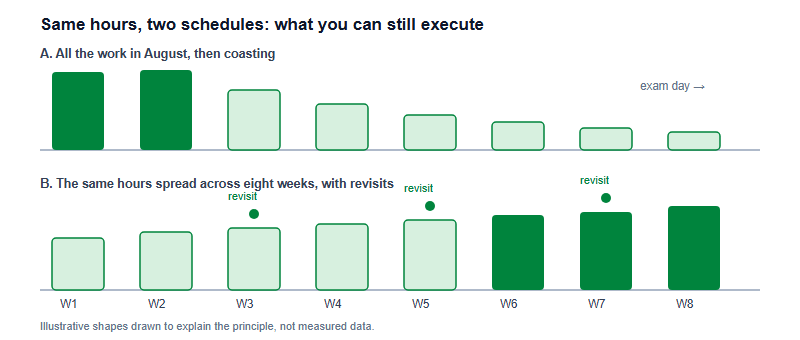
Turn that into two concrete habits. First, every topic gets touched at least three times across the eight weeks, at widening gaps — learn it, revisit about a week later, revisit again two or three weeks after that. Second, keep a revisit list rather than a finished list. A topic is not done when you understand the explanation; it is done when you can produce a solution cold, from a blank page, weeks later. Until then it stays on the list.
Let the runway reflect where marks are actually lost
Eight weeks of the wrong practice is still the wrong practice. The single most common way to waste this runway is to spend it re-drilling arithmetic and routine algebra that the school curriculum already covers well, because that work feels productive and produces satisfying pages of correct answers.
The paper is built so that the first twenty questions overlap heavily with school syllabi and the last ten do not. If you are already reliable on the opening stretch, extra practice there earns you almost nothing. Across our China-region coaching, marks concentrate in four recurring zones:
- Spatial and figure work — nets, folding, three-view problems. School maths barely drills these, so students meet them for the first time under exam pressure.
- Long English word problems, where the hard part is extracting the mathematical condition from the prose rather than doing the maths once you have it.
- Counting and probability, which cluster in the back third of the paper where the marks are heaviest.
- Speed against accuracy in arithmetic and number theory — students who can do the work but not fast enough, or fast enough but not cleanly.
Two format facts should shape your phase 3 rehearsal. There is no negative marking, so on the multiple-choice questions a blank is strictly worse than a guess — leaving one empty is simply discarding a free chance. The final five questions require you to supply an answer rather than choose one, so on those a blind guess earns nothing, though it costs nothing either; a considered partial attempt is worth more than a random number. Practise that distinction deliberately, because on the day it decides several marks. The total available is 135, weighted so later questions carry more than early ones — check the exact per-question values for your level on amt.edu.au.
Two dates, and the one that sneaks up
Exam day is 11 October 2026 and everyone remembers it. The date that catches families out is 28 September, when entries close — which, as the diagram shows, is the same moment your final block begins. A student can execute this plan beautifully for six weeks and still not sit the paper. Register in week one, treat it as an administrative task entirely separate from preparation, and confirm the arrangements with your school coordinator or ASDAN. Details and deadlines are set by the competition and can change, so verify the current position on amt.edu.au before you rely on any date.
One last check worth making early: be sure you are preparing for the right competition. The Australian AMC is run by the Australian Maths Trust and is a different event from the American AMC run by the MAA, and different again from AMO, run by SIMCC. They share initials and nothing else — different papers, different calendars, different entry routes. Our introduction to the Australian AMC sets out exactly which competition this site covers.
Frequently asked questions
Is eight weeks enough time to prepare properly?
Comfortably, if the weeks are structured. Eight weeks of three or four focused sessions beats a frantic fortnight, provided you revisit topics rather than abandon them.
What if we are starting later than mid-August?
Keep all four phases but shorten the middle two. Never cut the taper, and never bring new topics into the last ten days before 11 October.
Should I do a full timed paper every week?
No. Two full papers in phase 3 plus shorter timed sets is enough. Full papers are expensive to sit and to review properly.
When exactly do entries close?
The China-region deadline is 28 September 2026, with the exam on 11 October. Deadlines change year to year, so confirm on amt.edu.au.
Published by the Australian AMC editorial desk, operated by Hanlin Education for China-based international-school students. Official rules are set by the competition and change yearly — confirm current details on amt.edu.au. Errors are corrected within 7 working days.