
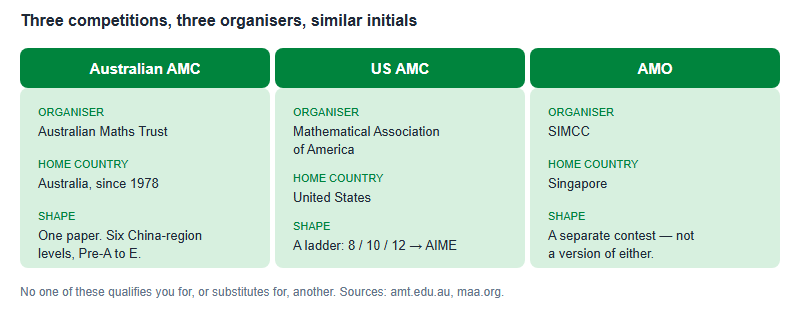
They share three letters and very little else. The Australian AMC is run by the Australian Maths Trust, first held in 1978, and sits in the China region on 11 October 2026 through ASDAN. The US AMC is a separate, tiered series run by the Mathematical Association of America in the United States. Different organisers, different countries, different shapes. Here is how to tell them apart and decide what belongs on your autumn.
Two organisations, one abbreviation
The confusion is not the families' fault. Three different competitions circulating in Chinese international schools use overlapping initials, and none of them is run by the others.
- Australian AMC — the Australian Mathematics Competition, run by the Australian Maths Trust (AMT) in Australia and first run in 1978. In the China region it is operated by ASDAN, with the 2026 sitting on 11 October and registration closing 28 September. If you want the full structural picture first, start with our guide to what the Australian AMC is.
- US AMC — the American Mathematics Competitions, run by the Mathematical Association of America (MAA) in the United States. It is not one paper but a series: AMC 8, AMC 10 and AMC 12, with the American Invitational Mathematics Examination (AIME) and then the USAMO or USAJMO further along.
- AMO — a third contest again, run by SIMCC out of Singapore. It is neither of the above, and we cover it separately.
So when a student says “I did AMC last year,” the first job is to find out which one. We ask this in almost every intake conversation, and roughly as often as not the answer is not the one the parent assumed.
Side by side, on the points that actually matter
Both organisers publish their own rules and both change details from year to year. The table below is a structural read, not a substitute for the official pages.
| Australian AMC | US AMC | |
|---|---|---|
| Organiser | Australian Maths Trust (AMT) | Mathematical Association of America (MAA) |
| Home country / start | Australia, first run 1978 | United States |
| China-region operator | ASDAN | Confirm arrangements on maa.org |
| Overall shape | One paper, sat once, recognised by percentile band | A tiered series: AMC 8 / AMC 10 / AMC 12, with AIME beyond |
| Age reach | Six China-region levels, Pre-A to E, covering Grades 1–12 | AMC 8 is for students in grade 8 or below, subject to an age limit — confirm current eligibility on maa.org; AMC 10 for grade 10 and below; AMC 12 for grade 12 and below |
| Paper | 30 questions — 25 multiple-choice and 5 integer — for a total of 135 marks | AMC 8, 10 and 12 are each 25 questions |
| Wrong answers | “There is no penalty for incorrect responses” | AMC 8 has no penalty for guessing; confirm the current rule for each paper on maa.org |
| Time | AMT publishes 60 minutes for its primary divisions and 75 for secondary; confirm the allowance for your China-region level | AMC 8 runs 40 minutes; AMC 10 and 12 run 75 minutes |
| Language | Bilingual paper in the China region | Confirm on maa.org |
| What follows | Recognition by band — AMT publishes Credit, Distinction, High Distinction, Prize and Medal levels | AIME qualification is a fixed score from 2027: 100 or above on the AMC 10, 85 or above on the AMC 12 |
| Autumn 2026 | China sitting 11 October; registration closes 28 September | AMC 10 and 12 are administered annually in November; confirm dates on maa.org |
Read that table twice and one difference should jump out ahead of all the others: one of these is a destination and the other is a doorway.
One paper versus a ladder — and why it changes how you prepare
The Australian AMC is a complete event in itself. A student sits one 30-question paper, and the result is expressed as recognition against the national field — AMT publishes bands from Credit up through Distinction, High Distinction, Prize and Medal. Nothing about the paper is designed to sort a small number of students into a next round. The whole 135 marks is the object.
The US AMC is built the other way round. The published progression is explicit: strong AMC 10 and AMC 12 scores earn AIME invitations, and AIME performance combined with the AMC score feeds the USAJMO and USAMO. Its structural purpose is selection, and the thresholds are stated as percentages of the field.
That difference is not cosmetic — it changes what good preparation looks like:
- On a ladder, you optimise against a threshold. If a cut-off sits near the top few per cent, then the marginal question that decides your year is a hard one, and prep tilts toward the difficult end.
- On a single paper, you optimise across the whole range. On the Australian AMC, marks are spread across all thirty questions, with later questions carrying more — check the exact per-question values for your level on amt.edu.au. A student who converts every accessible question and reaches sensibly into the back half will out-score a student who chases only the hardest problems and leaves ordinary marks on the table. Our overview of the competition sets out how the six China-region levels and the 135-mark paper fit together.
This is the single most common strategic error we correct in students arriving from a US-AMC-shaped training diet: they have been taught to hunt for the last five questions, and on a paper with five integer questions and a broad multiple-choice spread that instinct actively costs them marks.
What each format rewards — a coaching read
What follows is our own reading from China-region coaching, not an announcement by either organiser. Results vary by student.
The Australian AMC rewards breadth and steadiness. Thirty questions in a single sitting, spanning number, geometry, counting, ratio, pattern and data, means the paper punishes a narrow repertoire more than it punishes a missing advanced technique. A student with one weak topic will meet it three or four times.
It also rewards format literacy. Twenty-five multiple-choice questions plus five integer questions is a mixed instrument: the options are usable information on the first twenty-five, and then that support disappears entirely for the last five. Students who never notice the switch tend to carry multiple-choice habits into questions where nothing will catch a slip.
The US AMC ladder rewards depth against a clock. Twenty-five questions in 75 minutes on the AMC 10 and 12 is a demanding rate, and the selection design means the top of the paper carries disproportionate consequence.
One genuine convergence: both reward not leaving blanks where guessing is free. AMT states plainly that there is no penalty for incorrect responses, and the MAA describes the AMC 8 as having no penalty for guessing. Where a paper does not punish a wrong answer, an empty box is a strictly worse decision than a considered guess. Confirm the current rule for whichever paper you are sitting.
And one difference that matters for our students specifically: the Australian AMC paper is bilingual in the China region. For a student still building mathematical English, that removes a layer of friction that no amount of maths practice would have removed.
Can a China-based student do both this autumn?
On the calendar, yes — they do not collide on the day. The Australian AMC China sitting is 11 October 2026, and the MAA administers AMC 10 and AMC 12 in November. The collision is not in the diary; it is in attention.
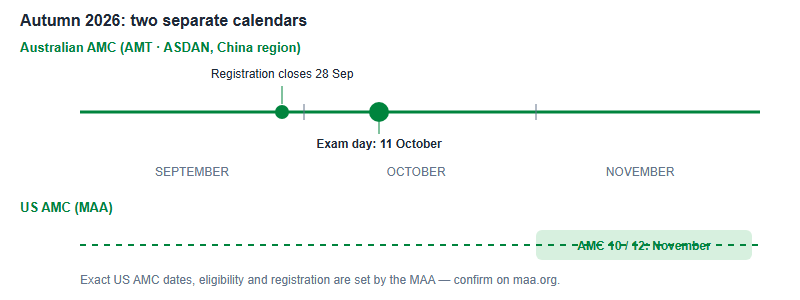
If a student is entering both, we sequence rather than double. The Australian AMC comes first, so the weeks up to 11 October belong to it — broad coverage, past-paper passes, format rehearsal. The transition afterwards is genuinely useful rather than wasted: the topic base transfers almost entirely, and the month of October between the two events is enough to shift the emphasis from breadth to speed under a tighter clock.
What does not work is running two preparation plans in parallel through September. Term one already carries school assessment, and a student split across two rule sets tends to arrive on 11 October having half-learned both.
Choosing — and the three confusions we see most
For most China-based international-school families the honest answer is that these are not competitors for the same slot. The Australian AMC reaches down to Grade 1 through the China-region Pre-A to E levels, so at the youngest end there is often no comparable US AMC sitting available locally — confirm US eligibility and access on maa.org. Further up, from Grade 8 or so, both become genuinely available and the choice is real. Our steer is to start with the Australian AMC as the broad annual benchmark and add a ladder contest when a student is consistently reaching into the back third of the paper — that is the readiness signal, not a birthday.
Three confusions cost families real time every year:
- “We already did AMC.” Ask which organiser. An Australian AMC certificate and an AMC 10 score report describe different competitions run on different continents.
- “A good Australian AMC score qualifies for AIME.” It does not. AIME invitations come from AMC 10 and AMC 12 performance and are issued by the MAA. The two systems are not connected.
- “AMC 10 prep will cover it.” Partly. The topic base overlaps heavily, but the Australian AMC has five integer questions with no options to fall back on, a different mark distribution across thirty questions, and a bilingual paper. Preparation that never rehearses that specific instrument leaves marks behind.
On applications, neither contest is a lever that produces an outcome, and any claim otherwise should be treated sceptically. What a strong result does is evidence sustained interest and capability in mathematics, and that evidence reads the same whichever side of the Pacific issued the certificate — provided the student can talk about the problems.
Whichever you enter, take the rules from the organiser. AMT publishes the Australian AMC's structure, timing and award bands on amt.edu.au; the MAA publishes the US AMC's eligibility, dates and thresholds on maa.org. Both change from year to year.
Frequently asked questions
Is the Australian AMC the same competition as the AMC 8 or AMC 10?
No. The Australian AMC is run by the Australian Maths Trust; AMC 8, 10 and 12 are run by the Mathematical Association of America in the US.
Does a strong Australian AMC result qualify my child for the AIME?
No. AIME invitations are issued by the MAA based on AMC 10 or AMC 12 scores. The two competition systems are separate.
Can a student sit both in autumn 2026?
Yes on the calendar — the China sitting is 11 October and the MAA runs AMC 10 and 12 in November. Sequence the preparation rather than running both at once.
Which should a Grade 4 student in China enter?
The Australian AMC covers Grades 1–12 through its six China-region levels. Confirm current eligibility for any US paper on maa.org.
Published by the Australian AMC editorial desk, operated by Hanlin Education for China-based international-school students. Official rules are set by the competition and change yearly — confirm current details on amt.edu.au. Errors are corrected within 7 working days.