
The Australian Maths Trust delivers the AMC online or on printed paper. The maths, the 30 questions and the 135 marks are identical either way — but how you annotate a diagram, how you record an answer and how you move through the paper are not. Which mode your seat uses is a one-line question to your school coordinator, and it should be asked before you plan another week of practice.
One question, worth more than a week of drilling
Most families never ask it. They prepare on printed past questions, sit down on the day in front of a screen, and spend the first ten minutes discovering the interface instead of doing mathematics. Ten minutes lost on a timed 30-question paper is a serious loss, and it is entirely avoidable.
So send your coordinator a short message: which delivery mode is my seat, online or printed paper? The China-region sitting is on 11 October 2026 and registration closes on 28 September 2026, so there is time to get an answer and act on it — but not much. Pair it with confirming your level, since both decisions shape what you practise; our overview of how the competition is organised covers the level bands.
Everything in this article about how to rehearse is our own coaching guidance. Everything about how the platform itself behaves — whether you can move backwards through questions, what you may have on the desk, how the answer entry looks — is set by the competition and administered in the China region by ASDAN. Confirm those specifics with them rather than assuming from another exam you have sat.
What differs, and what does not
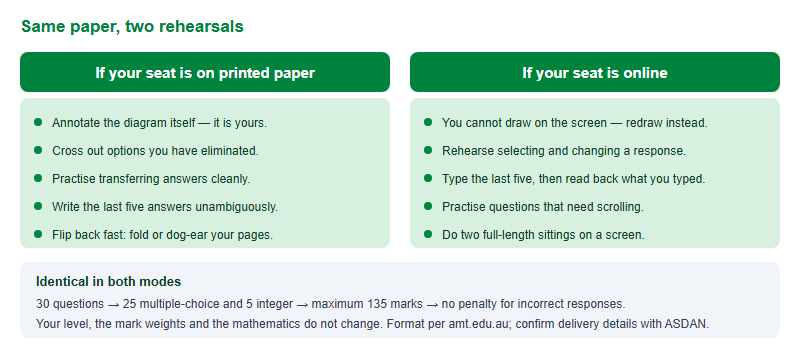
Start with what does not change, because it is most of the paper. AMT’s published structure is 30 questions — 25 multiple-choice and 5 integer — for a maximum of 135 marks, with no penalty for incorrect responses. The mark weights are the same, your level band is the same, and every technique that is really about mathematics transfers untouched.
What changes is the physical loop between reading a question and committing an answer.
| Dimension | Printed paper | Online | Confirm with ASDAN |
|---|---|---|---|
| Where you annotate | Directly on the diagram and the question text | Not on the screen — you need another surface | What writing materials are permitted at your seat |
| Recording the 25 multiple-choice | Marked on the paper or a separate sheet | Selected in the interface | Whether a separate answer sheet is used |
| Recording the 5 integer questions | Written by hand — legibility matters | Typed — accuracy of entry matters | The exact entry format expected |
| Moving between questions | Flip pages; trivially fast | Depends on the interface | Whether you can navigate back and flag |
| Watching the clock | Room clock or invigilator | Usually an on-screen timer | How time is displayed and announced |
| Reading long questions | Whole question visible at once | May require scrolling | Nothing — just rehearse it |
Notice how much of the right-hand column is a question rather than a claim. That is deliberate. Delivery arrangements are administrative and can differ between centres and years, and inventing a confident answer here would be worse than useless — a student who rehearses backward navigation that does not exist has practised a plan they cannot execute.
If your seat is on printed paper
Paper’s great advantage is that the diagram is a working surface. Use it. Mark the equal sides, write the value you deduced next to the vertex you deduced it at, shade the region you are computing. Students who solve geometry questions in their heads on a paper exam are declining a free tool.
Three habits repay rehearsal specifically:
- Elimination by pen. Physically strike through options you have ruled out. This matters most when you return to a flagged question later — without the strike-throughs you re-do the elimination you already did once.
- Transcription hygiene. If answers go on a separate sheet, transcription is a real and stupid source of loss. Transfer in blocks of five, and say the question number to yourself as you mark it. Confirm with your coordinator whether a separate sheet is used at your centre.
- Legibility on the last five. These are hand-written answers. A 1 that reads as a 7, or a hesitant digit, is an avoidable zero on a question worth up to 10 marks. Write the final answer deliberately, not in the same hurried hand as your working.
If your seat is online
The screen removes your annotation surface, and that single change accounts for most of the difficulty students report. The repair is a habit, not a technique: redraw the figure on whatever working surface you are permitted, then annotate the redrawing. Copying a diagram takes fifteen seconds and converts an online geometry question back into a paper one. Confirm with your coordinator what you may have at your seat before you build a plan that depends on it.
Beyond that, three things are worth rehearsing until they are boring:
- Read back what you typed. The five integer questions are entered rather than written. Typing a digit you did not intend is a different kind of error from a mathematical one, and it is caught by a one-second glance. Build the glance into the habit so it costs no decision.
- Scrolling questions. A long question or a tall diagram may not fit one screen. Practise reading a question in two screenfuls without losing the first half — the failure mode is scrolling down to the diagram, forgetting a condition stated above it, and answering a question that was not asked.
- Full-length screen time. Do at least two complete timed papers on a screen before the day. Screen reading is measurably more tiring than paper for most people, and the fatigue arrives in the middle block, which is exactly where the marks are densest.
Pre-A and the read-aloud facility
Parents of Grade 1 and 2 children should know one design detail before worrying about mode at all. Per our operator briefing of 8 August 2026, Pre-A papers are deliberately picture-led with minimal text, and come with a read-aloud facility so that children whose reading is still developing can compete fairly.
That is a design decision, not a watered-down paper — and it is the honest answer to a parent asking whether Grade 1 is too early. It is also a delivery feature, which means the practical question is how it works at your child’s seat: who reads, at what pace, and whether a question can be repeated. Ask your coordinator, then let your child practise a few questions in that same arrangement so the format is familiar rather than novel on the day.
A two-week, mode-matched rehearsal
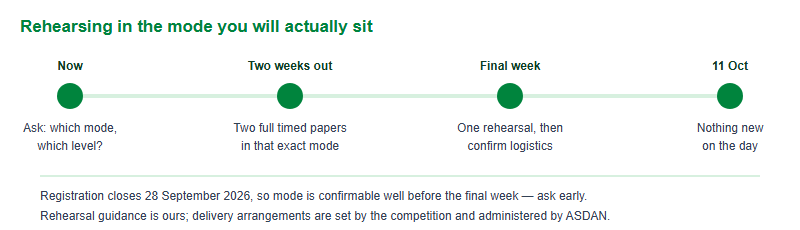
If you genuinely cannot get an answer in time, do not stall. Prepare the mathematics on paper, where annotation is free and practice material is easiest to work from, and add one full timed sitting on a screen so that the online interface is not the first screen you have ever worked from. That covers most of the downside in either direction. It is still worth asking again closer to the date — and worth confirming your level in the same message, since the grade bands from Pre-A to E decide what your paper looks like far more than the delivery mode does.
The plan is short because the goal is narrow. You are not learning mathematics in these two weeks; you are removing every source of novelty from the first ten minutes of the exam. A student who has already handled the interface, already redrawn a diagram from a screen, already typed and checked an integer answer, arrives at Question 1 with their full attention on Question 1.
One last note on interpretation. Mode does not change your band, your award chances or how the result is read afterwards — a Distinction is a Distinction. It changes only the friction between what you know and what gets recorded. That friction is worth about ten minutes and a handful of transcription errors, which on a 135-mark paper is not a rounding error. Results vary, but the cost of not asking is entirely one-directional.
Questions we get asked
Is the Australian AMC online or on paper?
Both exist — AMT delivers the competition online or on printed paper. Which applies to your seat is set by your centre; ask your school coordinator.
Does the mode change the questions or the marks?
No. It is 30 questions and a maximum of 135 marks either way, with no penalty for incorrect responses.
What is hardest about sitting online?
Losing the diagram as a writing surface. Redraw the figure on your permitted working surface, then annotate the copy.
How does Pre-A work for a child who cannot read fluently?
Pre-A papers are picture-led with minimal text and come with a read-aloud facility, per our operator briefing. Confirm the arrangement at your centre.
Published by the Australian AMC editorial desk, operated by Hanlin Education for China-based international-school students. Official rules are set by the competition and change yearly — confirm current details on amt.edu.au. Errors are corrected within 7 working days.