
Your Australian AMC level follows your year group as it stands from September 2026 — and six of the twelve year groups on the ladder are starting a brand-new band this season. If you are one of them, the paper in front of you on 11 October will not be the paper you remember, your raw score from last year is not a benchmark, and the sensible target has moved. Here is exactly what changes.
Six year groups are in a new band this season
In the China region the competition runs across six levels, mapped to year groups as they stand from September 2026: Pre-A for years 1 and 2, A for years 3 to 5, B for years 6 and 7, C for years 8 and 9, D for years 10 and 11, and E for year 12. Lay those bands against the twelve school years and something useful falls out that nobody usually says aloud.
The bands are not the same width. Level A covers three year groups; Pre-A, B, C and D cover two each; Level E covers exactly one. So in any given season, half the year groups on the ladder — years 1, 3, 6, 8, 10 and 12 — are sitting their first paper in a new band, while years 2, 4, 5, 7, 9 and 11 are on familiar ground.
That distinction predicts more about how a season feels than almost anything else, and it is invisible if you only ever look up which level you are in. Year 5 is the most settled position on the entire ladder: a third consecutive year in Level A. Year 12 is the least settled: Level E is a single year group, so every student in it is in their first and only year there. If you need the level bands themselves rather than the crossing logic, our overview of how the Australian AMC is organised lays them out.
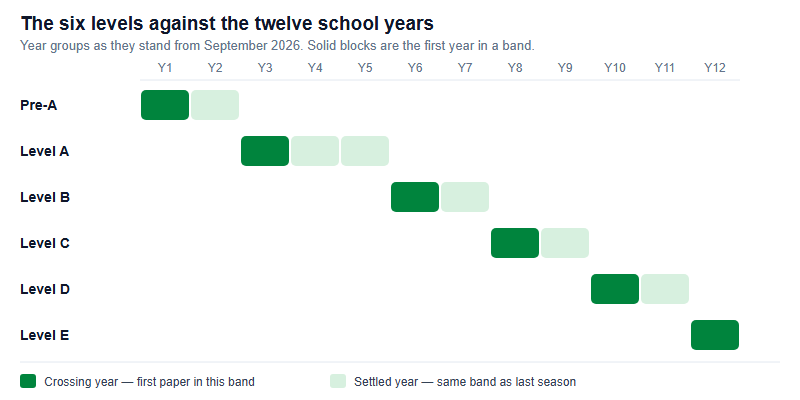
| Level | Year groups (from September 2026) | Band width | Crossing year | Settled year(s) |
|---|---|---|---|---|
| Pre-A | Years 1–2 | 2 year groups | Year 1 | Year 2 |
| A | Years 3–5 | 3 year groups | Year 3 | Years 4 and 5 |
| B | Years 6–7 | 2 year groups | Year 6 | Year 7 |
| C | Years 8–9 | 2 year groups | Year 8 | Year 9 |
| D | Years 10–11 | 2 year groups | Year 10 | Year 11 |
| E | Year 12 | 1 year group | Year 12 | None — every entrant is new to the band |
Your level follows your year group — it is not a choice
Families sometimes ask whether a student who did well last year could stay in the band they know, or whether a strong student could enter a level up for the challenge. The mapping answers the first question: in the China region the level is set by the year group as it stands from September 2026, so a student who moved from year 7 to year 8 moves from B to C whether or not it suits their preparation.
AMT’s own competition rules answer the second, and they are worth quoting in full because they are stricter than people assume: “No student is allowed to sit the competition more than once or to sit more than one division of a competition.” One sitting, one division. If your circumstances look like an edge case — a repeated school year, a mid-year transfer between systems, a student whose school year does not map cleanly onto the bands — that is an administrative question for ASDAN before the 28 September registration deadline, not something to resolve by assumption.
The practical consequence is that the crossing is not optional and not negotiable. It arrives on schedule, and the only variable you control is whether you prepared for the band you are actually in.
Same paper shape, higher ceiling
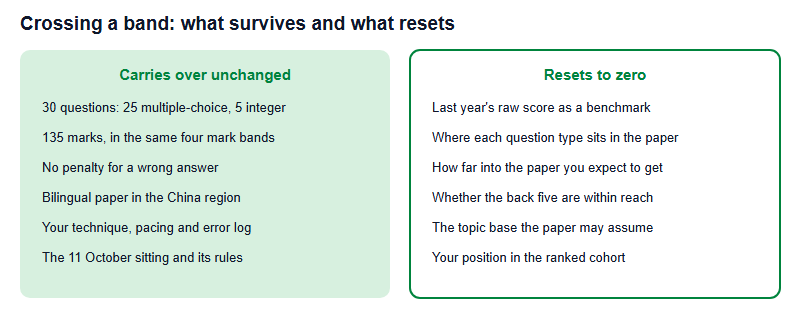
Start with the reassuring half. The structure does not change at all when you move up. Every AMC paper at every level is 30 questions — 25 multiple-choice and 5 integer-answer — for a maximum of 135 marks, with questions 1–10 worth 3 marks, 11–20 worth 4, 21–25 worth 5, and 26 to 30 rising from 6 to 10. There is no penalty for a wrong answer at any level. The China-region paper is bilingual at every level. Everything you learned last year about how to run a paper still applies.
What changes is the ceiling the questions are drawn from, and the effect on your experience is more disorienting than the phrase suggests. Three things happen at once, and all three are our coaching observation of what students report rather than anything published by the competition:
- The comfortable question moves earlier, or disappears. The kind of problem you were reliably solving at position 15 last year may now sit at position 7 — or may simply not appear, because the new band starts above it. Your sense of “how far into the paper I usually get” is calibrated to the wrong paper.
- The back five move out of reach for a year. Students who were beginning to make progress on questions 26 and 27 in their settled year often find the equivalents in the new band genuinely closed to them. That is normal in a crossing year and it is not where the marginal marks are.
- The middle gets crowded. Because the whole difficulty curve shifts up, questions 11 to 25 — 65 marks between them — carry material that used to sit at the top of your old paper. This is where a crossing year is won or lost.
There is one further wrinkle worth naming honestly. Our coaches read the introduction of Pre-A, which now absorbs the youngest entrants in years 1 and 2, as having made Levels A and B implicitly harder, because the cohort sitting them no longer includes the very youngest students. We want to be precise about the status of that claim: it is our reading of what we see, not an announcement from AMT, and we would not put more weight on it than that. It is relevant here only because a year 3 or year 6 student crossing into A or B should not be startled by a paper that feels a step steeper than an older sibling remembers.
Why last year’s raw score does not carry over
This is the part families most often get wrong, and it causes real and unnecessary distress in November when results arrive.
AMC awards are not fixed scores. AMT describes them as proportions: Prize at roughly the very top of a level and region, High Distinction at the top 3% for Levels A to D and the top 5% for Level E, Distinction at the top 20% for A to D and the top 25% for E, and Credit at the top 55% for A to D and the top 60% for E. A band is a rank within a cohort, not a number you can hit by practice.
AMT’s handbook for coordinators and supervisors is explicit about how those cut-offs are produced: “Cut-off scores are determined by comparing a student’s results with other students in the same level and region”, and “Cut-off scores are approximate and will vary year by year depending on the difficulty of the competition.” It also notes that for small regions, year levels may be combined when cut-offs are set. Exactly how the China region is grouped for that purpose is an administrative matter to confirm with ASDAN rather than to infer.
Put those two facts together and the conclusion is unavoidable. Your raw score last year was measured against a different paper, in a different band, with cut-offs set for a different year’s difficulty. Scoring lower in a crossing year is not evidence that anything went wrong. Comparing the two numbers is comparing measurements taken with different instruments.
How to prepare in a crossing year
With the sitting on 11 October 2026 and registration closing on 28 September, a student in years 1, 3, 6, 8, 10 or 12 has enough time to run this properly. Five steps, in order.
- Re-baseline at the new level, not the old one. Sit one timed paper at the band you are actually entering, under real conditions, and mark it honestly. Expect the number to be lower than last year. That is the point of the exercise: you are measuring the new instrument, not your worth.
- Point everything at questions 1 to 25. In a crossing year the marginal marks are almost never in the back five. The 95 marks in questions 1 to 25 are where a realistic improvement lives between now and October.
- Find the two or three topics the new band assumes. Work backwards from the re-baseline paper: which questions failed because of a technique you have simply not met yet, rather than a slip? That short list is your syllabus for the next four weeks.
- Do not set a score target. Set a process target instead — attempt every question in the first twenty, record every multiple-choice answer, keep an error log. Since cut-offs are proportional and move with each year’s paper difficulty, a raw-score goal is a number you cannot steer towards.
- Re-check your level before you register. The mapping runs off your September 2026 year group, and a family who registered from memory last season is the classic way a student ends up in the wrong band. Our guide to the competition and its levels is the quickest place to confirm it.
One last thing, mostly for parents. Across the cohorts we coach, a dip in a crossing year followed by a stronger settled year is a common enough shape that we now warn families about it in advance rather than explain it afterwards. It is our own observation and individual results vary widely, so we would not present it as a rule. But if your child moves from Level B to Level C this October and comes home saying the paper was much harder, the most likely explanation is simply that it was.
Frequently asked questions
Which year groups start a new Australian AMC level in 2026?
Years 1, 3, 6, 8, 10 and 12. Years 2, 4, 5, 7, 9 and 11 remain in the band they sat last season.
Can my child sit a lower level to get a better award?
No. The China-region level follows the September 2026 year group, and AMT rules state no student may sit more than one division of a competition.
Why did my child score lower after moving up a level?
Different band, different paper and different cut-offs. AMT notes cut-off scores are approximate and vary year to year with paper difficulty.
Is Level A really three year groups wide?
Yes. Level A covers years 3 to 5, so a year 5 student is in their third season in that band — the most settled position on the ladder.
Published by the Australian AMC editorial desk, operated by Hanlin Education for China-based international-school students. The Australian Mathematics Competition is run by the Australian Maths Trust and administered in the China region by ASDAN. Official rules are set by the competition and change from year to year — confirm current details on amt.edu.au and with ASDAN. Errors are corrected within 7 working days of being reported.