
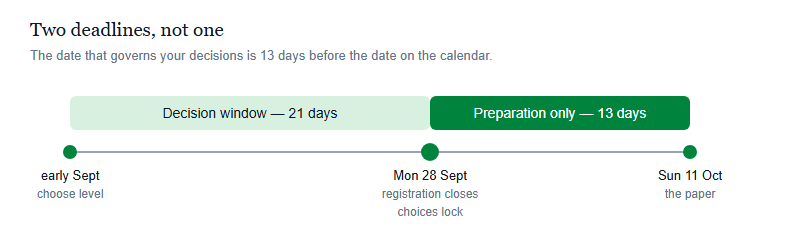
China-region registration for the Australian AMC closes on Monday 28 September 2026, and the paper is sat on Sunday 11 October. The form itself takes a few minutes. But three of the decisions bundled inside it — the level letter, the delivery mode, and the name that will be printed on the certificate — are hard or impossible to change once the window shuts. Here is the order to make them in.
The deadline is not the exam date, and the gap between them is the whole point
Families read “11 October” and quietly plan around it. The date that actually governs your autumn is thirteen days earlier. Registration closes on 28 September; the sitting is on 11 October. Those thirteen days are not slack in the system — they are the window in which the entry list becomes a set of papers, logins, venues and supervisors. Once an entry list closes, it stops being a list of intentions and becomes a logistics document.
The practical consequence is a change of subject. Up to 28 September, the useful questions in your household are which level, which delivery mode, is this the right year. From 29 September onwards, every one of those questions is settled, and the only remaining question is how to use the last two weeks. Families who blur the two lose the first conversation entirely: they spend September vaguely preparing, arrive at the deadline having never made the level decision on purpose, and default into whatever the school entered them as.
So treat this week as a decision week, not a study week. Three weeks of preparation is a real amount of time, but it is worth much less if it is aimed at the wrong paper.
Four choices, one form
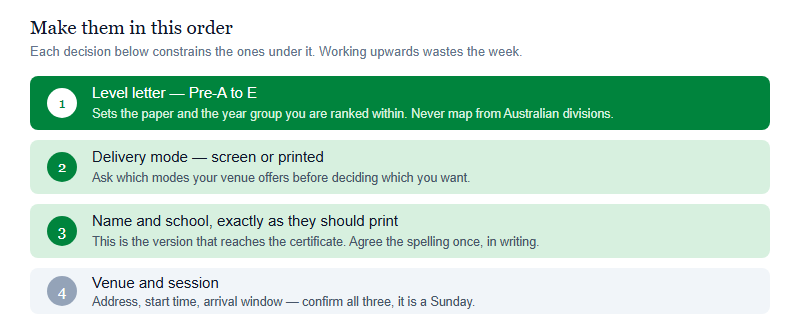
A registration form looks like admin. It is actually four separate decisions wearing one coat, and they differ enormously in how easy they are to revisit. The honest position on reversibility is this: we do not publish the competition's amendment rules, and they can change between years. What we can tell you is which decisions are cheap to ask about now and expensive to discover later.
| The choice | What it actually controls | Treat it as | Ask before 28 Sept |
|---|---|---|---|
| Level letter (Pre-A to E) | Which paper arrives. Different questions, different difficulty curve, and the year-level group your result is ranked within. | Locked | Whether a change is possible at all, and by when |
| Delivery mode | Whether the student works on screen or on printed paper — AMT publishes both as delivery options for the AMC. | Locked in practice | Which modes are actually offered at your venue |
| Name and school as entered | What is printed on the certificate and appears in any results record. | Effectively permanent | The exact spelling convention to use |
| Venue or session | Where and when the student sits, and how far you travel on a Sunday morning. | Semi-fixed | Address, start time, and arrival window |
Notice what is not in that table: how much preparation the student has done. Nothing on the registration form asks about readiness, and nothing on it improves with a fortnight of practice. That is why the decisions belong now and the studying belongs after.
Decision one: the level letter, and the mapping trap that catches most families
This is the only choice that changes the actual paper, so it deserves most of your thinking. The China region runs six levels, Pre-A through E, covering Grades 1 to 12. They are sat as a 30-question paper marked out of 135, with no penalty for a wrong answer — confirm the format for the youngest band with ASDAN. What differs is the difficulty curve and the cohort you are ranked against.
Here is the trap. AMT, the Australian Maths Trust, publishes its own division names for the Australian competition, and they are banded differently. AMT lists Middle Primary for Australian Years 3 and 4, Upper Primary for Years 5 and 6, Junior for Years 7 and 8, Intermediate for Years 9 and 10, and Senior for Years 11 and 12 — five divisions beginning at Year 3. The China region runs six letters beginning at Grade 1. These are two different banding systems and you cannot read one across onto the other. Every year we watch a family find an Australian division description online, match it to their child's age, and register on the strength of a mapping that was never valid. If you want the level structure itself set out properly, our overview of how the Australian AMC works covers all six China-region bands.
The same caution applies to timing. AMT publishes 60 minutes for its primary divisions and 75 minutes for its secondary divisions. Our own China-region sittings do not all run to AMT's Australian timings, and the letters are banded differently. Which figure applies to your child's letter is an ASDAN question, and it is worth asking, because it is the number your practice timer should be set to.
Three sane rules for choosing the letter:
- Start from the school year, not from ability. The letters are built around year groups, and the ranking that produces an award is calculated within a year level. Entering a level down to collect a better certificate is not the win it looks like — it changes the comparison group as well as the paper.
- Do not enter up as a stretch without a reason you can say out loud. “She is strong at maths” is not a reason; “she is formally accelerated and sits her maths lessons with the year above” is.
- When a child sits genuinely between two bands — a mid-year transfer, a repeated or skipped year, a school calendar that does not line up with the mainland one — that is precisely the case to put to ASDAN in writing rather than resolve by guessing.
Decision two: the delivery mode, and what it does to a hard question
AMT publishes both online and printed paper as delivery formats for the AMC. Which of them is available for a given China-region seat is set locally, so the first question is not “which would we prefer” but “which are we actually being offered”.
Where you do have a choice, the deciding factor is rarely comfort with technology. It is what the student does with a hard question. Scratch working, marginal diagrams, crossing out three of five options, circling a question to return to — on a printed paper these all live on the page in front of them. On screen, some of that has to move to separate paper and some of it has to move into the student's head. A student who annotates heavily is not automatically worse online, but they need one full rehearsal in that mode before they discover the difference on 11 October.
The one thing that does not change with mode: 25 of the 30 questions are multiple choice and five require an integer answer, and there is no negative marking either way.
Decision three: the name that will be printed, and why a small field matters later
This is the least discussed field on the form and the one we are asked to fix most often after the fact. Whatever you type becomes the version that appears on the certificate and in the results record. Chinese students commonly have several defensible written forms of their own name — passport romanisation, a school-register form, an English given name adopted in Year 7, family name first or last. All of them are “correct”. Only one of them ends up printed.
The reason to care is not vanity. When a result is eventually read by someone outside the family, it is read against other documents. An admissions reader looking at a maths profile checks an award against the transcript, the activity list and what the student says about themselves in an essay; several results across one file corroborate one another, and that mutual corroboration is what makes the whole picture believable. A certificate that carries a name in a different form from the transcript does not destroy that, but it introduces a small piece of friction into a process whose entire job is matching things up. Use the form the school uses on its transcripts, and use it consistently across every competition the student enters.
No single award decides an admission outcome, and no one should register for that reason alone. The point is narrower: if a result is going to be part of a file later, spend thirty seconds now making it easy to attribute.
The message to send this week — and what registration does not buy
Almost everything above resolves into one short message to ASDAN, sent while the answers still change something. Three questions, in this order:
- “Our child is in Grade ___ at ___ school. Which level letter should the entry use, and is that letter changeable after we register?” Put the school and year group in the message; a level question without them cannot be answered.
- “Which delivery modes are available at our venue, and how long is the sitting for this level?” The duration is the number your rehearsals should use, and it is not safely inferred from AMT's Australian division timings.
- “What is the venue address, the session start time and the arrival window on Sunday 11 October?” Ask now, because in the last week the same question competes with several hundred others.
Finally, the honest caveat about what a completed registration actually gets you. It buys a seat, a paper and a place in a ranking. It does not buy a study plan, a diagnosis of your child's weak topics, or a judgement about whether this is the right year to enter. Those are separate pieces of work, and the good news is that they are the ones the next fortnight is genuinely for. If you are still deciding whether the competition suits your child at all rather than which box to tick, start with what the Australian AMC is and who it is built for and make the entry decision from there — but make it before Monday 28 September, because after that the decision makes itself.
Frequently asked questions
When exactly does China-region registration close?
Monday 28 September 2026. The paper is sat on Sunday 11 October, thirteen days after the entry list closes.
Can we change the level after we have registered?
Treat it as fixed. Confirm the amendment rules with ASDAN before 28 September rather than assuming a swap is possible afterwards.
Are the Australian divisions the same as the China-region levels?
No. AMT bands Years 3-4, 5-6, 7-8, 9-10 and 11-12; the China region runs six letters, Pre-A to E, from Grade 1.
Is a wrong answer worse than leaving a question blank?
No. The AMC applies no negative marking, so an unanswered multiple-choice question is never better than a considered guess.
Published by the Australian AMC editorial desk, operated by Hanlin Education for China-based international-school students. The Australian Mathematics Competition is run by the Australian Maths Trust (AMT), with the China region administered by ASDAN. Official rules are set by the competition and change yearly — confirm current details on amt.edu.au. Errors are corrected within 7 working days.