
Many Australian AMC problems invite you to divide large numbers and inspect remainders. The trap is to reach for brute-force arithmetic. The faster path is to recognise when remainders must repeat, then use that cycle to jump directly to the answer. This article shows how, through two teaching illustrations and a diagnostic contrast.
Why Remainder Cycles Matter in Australian AMC
The Australian Mathematics Competition (AMC) is run by the Australian Maths Trust (AMT), with ASDAN handling operations in China. It covers six levels from Pre-A to E, serving students from Grades 1–12. Problems at the middle and upper levels often test modular reasoning without ever using that phrase. A student who can see the hidden cycle saves minutes per question—critical in a timed setting where C–E levels allow only 75 minutes for 30 problems.
The core skill is simple: when you divide successive powers or successive integers by the same modulus, the remainders eventually repeat. Once you know the period of that repetition, you can replace a large exponent or a distant term with a small equivalent. The challenge is not the arithmetic; it is recognising when this shortcut applies and when a hidden condition blocks it.
For broader context on how the competition is structured, see Australian AMC 2026 China Results: The 6–8 Week Window, Score Report and Who to Ask.
Worked Hypothetical Example 1: Powers and a Clean Cycle
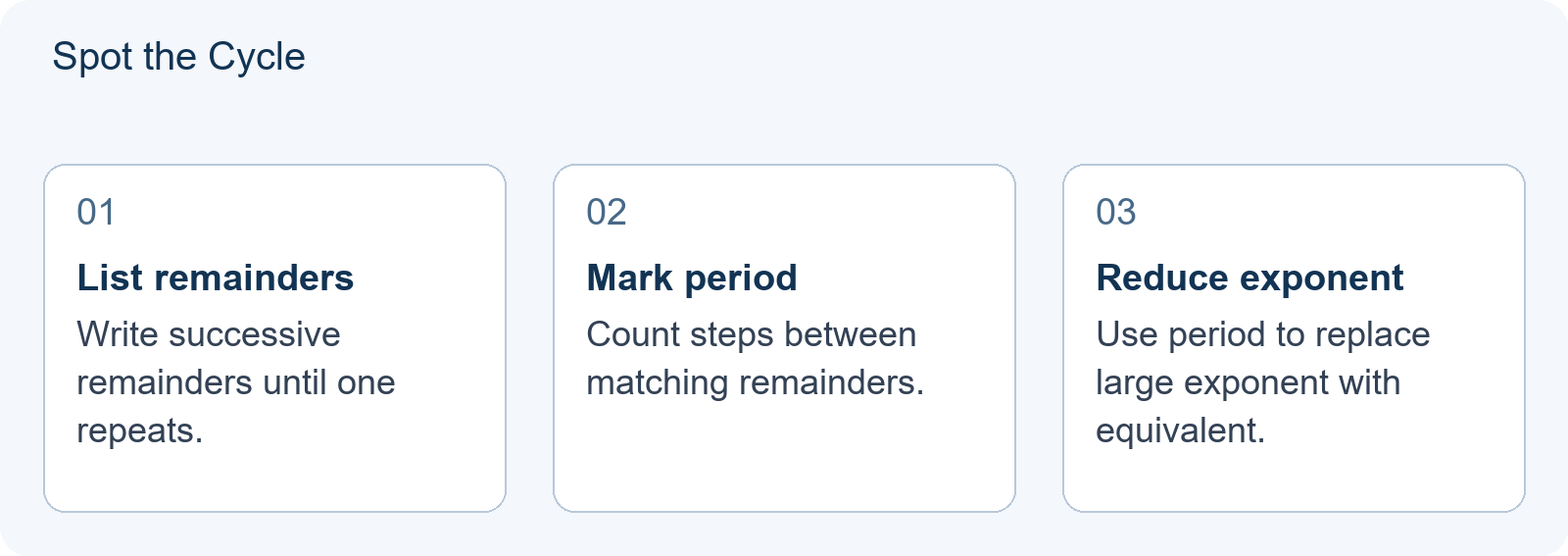
Suppose a problem asks for the remainder when a large power of 3 is divided by 7. Rather than compute the full power, list the remainders of successive powers of 3 modulo 7:
- 31 = 3 ≡ 3 (mod 7)
- 32 = 9 ≡ 2 (mod 7)
- 33 = 27 ≡ 6 (mod 7)
- 34 = 81 ≡ 4 (mod 7)
- 35 = 243 ≡ 5 (mod 7)
- 36 = 729 ≡ 1 (mod 7)
At 36 the remainder returns to 1. The cycle length is 6. If the problem had asked for 3100 mod 7, you would note that 100 = 6 × 16 + 4, so the remainder matches that of 34, namely 4. The calculation collapses from impossible to trivial.
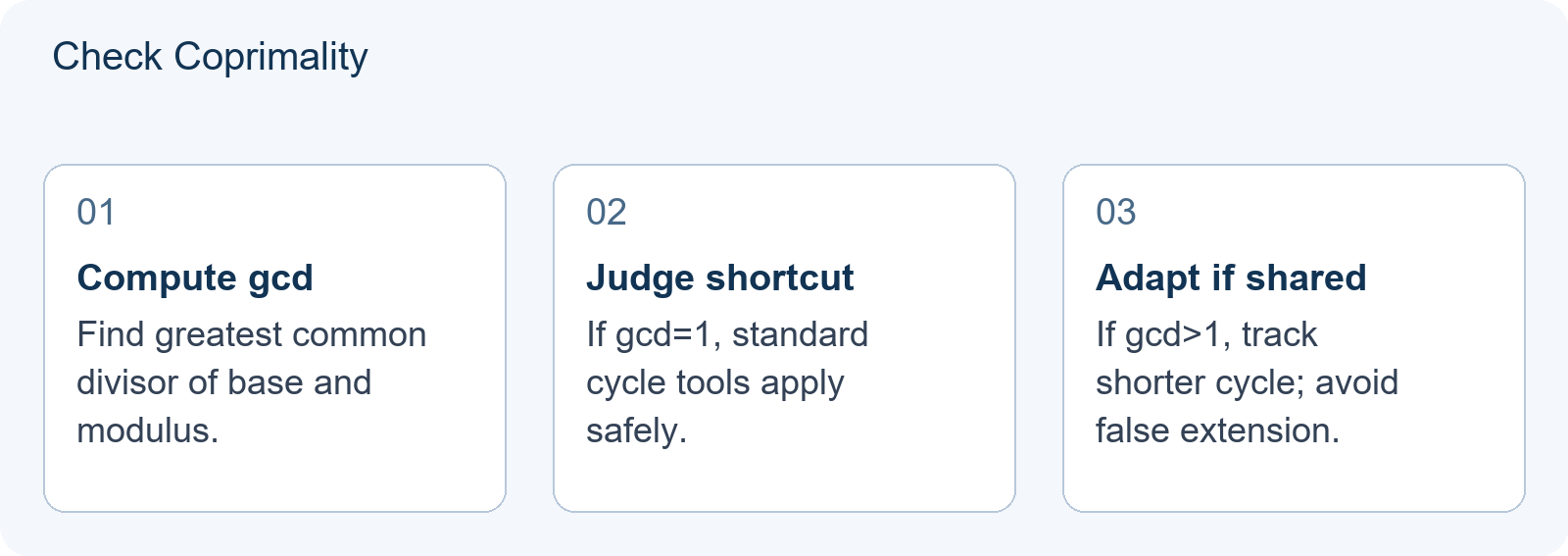
Why does this work? Because 3 and 7 share no common factors other than 1; they are coprime. This guarantees that some power of 3 will eventually hit remainder 1, producing a clean multiplicative cycle. The smallest such exponent—6 in this case—is called the multiplicative order of 3 modulo 7. You do not need to remember this term for the AMC; you only need to know that the pattern exists and how to exploit it.
This is not an official past-paper question; it is an original teaching illustration designed to isolate the reasoning pattern.
Worked Hypothetical Example 2: Where the First Shortcut Fails
Now consider a superficially similar problem: remainders of powers of 2 modulo 6. A hasty student might expect another clean cycle:
- 21 = 2 ≡ 2 (mod 6)
- 22 = 4 ≡ 4 (mod 6)
- 23 = 8 ≡ 2 (mod 6)
- 24 = 16 ≡ 4 (mod 6)
The cycle here is only 2, but there is a hidden obstacle: 2 and 6 share a common factor of 2. The pattern 2, 4, 2, 4… never reaches 1. This means you cannot use the same shortcut as in Example 1, because there is no power of 2 that is congruent to 1 modulo 6. The student who recognises this limitation avoids a false generalisation.
What goes wrong if you ignore this? Suppose you tried to apply the same logic: you might hunt for an exponent where 2k ≡ 1 (mod 6), fail to find one, and waste precious minutes—or worse, invent a non-existent answer. The correct approach is to accept the shorter cycle for what it is: 2, 4 repeating. If a problem asked for 297 mod 6, you would note that odd exponents give remainder 2 and even exponents give remainder 4. Since 97 is odd, the answer is 2. The cycle is still usable; you simply cannot extend it with the same tools as in Example 1.
Diagnostic Table: When Does the Shortcut Work?
| Situation | Cycle exists? | Can use standard shortcut? | What to check first |
|---|---|---|---|
| Base and modulus are coprime | Yes | Yes | Confirm gcd(base, modulus) = 1 |
| Base and modulus share a factor | Yes, but shorter | No—cycle may not reach 1 | Factor the modulus; watch for zero divisors |
| Modulus is prime | Yes | Usually, via Fermat’s little theorem | Verify the base is not a multiple of the modulus |
| Successive integers, not powers | Yes, trivial cycle of length modulus | Yes—remainder pattern is 0,1,2,… | Match position to remainder directly |
Use this table as a quick decision aid during practice. On competition day, the habit of checking coprimality before applying a power-cycle shortcut prevents the most common error seen in student work. The key distinction is not whether a cycle exists—cycles always exist—but whether the cycle is long and useful or short and limiting.
A Targeted Practice Sequence
To build fluency, work through this progression:
- Isolate the cycle: Pick any base and small modulus. Write remainders until repetition. State the period in your own words. Start with coprime pairs like (4, 5) or (5, 7) where the cycle is clean and confidence-building.
- Match large exponents: Given a cycle length, reduce the exponent using integer division and remainder. Verify with a calculator for small cases. For example, with base 4 and modulus 5, the cycle is 4, 1 with period 2. Since 100 is divisible by 2, corresponds to the second term in the cycle (or ), which is 1.
- Contrast coprime and non-coprime: Repeat with a shared factor, such as base 4 and modulus 6. Note what changes and what stays the same. Here 41 ≡ 4, 42 ≡ 4 (mod 6), so the cycle collapses immediately to a single value. This extreme case is worth seeing once.
For additional preparation materials and past papers, visit Australian AMC to AMC8 transition: From Australian AMC October to AMC8 January: A Three-Month Skill Bridge. If you are deciding which competition level suits your current year, Australian AMC Tutoring: Which Gaps Need Support Beyond School Maths? provides a clear mapping.
What You Should Be Able to Demonstrate Next
After practising the sequence above, a learner should be able to: (1) identify within 30 seconds whether a remainder-cycle shortcut is appropriate for a given base and modulus; (2) compute the reduced equivalent of a large exponent or term without performing the full calculation; and (3) explain why a non-coprime pair behaves differently, without invoking advanced number theory. These skills transfer directly to the multiple-choice and integer-answer formats used in the Australian AMC.
The final habit to cultivate is restraint. When you see a remainder problem with a large number, your first instinct should not be to calculate. It should be to ask: do the remainders repeat? If yes, what is the period? And is my base coprime to the modulus? Answering these three questions first will, more often than not, replace five minutes of arithmetic with thirty seconds of pattern recognition.
Frequently Asked Questions
Do I need to know modular arithmetic formally to use remainder cycles in the Australian AMC?
No. The competition tests reasoning, not terminology. If you can spot that remainders repeat and use that repetition to skip steps, you have the skill. Formal notation helps organise your work but is not required for any level through E.
How do I practise if I run out of official past-paper questions on this topic?
Generate your own. Pick any two-digit base and any single-digit modulus, then list remainders until you see the cycle. Deliberately include cases where the base and modulus share a factor, so you learn to recognise the warning sign. Check your predicted cycle against a calculator for the first several terms.
Can remainder cycles help with non-power problems, like sequences or factorials?
Yes. Any sequence defined by repeated multiplication or fixed recurrence will show periodic remainders. For factorials, the pattern often collapses to zero once the factorial contains the modulus as a factor. The same diagnostic—list, observe, exploit—applies across problem types.