
One of the most persistent traps in Australian AMC preparation is the “reverse percentage” problem. Students often calculate forward correctly but fail when asked to find the original value after two successive changes. This article explains the logical framework for recovering the starting value, a skill useful for multi-step word problems across various levels.
The Core Misconception
A common error is assuming that if a price increases by 20% and then decreases by 20%, it returns to the original. It does not. Percentages are relative to the current base. When you reverse two changes, you must divide by the multiplier, not subtract the percentage. For example, a 20% increase means multiplying by 1.2. To reverse it, you divide by 1.2, which is approximately a 16.7% decrease, not 20%.
Step-by-Step Recovery Method
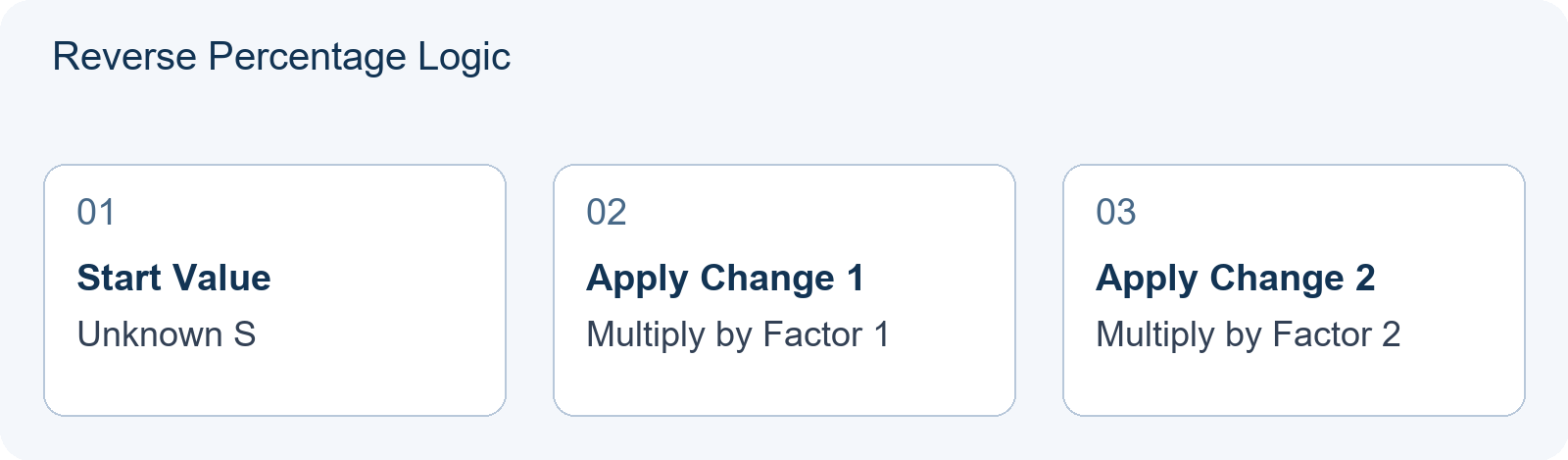
To solve these problems efficiently during the exam, use the following algebraic approach. Let be the starting value, and be the change factors (e.g., 1.2 for +20%, 0.9 for -10%), and be the final value.
| Step | Action | Example (+20%, then -10%) |
|---|---|---|
| 1. Identify Factors | Convert % changes to decimals. | , |
| 2. Set Equation | ||
| 3. Combine Multipliers | Multiply and first. | |
| 4. Solve for Start |
Why Accurate Calculation Matters
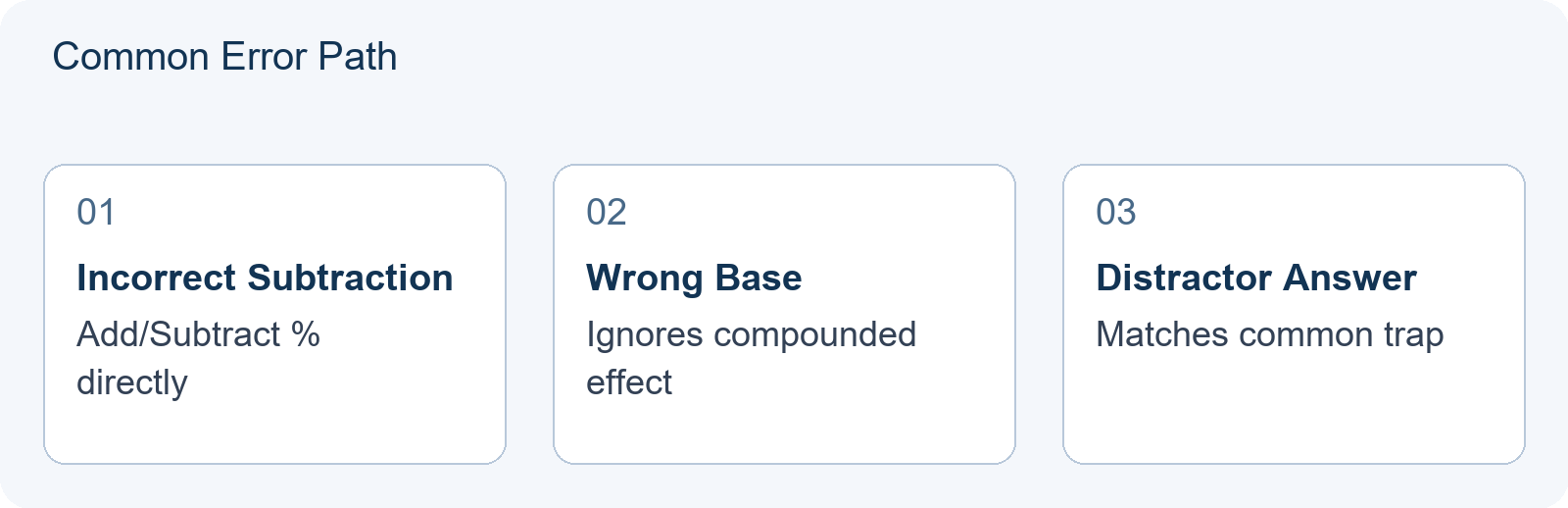
In the Australian AMC, questions are designed to test conceptual understanding under time pressure. A small arithmetic error in reversing percentages can lead to selecting a distractor option that represents a common mistake (like simply adding/subtracting percentages). Practicing this method ensures you can recover the starting value quickly and accurately, preserving mental energy for harder geometry or combinatorics questions later in the paper.
Teaching Illustration: A Two-Change Scenario
Note: This is a teaching illustration, not an official past paper question.
A shop marks up a toy by 25% for Christmas. In January, it discounts the new price by 20%. The final price is $60. What was the original price?
- Markup factor:
- Discount factor:
- Combined factor:
- Original Price:
Here, the net change is zero. If students incorrectly calculated markup, they would get the wrong answer ().
Strategic Preparation Tips
- Practice with Fractions: Sometimes converting percentages to fractions (e.g., 20% = 1/5) makes division easier mentally.
- Check Reasonableness: If the final price is lower than the start, the combined multiplier must be less than 1.
- Time Management: These problems should take under 60 seconds. If you are stuck, skip and return.
For more structured practice on handling word problems, consider reviewing our guide on The Maths Isn’t the Hard Part: Extracting the Condition from Australian AMC Word Problems (2026). Additionally, understanding the broader context of your preparation timeline is crucial; see our advice on The Long Runway: An Eight-Week Australian AMC Plan from Mid-August to 11 October (2026). Finally, if you need targeted support for specific gaps like this, explore our insights on Australian AMC Tutoring: Which Gaps Need Support Beyond School Maths?.
Order Independence and Common Misconceptions
For successive percentage changes applied to the same running value (e.g., price increases/decreases), the order of operations is mathematically commutative because . A common misconception is that applying a tax before a discount yields a different result than applying it after. On a running subtotal, percentage tax and percentage discount commute. Order only matters if the operations use different fixed bases (e.g., tax on original price vs. discount on final price) or involve fixed-amount changes rather than percentages. Understanding this property simplifies complex chains by allowing you to group multipliers efficiently.
Consider a three-step teaching illustration: A stock price drops 10%, then rises 15%, then drops 5%. The final value is $98.325. What was the starting price?
- Identify Factors: Drop 10% (), Rise 15% (), Drop 5% ().
- Combine Multipliers: Calculate the net factor first. . Then .
- Solve for Start: .
This example demonstrates why accurate calculation matters. If you had approximated the net change as , you would have guessed the start was also , which is incorrect. The multiplicative method reveals the true starting value. When preparing for the Australian AMC, practice estimating the net multiplier first. If , the start is greater than the end. If , the start is less than the end. This allows you to eliminate impossible options quickly before performing precise division.
Frequently Asked Questions
How can I check a recovered starting value?
Apply the changes forward in the stated order to see if you recover the final value. Also, verify which base each change uses to ensure accuracy.
How should I approach multiple-choice options?
Focus on calculating the exact net multiplier. If you are unsure, estimate the range of the answer to eliminate clearly incorrect options before committing.
How long should I spend on one percentage problem?
In a timed contest, aim for under 60-90 seconds per question. If you cannot set up the equation quickly, flag it and move on.