
The Australian Mathematics Competition (AMC) China region exam concluded on October 11, 2026. For many families, the immediate next step is an Australian AMC Answer Review. However, simply checking which option was correct is often a missed opportunity. The most valuable part of post-exam analysis is not verifying the final number, but auditing the reasoning path that led to it. This article explains why you should check your child’s logic before watching any worked solution, using specific teaching illustrations based on common competition structures.
Why Logic Auditing Beats Answer Checking
According to the AMT official guidelines and Hanlin preparation notes, the AMC structure varies by level. For Levels A through E, there are 30 questions with a maximum score of 135 points. Crucially, wrong answers do not incur negative marking. This rule creates a specific psychological trap: students may guess correctly without understanding the underlying concept. If a student guesses “B” and the answer key says “B,” they might feel successful. But if their reasoning was flawed—perhaps they eliminated options randomly rather than solving logically—they have not actually demonstrated competence. An effective Australian AMC Answer Review must distinguish between lucky guesses and solid mathematical thinking.
The Scoring Structure and Its Implications
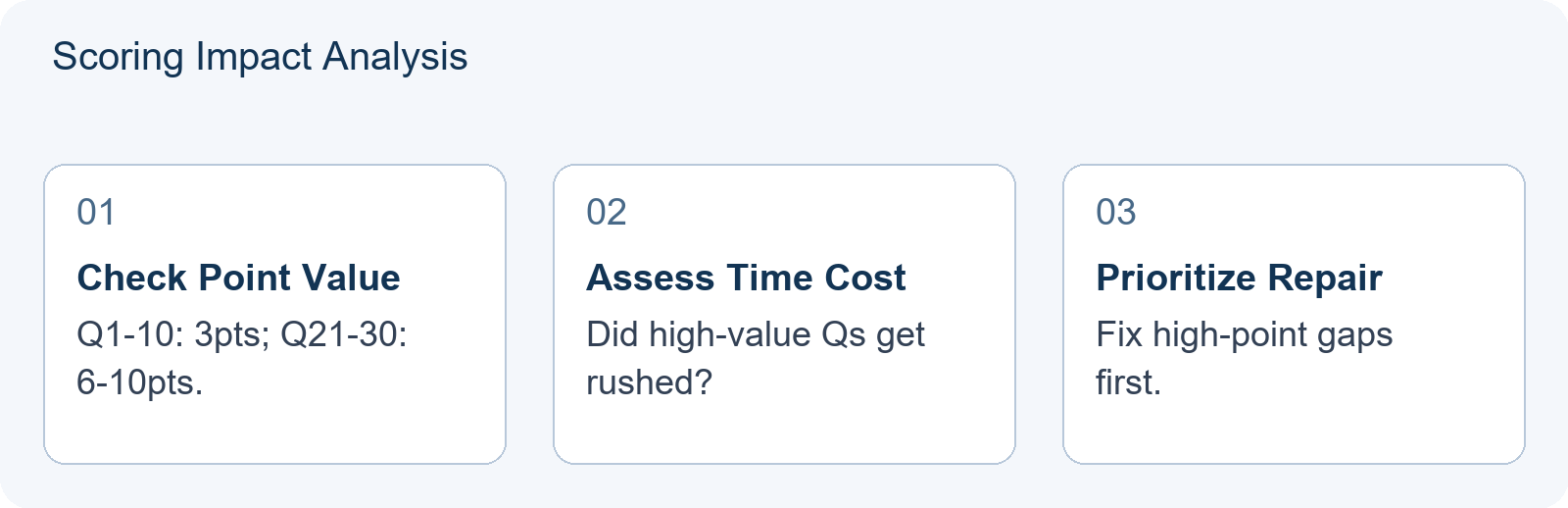
Understanding the point distribution helps prioritize review efforts. In the Pre-A level (Grades 1-2), there are 25 questions worth 100 points total. Questions 1-10 are worth 3 points each, questions 11-20 are worth 4 points each, and questions 21-25 have escalating values (5, 5, 6, 6, 8 points). For Levels A-E, the first 10 questions are worth 3 points each, questions 11-20 are worth 4 points, and the final five questions increase in value from 6 to 10 points. Because higher-value questions appear at the end, errors here have a disproportionate impact on the final score. When reviewing answers, pay special attention to questions 21-30. Did the student run out of time? Did they rush? These behavioral patterns are more important for future preparation than the raw score itself.
Teaching Illustration: The Percentage Trap
Note: This is a constructed teaching illustration based on common mathematical misconceptions, not an actual Australian AMC contest question or official scoring guidance.
Consider a problem involving percentage changes: A shop increases the price of a toy by 20%, then decreases the new price by 20%. What is the net change?
- Flawed Reasoning: Many students assume +20% and -20% cancel out, leading them to answer “No change.” This is a classic conceptual error regarding base values.
- Correct Reasoning: Start with 100. Increase by 20% gives 120. Decrease 120 by 20% means calculating 20% of 120, which is 24. So, 120 − 24 = 96. The net change is a decrease of 4%.
If a student answered “No change” due to this flawed reasoning, or if they guessed randomly and happened to select a different option that was also wrong, the Australian AMC Answer Review process must uncover this gap. Simply seeing the correct answer “Decrease by 4%” in a worked solution does not fix the misunderstanding about sequential percentages. Note that with no negative marking, a random guess among five options has 20% chance of being marked correct without any reasoning at all—another reason to audit logic, not just answers.
Contrasting Case: Where Superficial Checks Fail
Note: This is a constructed teaching illustration for demonstration purposes, not an official contest problem.
Consider a geometry problem: A square sheet of paper is folded along its diagonal. What fraction of the original visible area remains?
A student might select the correct answer (one half) because they memorized a similar diagram from past practice. However, this success is fragile. A deep reasoning audit asks two distinct questions: (1) Does folding change the physical area of the paper itself? (No—the material is conserved, merely repositioned. The physical sheet area remains unchanged.) (2) What is the visible footprint after the fold? (The triangular visible region covers half the original square’s area.)
These are different physical facts. The unchanged total area of the sheet does not explain why the visible footprint is halved. If the student cannot articulate this distinction—confusing the conserved physical sheet with the halved visible footprint—they may fail when the fold line changes to a midline or when asked about a different transformation. A superficial answer check confirms they got the point. A deep reasoning audit confirms they understood why.
Diagnostic Application: Three Key Questions
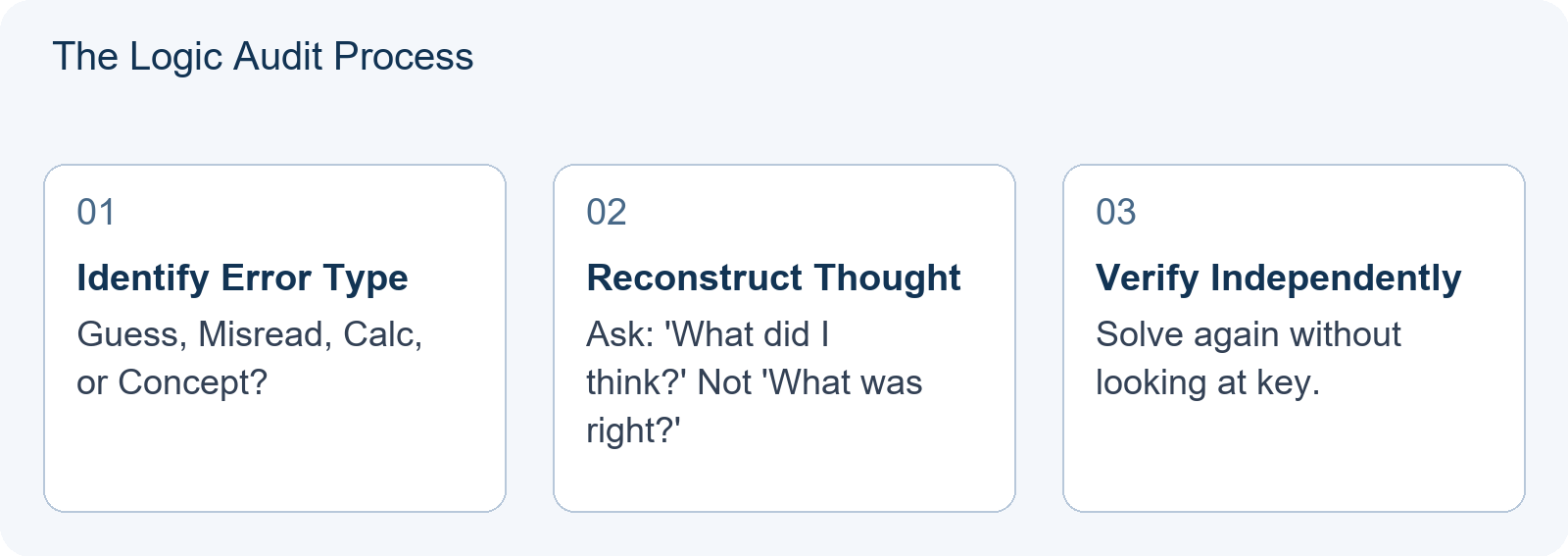
Before opening any video solution, ask your child these three diagnostic questions for every incorrect or uncertain answer:
- What did I think the question was asking? Often, errors stem from misreading the prompt (e.g., confusing perimeter with area).
- Where exactly did my logic break down? Was it the setup, the calculation, or the interpretation of the result?
- Could I solve this now without looking at the answer? If yes, the issue was likely time pressure or carelessness. If no, it is a knowledge gap.
This method transforms passive review into active learning. It aligns with Hanlin’s observation that The Maths Isn’t the Hard Part: Extracting the Condition from Australian AMC Word Problems (2026) is often harder than the math itself. By focusing on comprehension first, you address the root cause of errors.
Interpreting Results for Next Steps
The outcome of your Australian AMC Answer Review should guide your next preparation phase. If the majority of errors were due to misreading questions, focus on practice with timed reading exercises. If errors were computational, drill arithmetic accuracy under pressure. If errors were conceptual, revisit foundational topics like ratios or geometry properties.
For students considering the 2027 AMC8, note that this competition has a different format: 25 questions in 40 minutes versus 30 questions in 60-75 minutes for most Australian AMC levels. The tighter time window rewards faster decision-making, but this is a format difference, not a universal statement about relative rigor. Identifying slow or flawed logic in Australian AMC reviews helps build the efficiency needed for this different structure. Our Australian AMC to AMC8 transition: From Australian AMC October to AMC8 January: A Three-Month Skill Bridge article details how to transition between these competitions.
Related Resources and Context
For families interested in deeper structural analysis, our previous articles cover specific techniques. You can read about Australian AMC Percentage Reversal: Recovering the Starting Value After Two Changes to see how reverse-engineering works in percentage problems. Additionally, understanding Australian AMC Remainder Cycles: Recognising Repetition Before Calculating can help identify patterns before calculating large numbers. Finally, for those planning ahead, our guide on the Australian AMC to AMC8 transition: From Australian AMC October to AMC8 January: A Three-Month Skill Bridge provides a three-month skill bridge strategy.
Deep Dive: The “Conservation vs. Projection” Diagnostic
The folding example in the previous section highlights a critical distinction that often trips up students even when they select the correct multiple-choice option. Let us expand this into a concrete diagnostic tool you can use immediately after checking an answer key. This is not about whether the student got the point; it is about whether their mental model of geometry is robust enough to handle variations.
The Core Misconception: Area Conservation as a Visual Explanation
A common flawed reasoning path goes like this: “The paper didn’t disappear, so the area must be the same.” While physically true for the material itself, this logic fails to explain why the visible footprint on the desk changes. If a student uses “area conservation” to justify why the visible shape is half the size, they are conflating two different geometric properties:
- Material Area: The total surface area of the paper sheet (constant).
- Projected Area: The area covered by the folded shape on the plane below (variable).
In the diagonal fold case, the projected area becomes exactly half because the two triangular layers overlap perfectly. However, if the fold were along a midline (parallel to one side), the projected area would also be half, but for a completely different reason: the rectangle is halved in dimension, not just overlapped. A student who only memorizes “fold = half” without understanding the mechanism will fail when asked about a non-symmetrical fold or a 3D projection question.
Diagnostic Question: The Midline Variation
To test if your child truly understands the difference between physical conservation and visual projection, ask them this hypothetical follow-up (a teaching illustration, not a past exam question):
“Imagine you take the same square paper. Instead of folding it diagonally, you fold it in half vertically, bringing the left edge to meet the right edge. What fraction of the original square’s area is now visible on the table?”
Expected Correct Answer: One half (1/2).
Expected Reasoning Check:
- Superficial Response: “It’s still half because folding always halves it.” (This indicates rote memorization.)
- Robust Response: “The visible shape is a rectangle with half the width of the original square. Since the height stays the same, the area is , which is half the original area. Also, the two layers overlap perfectly, so no extra area is hidden beyond the footprint.”
If the student cannot articulate the change in dimensions (width halving) versus the overlap mechanism, they have not mastered the concept. They have merely guessed the pattern.
Concrete Next Practice Task: The “Unfold and Trace” Method
Do not rely solely on verbal explanation. Use a physical piece of paper to perform this three-step audit at home. This transforms abstract geometry into tangible data.
Step 1: Predict Before Folding
Take a square piece of paper. Ask your child to draw what they think the outline will look like on the table before they make a specific fold (e.g., corner-to-center). Have them write down their predicted area fraction.
Step 2: Fold and Verify
Perform the fold. Compare the actual visible shape to the prediction. Did the area match? If not, where was the error? Was it in assuming symmetry? In misjudging the overlap?
Step 3: Unfold and Mark
Unfold the paper. Mark the crease line. Now, ask the reverse question: “If I wanted to create a visible footprint of exactly 1/4 of the original area, how many folds would I need, and where would they go?”
This task forces the student to move from passive observation to active construction. It reveals whether they understand that each fold acts as a reflection axis. For AMC-style problems, recognizing these axes of symmetry is often the key to solving complex counting or probability questions involving shapes.
Why This Matters for Future Levels
As students progress from Level B to C and D, geometry questions shift from simple area calculations to spatial reasoning involving rotations, reflections, and nets of 3D solids. The “Conservation vs. Projection” gap identified here is a precursor to more serious errors in 3D visualization. A student who thinks “folding preserves area” might incorrectly assume that unfolding a cube net preserves the 2D layout’s adjacency relationships in a way that ignores orientation. By auditing the logic behind the simple 2D fold now, you prevent deeper misconceptions later.
When reviewing answers, do not stop at “Correct” or “Incorrect.” Stop at “Explainable” or “Memorized.” Only the former builds transferable skills.
Frequently Asked Questions
Should I look at the answer key immediately?
No. First, try to re-solve the problem independently. Looking at the key too soon prevents you from identifying whether your error was logical or computational.
Does getting the right answer mean I understood it?
Not necessarily. With no negative marking, guessing is possible. Always verify the reasoning path, especially for high-value questions at the end of the paper.
How does this help with AMC8 preparation?
AMC8 has a tighter time window (25 questions in 40 minutes). Identifying slow or flawed logic in Australian AMC reviews helps build the efficiency needed for this different format.