
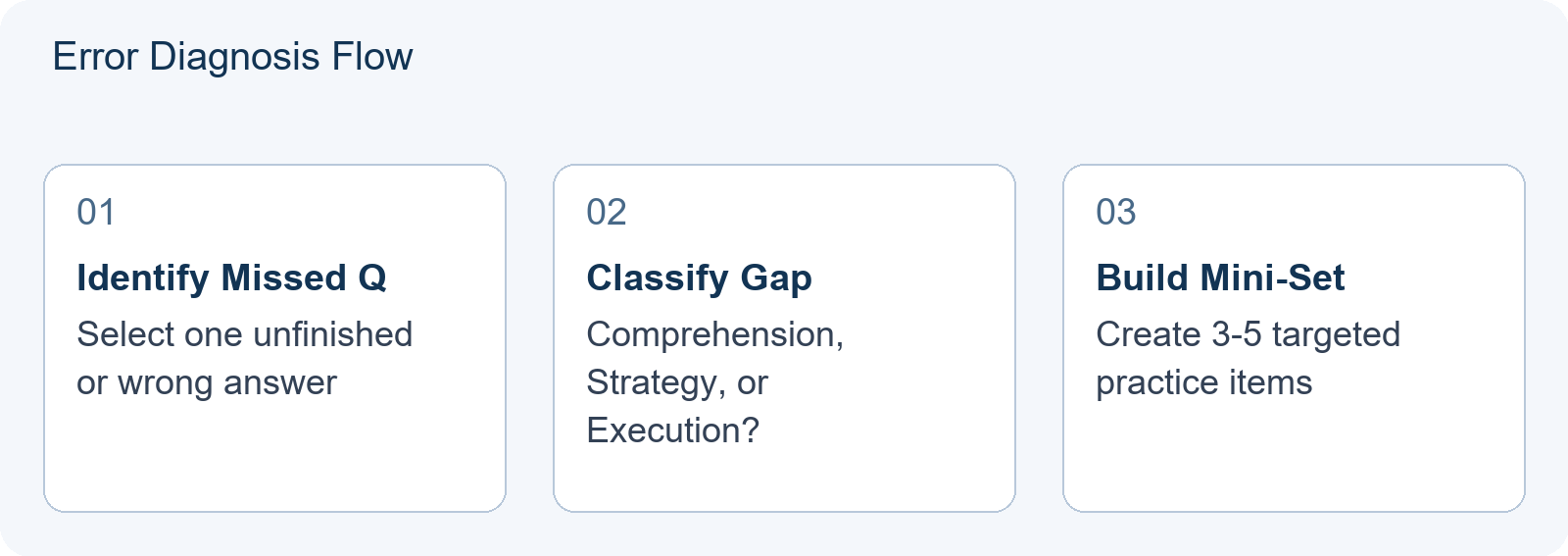
The Australian Mathematics Competition (AMC) China region exam took place on October 11, 2026. For many families, the immediate aftermath involves checking answers and estimating scores. However, a higher-value activity is analyzing Australian AMC missed questions not as failures, but as diagnostic data. A single unfinished or incorrect solution can reveal precise gaps in logic, calculation speed, or conceptual understanding. This article explains how to transform one such question into a focused practice set, helping students prepare for future competitions like the upcoming AMC8 in January 2027.
Why One Question Matters More Than Ten
Students often feel pressured to solve entire past papers under timed conditions. While a fresh full timed test has value for checking transfer, broad unfocused drilling can obscure specific weaknesses. If a student misses ten questions, they might attribute it to “lack of time” or “difficulty.” But if they analyze one missed question deeply, they can form a testable hypothesis about whether the issue was a misread condition, a flawed strategy, or a computational error. Targeted repair lets you test whether you have corrected a particular error before attempting another whole paper. The goal is not to re-solve the problem immediately, but to understand the mechanism the failure suggests—a hypothesis to test with follow-up practice, not a certainty drawn from one error.
The Diagnostic Framework: Three Layers of Error
To turn a missed question into a practice set, categorize the error into one of three layers:
- Comprehension Gap: Did the student misunderstand what the question asked? This is common in word problems where key constraints are overlooked.
- Strategy Gap: Did the student choose an inefficient method? For example, using brute-force counting instead of combinatorial principles.
- Execution Gap: Did the student know the right approach but make a calculation or transcription error?
Each layer requires a different type of practice. Comprehension gaps need reading-aloud exercises; strategy gaps require comparing multiple solution paths; execution gaps demand timed drill sets on similar calculations. Treat this classification as a testable hypothesis: if you guess “strategy gap” but practice does not improve similar problems, revisit whether the root was comprehension.
Worked Teaching Illustration: Grid-Divided Rectangle Areas
Teaching illustration—hypothetical problem based on common competition structures, not an official Australian AMC question.
Problem: A rectangle is divided into four smaller rectangles by one vertical and one horizontal line. The areas of three small rectangles are given: top-left = 2, top-right = 4, and bottom-left = 3. What is the area of the bottom-right rectangle?
Student’s Attempt: The student added 2 + 4 + 3 = 9 and guessed the fourth area was 9, assuming some kind of total conservation. They ran out of time trying to draw more cases.
Diagnosis: This suggests a Strategy Gap. The student failed to recognize the proportional relationship inherent in grid-divided rectangles. They treated it as an additive puzzle rather than a multiplicative one.
Why the ratio works: Let the vertical divider create columns of widths c₁ and c₂, and the horizontal divider create rows of heights r₁ and r₂. Then:
- Top-left: c₁ × r₁ = 2
- Top-right: c₂ × r₁ = 4
- Bottom-left: c₁ × r₂ = 3
- Bottom-right: c₂ × r₂ = ?
From the first two equations, the ratio of column widths is c₂/c₁ = 4/2 = 2. From the first and third, the ratio of row heights is r₂/r₁ = 3/2. The bottom-right area equals c₂ × r₂ = (c₂/c₁) × (r₂/r₁) × (c₁ × r₁) = 2 × (3/2) × 2 = 6. This derivation shows why the cross-multiplication rule holds: the shared dimensions cancel in a way that links all four areas.
Non-integer case: The same logic applies when numbers do not yield a whole number. Suppose top-left = 3, top-right = 5, and bottom-left = 7. Let the unknown bottom-right area be x. By the cross-multiplication rule:
3x = 5 × 7 = 35, so x = 35/3.
This can also be seen from the row-height and column-width ratios: the column-width ratio is c₂/c₁ = 5/3 and the row-height ratio is r₂/r₁ = 7/3, giving bottom-right area = (5/3) × (7/3) × 3 = 35/3.
Focused Practice Set:
- Concept Reinforcement: Solve three problems using the cross-multiplication rule, showing the setup equation each time. Example 1: top-left = 2, top-right = 4, bottom-left = 3, find bottom-right. Setup: 2 × ? = 4 × 3 = 12, so ? = 6. Example 2: top-left = 3, top-right = 6, bottom-left = 4, find bottom-right. Setup: 3 × ? = 6 × 4 = 24, so ? = 8. Example 3 (non-integer): top-left = 3, top-right = 5, bottom-left = 7, find bottom-right. Setup: 3x = 5 × 7 = 35, so x = 35/3.
- Visual Mapping: Draw five different grids with labeled areas and verify the cross-multiplication rule (Area₁ × Area₄ = Area₂ × Area₃). Test: TL=5, TR=10, BL=7, BR=? → 5 × ? = 10 × 7 = 70, so BR = 14.
- Speed Drill: Complete five similar problems in under 10 minutes, focusing on recognizing the pattern instantly without drawing full diagrams. Include a case with decimals: TL=1.5, TR=3, BL=2.5, BR=? Setup: 1.5 × ? = 3 × 2.5 = 7.5, so ? = 5.
Contrasting Case: When Superficial Fixes Fail
Teaching illustration—hypothetical scenario based on common coaching observations.
Consider a student who misses a geometry question involving angles in a circle. They correctly identify that they forgot the theorem “angle at the center is twice the angle at the circumference.” Their fix is to memorize the theorem. They then encounter a new problem where the diagram is rotated, and the relevant angles are not obviously centered. They fail again.
Why it failed: The student addressed a knowledge gap but not the strategy gap. They didn’t learn how to find the center or identify which arcs correspond to which angles. A better practice set would include problems where the center is hidden, requiring auxiliary lines, rather than just standard textbook diagrams. This contrast shows why labeling the gap type matters: misdiagnosis leads to misdirected practice. The initial “knowledge gap” was only a hypothesis; the failed follow-up test disproved it and pointed to the true strategy gap.
Building Your Own Practice Set from Official Resources
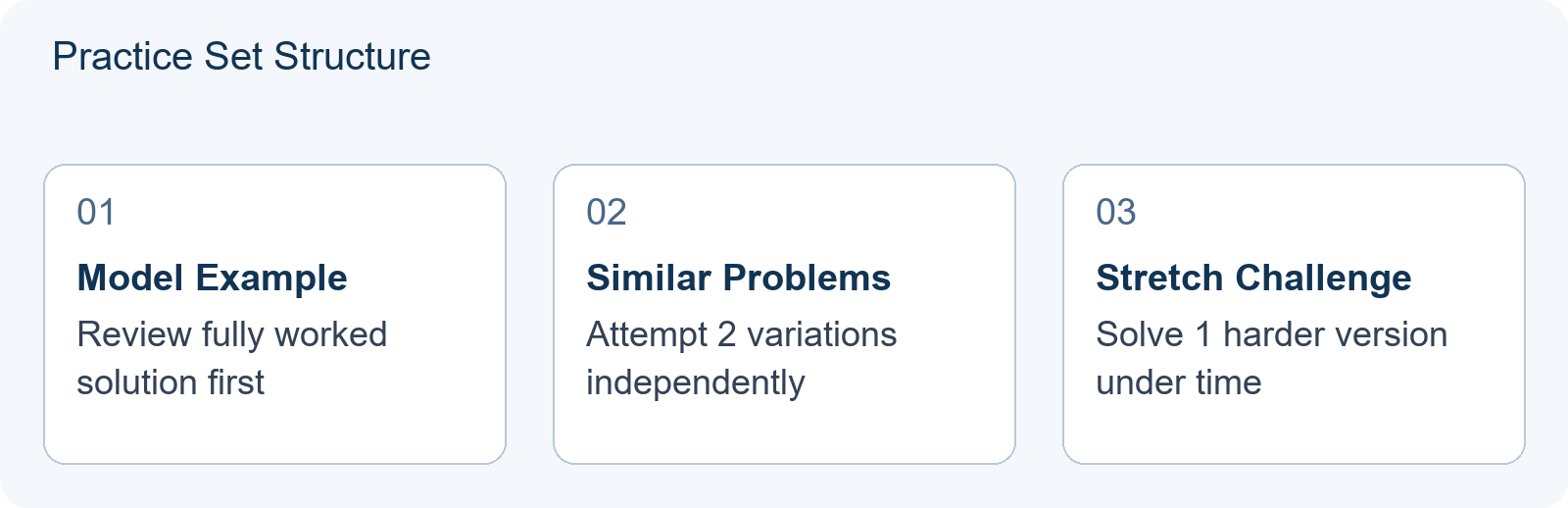
You do not need external downloads to build these sets. Use the official AMT structure and available past papers. For instance, if a student struggles with number theory questions (common in Levels C-E), create a mini-set of five questions from previous years that share the same concept—such as divisibility rules or remainders—but vary in complexity. Start with a known solved example, then attempt two similar ones, and finally tackle one harder variant. This scaffolding ensures confidence builds alongside skill.
For systematic error tracking, see our guide on The Error Log That Earns Marks: A Weekly Repair Method for the Weeks Before 11 October (2026). For students transitioning to other competitions, our article on Australian AMC to AMC8 transition: From Australian AMC October to AMC8 January: A Three-Month Skill Bridge discusses how skills transfer across formats.
What Next? From Analysis to Action
After identifying your missed questions, schedule targeted practice sessions within two weeks. Do not wait for results to be released. Implement the focused practice sets described above, treating your initial diagnosis as a testable hypothesis. Once specific gaps are repaired, a fresh full timed test can check whether the learning transfers to new problems. Remember, the value of a missed question lies not in the lost marks, but in the insight it provides into your thinking process. By turning one unfinished solution into a structured learning opportunity, you build resilience and precision for future competitions.
From Diagnosis to Drill: A Concrete Practice Protocol
Once a student identifies the Strategy Gap in a grid-rectangle problem—such as failing to see that Area(TL) × Area(BR) = Area(TR) × Area(BL)—the next step is not just to re-solve the same question, but to build a specific drill set. This protocol transforms a single error into a targeted repair cycle.
Step 1: The Verification Check (5 Minutes)
Before attempting new problems, the student must verify their understanding of the ratio principle using the original failed example. If the missed question was: Top-Left = 2, Top-Right = 4, Bottom-Left = 3, find Bottom-Right.
- Action: Write down the relationship: .
- Calculation: , so .
- Reflection: Ask, “Why did I add instead?” The answer should be: “I treated areas as independent quantities rather than products of shared dimensions.” This verbalization cements the conceptual shift.
Step 2: The Scaffolded Drill Set (15 Minutes)
Create three new problems with increasing complexity. Do not use official past papers for this immediate drill; use simple integer values to isolate the strategy from calculation noise.
- Basic Ratio: TL=3, TR=6, BL=4. Find BR.
Solution: .
Focus: Recognizing that doubling the top-right area doubles the bottom-right area if the left column stays constant. - Fractional Result: TL=5, TR=7, BL=2. Find BR.
Solution: .
Focus: Comfort with non-integer answers. Many students hesitate here, assuming they made an error because the result isn’t whole. This builds confidence in decimal/fraction outputs. - Reverse Engineering: Given TL=4, BR=9, and TR=6, find BL.
Solution: .
Focus: Flexibility in applying the cross-multiplication rule regardless of which variable is missing.
Step 3: The Transfer Test (10 Minutes)
After completing the drill, attempt one problem from a different context that uses the same underlying logic: proportional reasoning in rectangles. For example, a problem involving similar triangles or scaled maps where side lengths are given instead of areas. The goal is to confirm that the student can recognize “shared dimension ratios” outside the specific grid format. If they succeed, the Strategy Gap is likely closed. If they struggle, revisit Step 1 to ensure the core concept of multiplicative relationships is fully internalized before moving on.
Frequently Asked Questions
Should I redo the whole paper after finding mistakes?
Not immediately. Focus first on targeted practice for specific concepts linked to your missed questions. Later, a fresh full timed test checks whether learning transfers to new problems.
How many practice questions should I create per missed item?
Aim for 3-5 questions. One model, two similar, and one stretch challenge is a balanced set.
Can I use AI to generate these practice sets?
Yes, but verify accuracy. Always cross-check generated solutions against official methods or teacher guidance.