
The Direct Answer: Area Scales with the Square of Length
When every length in a two-dimensional figure is scaled by the same multiplicative factor, the area changes by the square of that factor. Double every length, and the area becomes four times as large—not two. This follows from the definition of area as a product of two lengths. If a rectangle has base b and height h, its area is A = b × h. After doubling both dimensions, the new area is (2b) × (2h) = 4bh = 4A. The factor of 4 is k² for scale factor k = 2.
This principle is foundational for geometry work across all Australian AMC levels, often embedded in word problems where students must compare original and scaled figures.
Why Students Confuse Length and Area Scaling
The error typically arises from two sources. First, everyday language treats “twice as big” ambiguously—sometimes meaning length, sometimes meaning overall size. Second, linear intuition is stronger than multiplicative intuition: a student can visualise a line becoming longer more easily than a region becoming more covered.
In competition settings, this confusion costs marks on problems that appear simple once unpacked. A student who doubles a single side of a rectangle and expects doubled area may then misallocate time on harder questions, not realising the earlier error.
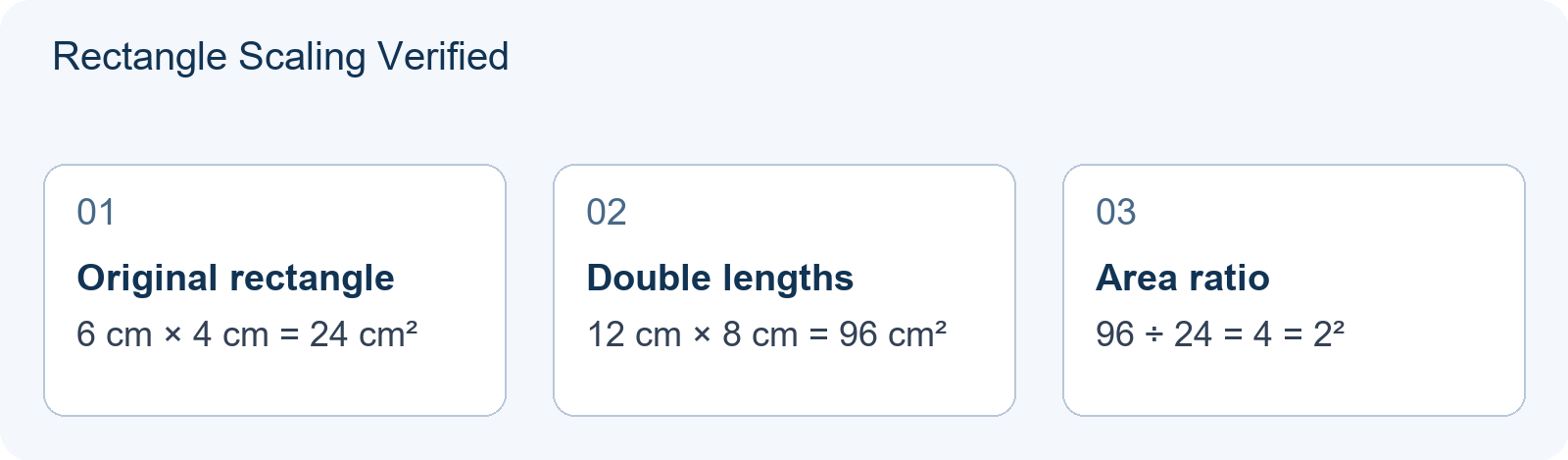
Worked Teaching Case: Verified Rectangle and Triangle Scaling
Case 1: Rectangle
Consider a rectangle with base 6 cm and height 4 cm.
- Original area: 6 × 4 = 24 cm²
- After doubling both lengths: base 12 cm, height 8 cm
- New area: 12 × 8 = 96 cm²
- Ratio: 96 ÷ 24 = 4
Verification: (2 × 6) × (2 × 4) = 4 × (6 × 4) = 4 × 24 = 96. The arithmetic checks.
Case 2: Right Triangle
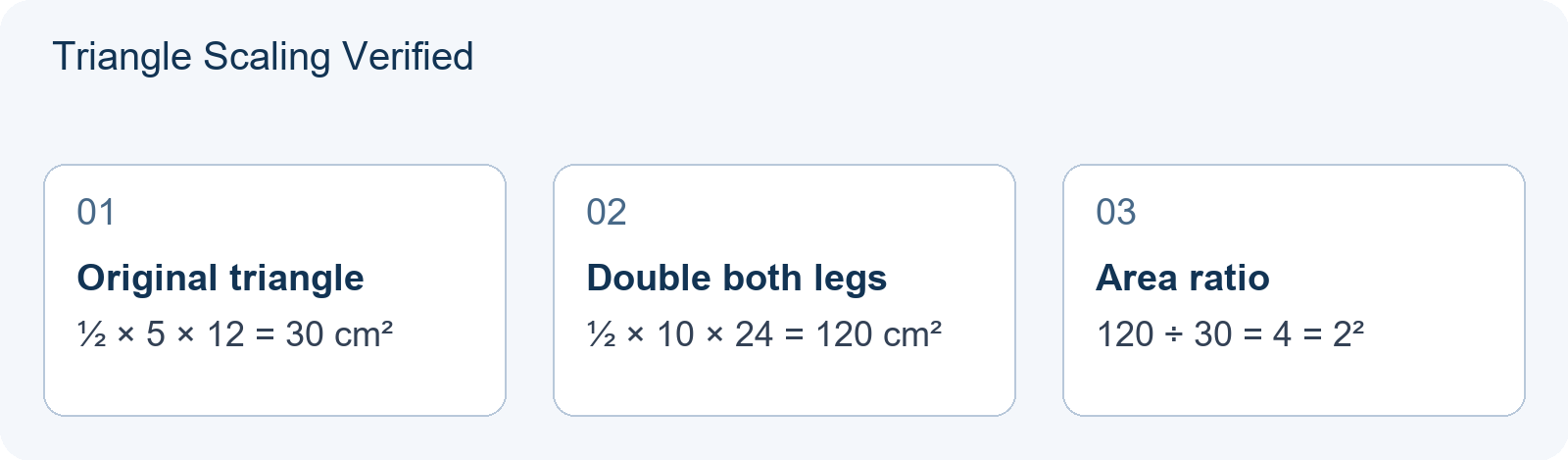
Consider a right triangle with legs 5 cm and 12 cm.
- Original area: ½ × 5 × 12 = 30 cm²
- After doubling both legs: 10 cm and 24 cm
- New area: ½ × 10 × 24 = 120 cm²
- Ratio: 120 ÷ 30 = 4
Verification: ½ × (2 × 5) × (2 × 12) = 4 × [½ × 5 × 12] = 4 × 30 = 120. The factor of ½ is unaffected by scaling; the squared factor k² = 4 still applies.
These cases illustrate that the scaling rule depends on dimensionality, not on specific shape. Any figure whose dimensions are all scaled by factor k has its area multiplied by k².
Contrasting Case: Adding Length Versus Scaling Length
Case 3: Why Adding a Constant Is Not Scaling
Uniform scaling requires multiplying every length by the same factor k. Adding a fixed absolute amount to each side is a fundamentally different transformation—and it does not produce a fixed multiplicative factor.
Take a square with side 2 cm. Adding 3 cm gives side 5 cm.
- Original area: 2 × 2 = 4 cm²
- New area: 5 × 5 = 25 cm²
- Ratio: 25 ÷ 4 = 6.25
Now take a square with side 6 cm. Adding the same 3 cm gives side 9 cm.
- Original area: 6 × 6 = 36 cm²
- New area: 9 × 9 = 81 cm²
- Ratio: 81 ÷ 36 = 2.25
The same absolute addition (3 cm) yields area ratios of 6.25 and 2.25—demonstrating that there is no fixed multiplicative relationship. The larger starting square sees a smaller relative gain. Addition and multiplication commute differently with area. This contrast is pedagogically important: competition problems may present additive changes to test whether students mistakenly apply multiplicative rules where they do not belong.
Case 4: One-Dimensional Scaling of a Two-Dimensional Measure
Consider the same 6 cm × 4 cm rectangle, but now only the base is doubled while the height stays fixed.
- Original area: 24 cm²
- New dimensions: 12 cm × 4 cm
- New area: 48 cm²
- Ratio: 2, not 4
This is a legitimate scaling, but only one dimension changed. The area scales by k (not k²) because the transformation was one-dimensional. Some problems require students to identify which dimensions were scaled and which were not.
Diagnostic Application: Three Quick Checks
Use these checks to determine whether area scaling is solid in your current preparation or needs targeted work.
Check 1: The Square Test
A square has area 49 cm². Each side is tripled. What is the new area?
Reasoning: Original side = √49 = 7 cm. New side = 21 cm. New area = 21² = 441 cm². Alternatively, area scales by 3² = 9, so 49 × 9 = 441. If you obtained 147 (49 × 3), the error is length-area confusion.
Check 2: The Triangle Trap
A triangle has base 8 cm and height 6 cm. Only the base is doubled. By what factor does the area change?
Reasoning: Original area = ½ × 8 × 6 = 24 cm². New area = ½ × 16 × 6 = 48 cm². Factor = 2. The trap is applying 4 (2²) because “doubling” was mentioned; only one dimension changed.
Check 3: The Reverse Problem
A rectangle’s area increases from 20 cm² to 180 cm² under uniform scaling. By what factor was each length multiplied?
Reasoning: Area ratio = 180 ÷ 20 = 9. Since area scales as k² under uniform scaling (geometrically similar figures), we have k² = 9, so k = 3. Each length was tripled.
Critical caveat: The premise of uniform scaling is essential. Without it, the problem is underdetermined—there are infinitely many non-uniform transformations (changing length and width by different factors, or adding constants, or applying non-linear distortions) that could also produce an area change from 20 to 180. The inference k = 3 is valid only because we assume all lengths are multiplied by the same factor.
What Your Diagnostic Result Means for Next Steps
If you made Check 1 or Check 3 errors: The core concept of squared scaling is not yet secure. Priority work includes deriving the rule from first principles (area as product of lengths), then practising with varied shapes—triangles, parallelograms, composite figures—until the pattern is automatic. Australian AMC Geometry, Decoded: Shapes, Angles, and Spatial Reasoning (Grades 3-12) covers the broader geometry foundation that supports this scaling work.
If you made Check 2 errors only: You understand k² scaling but struggle to parse which dimensions changed. This is a reading-comprehension gap in geometry contexts, not a conceptual gap. Practice identifying explicit and implicit dimension changes in word problems. The Maths Isn’t the Hard Part: Extracting the Condition from Australian AMC Word Problems (2026) addresses this parsing skill directly.
If all checks were correct: Area scaling is secure at the procedural level. Next, integrate it with perimeter and volume scaling (volume scales as k³) in mixed problems, and watch for questions that combine scaling with percentage change or ratio reasoning. Ratios, Rates and Percentages: Beating the Australian AMC’s Word Problems (Grades 1-12) provides relevant cross-topic practice.
Extending the Principle: Perimeter, Area, and Volume Together
Competition problems rarely test area scaling in isolation. More commonly, they require students to move between related quantities. Consider a cube whose edge length is doubled:
- Edge length scales by k = 2
- Face diagonal scales by k = 2 (one-dimensional)
- Surface area scales by k² = 4 (two-dimensional)
- Volume scales by k³ = 8 (three-dimensional)
Problems may present a solid and ask for the ratio of surface areas after a scaling described in words. The disciplined approach is to identify the dimensionality of the quantity requested, then apply the corresponding power of k.
Another common variant: a figure is scaled by factor k, and the student must find the ratio of perimeters. Since perimeter is a sum of lengths (one-dimensional), it scales as k¹, not k². This creates a natural triplet for verification: if perimeter ratio is 3 and area ratio is 9, then k = 3 is consistent; if the two ratios do not satisfy this relationship, either the scaling was not uniform or an error has occurred.
Practical Application: The “Cut and Paste” Area Conservation Trap
While scaling problems test multiplicative reasoning, Australian AMC geometry questions frequently employ a different trap: area conservation under rearrangement. Students often assume that if the perimeter changes, the area must change proportionally. This is false. A figure can be cut into pieces and reassembled into a new shape with a completely different perimeter but identical area.
This distinction is critical because it reverses the logic of scaling. In scaling, lengths change by factor k, so area changes by k². In rearrangement (dissection), the total amount of surface material remains constant, so area stays fixed while boundary lengths shift. Competition problems exploit this by asking students to calculate an unknown dimension after a shape has been “stretched” or “compressed” via cutting and pasting, where no uniform scale factor exists.
Teaching Illustration: The Rectangle Rearrangement
Consider a rectangle with dimensions 10 cm × 6 cm. Its area is 60 cm² and its perimeter is 32 cm.
Now, imagine cutting this rectangle along its diagonal to form two right-angled triangles. These two triangles can be rearranged to form a parallelogram. Let us construct a specific case:
- Take the two triangles (base 10, height 6).
- Join them along their hypotenuses? No, that returns the original rectangle.
- Instead, join them along their shorter legs (length 6). The resulting shape is a larger triangle with base 20 cm and height 6 cm.
Verification of Area:
- New Triangle Area: ½ × 20 × 6 = 60 cm².
- Original Rectangle Area: 10 × 6 = 60 cm².
- Result: Area is conserved.
Verification of Perimeter:
- Original Rectangle Perimeter: 2(10 + 6) = 32 cm.
- New Triangle Sides: Base = 20 cm. The other two sides are the hypotenuses of the original triangles. Hypotenuse = √(10² + 6²) = √(100 + 36) = √136 ≈ 11.66 cm.
- New Perimeter: 20 + 11.66 + 11.66 ≈ 43.32 cm.
The perimeter increased by over 35%, yet the area remained exactly the same. If a student incorrectly applies linear scaling intuition here—assuming a longer boundary implies more space—they will fail to solve for missing dimensions in dissection problems.
Diagnostic Check: Identifying the Transformation Type
To avoid this error, students must classify the transformation before calculating:
- Uniform Scaling: All lengths multiplied by k. Area scales by k². Perimeter scales by k.
- Rearrangement/Dissection: Pieces are moved without overlap or gap. Area is constant (k=1 for area). Perimeter changes unpredictably based on which edges are joined.
- Non-Uniform Stretching: One dimension scaled, another fixed. Area scales by k. Perimeter changes non-linearly.
In AMC Level C-E papers, look for keywords like “cut,” “reassemble,” “fold,” or “overlap.” These signal area conservation or partial overlap subtraction, not simple scaling. Conversely, words like “enlarged,” “reduced,” or “similar” signal uniform scaling. Misidentifying the operation leads to applying the wrong power of k or ignoring the invariant area.
Practice this by taking any polygon, dissecting it into triangles, and reassembling them into a different convex shape. Calculate both areas to confirm they match, then compare perimeters. This builds the intuition that shape flexibility does not imply area flexibility.
Frequently Asked Questions
Does the area scaling rule apply to all shapes or only rectangles and triangles?
The rule applies to any two-dimensional figure. When all lengths are scaled by factor k, area scales by k². This follows from area being a product of two lengths. The rectangle and triangle cases are worked examples; the principle extends to circles (where radius scales linearly and area by k²), polygons, and irregular figures.
Why is adding a constant to side lengths different from scaling?
Uniform scaling requires multiplying every length by the same factor k. Adding a fixed absolute amount is a different transformation entirely. As shown in Case 3, adding 3 cm to a 2 cm side gives a ratio of 6.25, but adding the same 3 cm to a 6 cm side gives a ratio of only 2.25. There is no fixed multiplicative factor—proving this is not uniform scaling. Always verify whether a problem describes multiplicative scaling or additive modification.
How does area scaling connect to volume scaling for three-dimensional figures?
Volume scales as k³ when all lengths are scaled by k, since volume is a product of three lengths. This creates a natural progression: length (k¹), area (k²), volume (k³). Problems sometimes require students to move between these dimensions, particularly involving containers, packing, or spatial reasoning. Perimeter, being a sum of lengths, scales as k¹.