
The Australian Mathematics Competition (AMC) added a Pre-A level in 2026 for Grade 1 and Grade 2 students. For many families, this is the first formal mathematics competition their child has sat. A common misunderstanding is that Pre-A is simply the older A-E paper with five questions removed. It is not. Pre-A has its own 25-question, 100-mark structure, and its final five questions have a different mark pattern from the A-E levels.
Now that the 2026 sitting is behind us, parents reviewing a child’s experience or planning the next stage need one clear map: where the 100 marks sit. This article breaks down the Pre-A scheme, shows why the first 20 questions already account for 70 marks, and uses an illustrative 80/100 score scenario—not an official rule—to help prioritise accuracy, reading and pace for a young learner.
The 100-mark map: how 25 questions reach 100
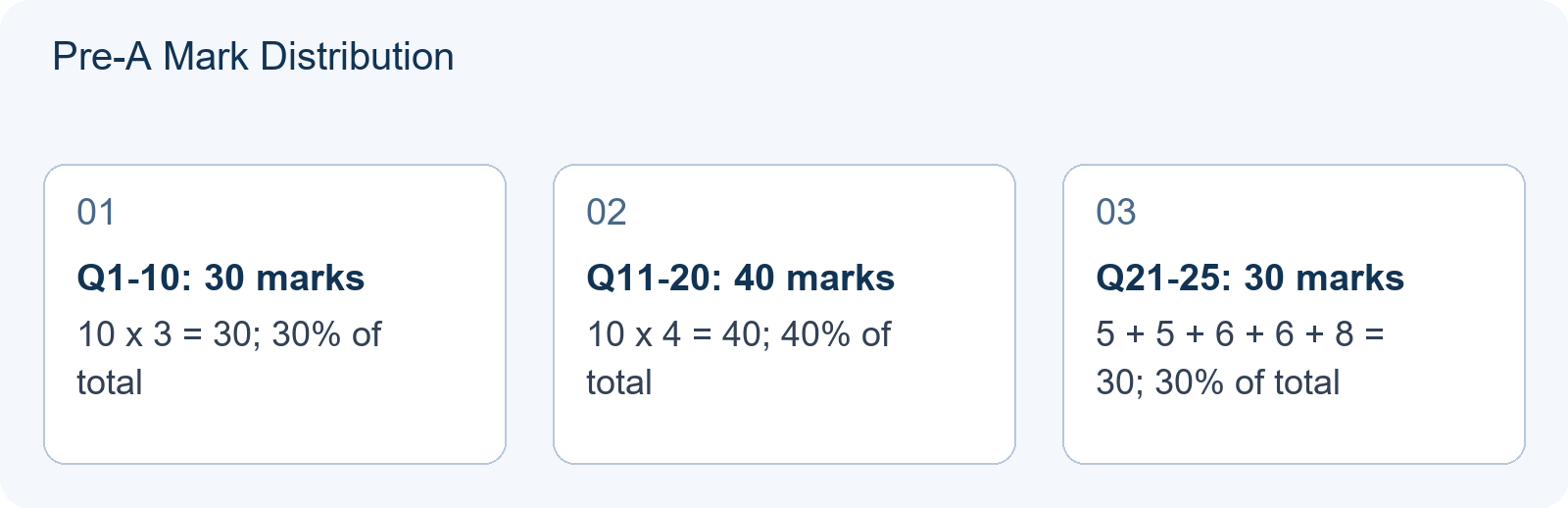
The supplied 2026 exam-day note describes the Pre-A paper as 25 questions with a maximum score of 100 marks. The weights are not uniform. They rise in five steps:
- Questions 1-10: 3 marks each, for a total of 30 marks.
- Questions 11-20: 4 marks each, for a total of 40 marks.
- Questions 21-22: 5 marks each, for a total of 10 marks.
- Questions 23-24: 6 marks each, for a total of 12 marks.
- Question 25: 8 marks.
Add the five tiers: 30 + 40 + 10 + 12 + 8 = 100. The structure is top-heavy at the end, but the end weighting is concentrated into five questions: 5, 5, 6, 6 and 8. Q25 is worth 8 marks, while Q23 and Q24 are worth 6 each. The last five questions together are worth 30 marks, exactly the same as the first ten questions combined.
This is the first reason Pre-A is not just a smaller A-E paper. The A-E levels use 30 questions and 135 marks. Their first 20 questions also carry 70 marks, but their Q21-25 and Q26-30 create a different endgame. For Pre-A, the endgame is concentrated into five questions: 5, 5, 6, 6 and 8.
Why the first 20 questions carry 70 marks
Before a child reaches Q21, the paper has already offered 70 marks. Q1-10 provide 30 marks, and Q11-20 provide another 40. That is 70% of the total score available from the first 20 questions.
For a Grade 1-2 student, this matters because the early and middle sections are often where pace, reading and careful handling decide the score. Even if the later questions are harder, a child who loses several early questions can lose a large share of the total. One Q1-10 question is 3 marks; one Q11-20 question is 4 marks. Missing three middle questions costs 12 marks, more than missing Q25. Missing five middle questions costs 20 marks, which is the same as the entire Q23-25 block.
That arithmetic does not mean later questions are unimportant. It means practice time should not be organised around the assumption that only the final five questions matter. A balanced plan should protect the first 20 marks first, then build toward the final five. For the read-aloud format and Pre-A practice routines, see Preparing for a Read-Aloud Paper: How Pre-A Practice Works for Grades 1-2 (2026).
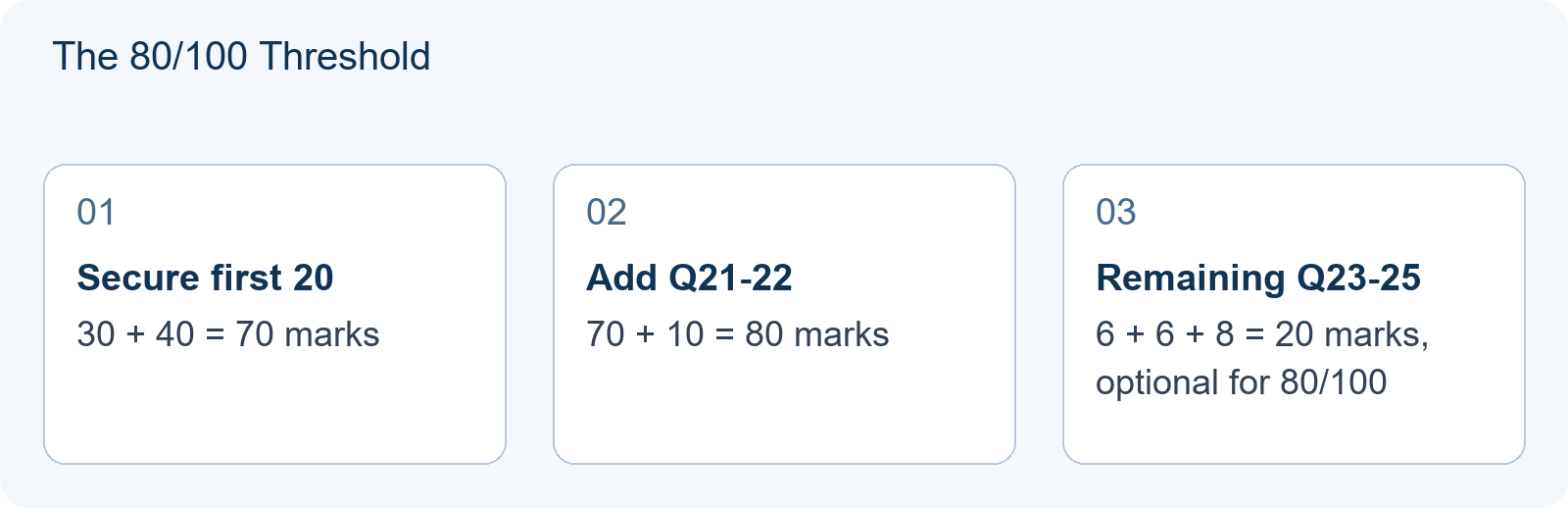
A labelled teaching illustration: the 80/100 threshold
The following is a teaching illustration, not a real contest problem or official scoring rule. It shows how the mark weights combine for a hypothetical student.
Suppose a student answers all first 20 questions correctly and also gets Q21 and Q22 correct. The score is:
- Q1-10: 10 x 3 = 30 marks
- Q11-20: 10 x 4 = 40 marks
- Q21-22: 2 x 5 = 10 marks
- Total: 30 + 40 + 10 = 80 marks
At that point, the remaining Q23, Q24 and Q25 are worth 6 + 6 + 8 = 20 marks. If the student leaves them blank, the score remains 80/100. This is the 80/100 threshold: a child can secure four-fifths of the paper without solving the three hardest weighted questions.
Now compare a different hypothetical case. Suppose a student gets all first 10 questions correct (30 marks), only five of Q11-20 correct (5 x 4 = 20 marks), and then answers all Q21-25 correctly (5 + 5 + 6 + 6 + 8 = 30 marks). The total is 30 + 20 + 30 = 80 marks. Losing five middle questions costs 20 marks, but a perfect finish can still bring the score back to 80/100. Conversely, if a child loses five middle questions and also struggles at the end, the score falls quickly. The middle section is therefore not a waiting room before the real questions; it is a scoring engine.
Parents can use this threshold in a low-pressure way: If you get the first 22 right, you have already done very well. That reframes the goal from solving everything to securing the marks you can control.
No penalty: what it does and does not change
All Australian AMC levels, including Pre-A, use a no-penalty rule. Incorrect answers and unanswered questions do not deduct marks. This is confirmed in the supplied 2026 exam-day note for all levels.
The rule removes the fear of a wrong answer, but it does not make guessing a strategy. A child who guesses without reading carefully may still lose the chance to earn marks on questions they could have solved. For young learners, the more useful lesson is: attempt the question if you understand it, and do not spend five minutes on one item while easier marks remain untouched. If a child can eliminate clearly impossible answers, that is useful reasoning practice. But the no-penalty rule should not be taught as any answer is as good as any other.
No penalty also changes the review conversation. A blank answer is not a failure; it is information. It may mean the child ran out of time, did not understand the wording, or did not know the concept. A wrong answer may mean the same things. The next step is to sort the reason, not just count the score.
A practical diagnostic: sorting errors into three buckets
After a mock paper or past-paper practice, parents can classify mistakes into three buckets. This is a teaching suggestion, not an official AMC diagnosis.
- Reading and handling: The child understood the mathematics but misread the question, lost the place, or marked the wrong answer. For Pre-A, read-aloud practice and underlining key words can help.
- Concept gap: The child did not know how to approach the question type. The fix is a short, targeted mini-lesson, not a full return to the whole syllabus.
- Pace issue: The child knew enough but ran out of time. The fix is timed practice on the first 20 questions, where 70 marks are available, before adding longer final-question work.
For example, if a child repeatedly misses Q11-20, the cause may be multi-step reading rather than calculation. If a child misses Q1-10, the cause may be handling and speed rather than difficulty. If a child finishes the first 20 quickly but cannot start Q23-25, the issue is endurance with unfamiliar problems. Each pattern suggests a different practice plan.
When reviewing, ask the child to explain the question in their own words before showing any method. This separates reading from mathematics. It also protects confidence: the child sees that some lost marks were not about being bad at maths but about missing a condition.
Rehearsing pace without turning practice into algebra lessons
Grade 1-2 students do not need abstract algebra to prepare for Pre-A. Their pace problems usually come from slow counting, uncertain number bonds, or hesitation in reading a question. A useful routine is a short timed burst on the first 10 questions. The goal is not to rush; it is to notice where time disappears.
Try a 10-minute sprint on Q1-10. If the child finishes early, check accuracy. If the child takes longer, ask what caused the delay: reading, drawing, counting, or deciding what to do. Then practise that one bottleneck. This is more effective than assigning a full 25-question paper every day.
For the middle section, use small sets of Q11-20 questions and ask the child to say the condition aloud before solving. The arithmetic is usually not the main obstacle; the condition is. For the final section, do not begin with Q25. Begin with Q21-22, which are worth 5 marks each, then Q23-24 at 6 marks each. Q25 is the single 8-mark item, but it should not dominate practice time.
Parents should also rehearse the paper’s mark shape. A child who knows that the first 20 questions are worth 70 marks can learn to check those answers before chasing the final five. That is not gamesmanship; it is basic exam awareness. At this age, the habit should be simple: answer, check the question, check the mark, move on.
Conclusion: build confidence with the mark shape
The Pre-A level is the 2026 Australian AMC division for Grade 1-2 students. Its 100-mark paper is not a shortened A-E paper. It has 25 questions, weights of 3, 4, 5, 6 and 8, and no penalty for wrong or blank answers. The first 20 questions carry 70 marks; adding Q21-22 reaches 80; the final three questions carry the last 20 marks.
That mark shape gives parents a practical priority order: protect the first 20 questions, build reading and handling accuracy, then extend into the final five without treating them as the only meaningful part of the paper. For a coaching read on how the new Pre-A level affects Levels A and B, see What the New Pre-A Level Changes for Everyone Else: A Coaching Read on Australian AMC Levels A and B (2026). For the distinction between an early-primary pilot and China’s Pre-A, see The 2026 Early-Primary Pilot Is Not China’s Pre-A: What China Families Should Not Assume.
The Australian AMC is organised by AMT, with China operations handled by ASDAN. For Grade 1-2 families, the most valuable outcome is not a perfect score. It is a child who can read a question, choose a strategy, and check work with growing independence.
Frequently Asked Questions
Is Pre-A harder than Level A?
Pre-A is not a shortened A-E paper. It is the 2026 division for Grade 1-2 with 25 questions and 100 marks, while A-E use 30 questions and 135 marks. Difficulty depends on the child’s preparation, but the scoring structure is different.
Do wrong answers lose marks?
No. The supplied 2026 note says incorrect or blank answers carry no deduction at any level, including Pre-A. Students can attempt without penalty, but careful reading still protects marks.
How many questions should my child aim to finish?
Aim for all 25 when comfortable. The first 20 are worth 70 marks, so secure them before spending a long time on Q23-25. The final three are worth 20 marks together.