
After the 11 October 2026 Australian AMC sitting, many families will do what they did before the paper: search for australian amc past papers, download a folder of PDFs, and hope that volume produces readiness. The problem is not effort. The problem is often selection. A paper that does not match the student’s current level and format can produce misleading scores, wasted review time, and unnecessary anxiety.
The 2026 cycle made this filtering step more important because China-region entrants now use six levels: Pre-A, A, B, C, D, and E. Pre-A is new for 2026 and serves Grades 1–2. Levels A–E serve the remaining grade bands and use a different paper shape. Before a student opens a file labelled by year, the family should check the paper’s internal structure. The year on the cover matters less than the level and mark scheme inside.
The Wrong-Paper Trap in Past-Paper Practice
When a student opens a past paper without checking its level shape, the practice session can fail before the first question is read. A Grade 2 student who needs Pre-A practice may open an older Level A paper. That paper may look age-appropriate, but it has 30 questions and a 135-mark total. It is not a Pre-A simulation. A Grade 5 student in Level B may open a Level E paper because it is the newest file in the folder. That paper may contain mathematics far beyond the current syllabus and provide no useful diagnostic information.
The negative effects compound. A mismatched hard paper can look like a knowledge gap when the real issue is format shock. A mismatched easy paper can hide gaps because the student finishes quickly and feels ready. Parents then compare these distorted scores with published award thresholds or historical cutoffs that apply to a different level. The result is noise, not evidence.
The first editorial rule is therefore simple: do not treat every Australian AMC past paper as interchangeable. A paper is useful only after it clears two filters. First, it must match the current level structure. Second, it must match the student’s current level, not the highest year available or the most difficult paper a sibling once used.
First Filter: Identify the Current Level Shape
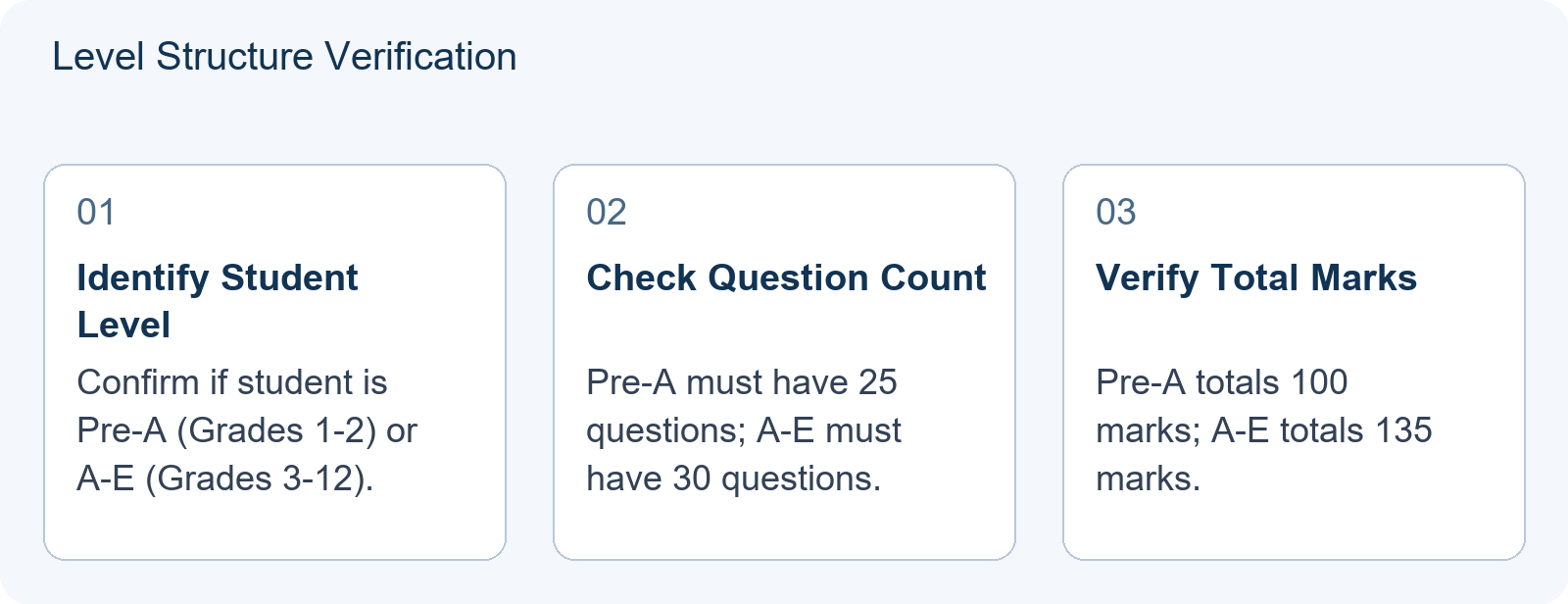
Before reading any question, count the questions and verify the total marks. In the China-region structure described by the source material, the split is clear. Pre-A uses 25 questions and a total of 100 marks. Levels A–E use 30 questions and a total of 135 marks.
The internal scoring also differs. For Pre-A, questions 1–10 are worth 3 marks each, giving 30 marks. Questions 11–20 are worth 4 marks each, giving 40 marks. Questions 21–22 are worth 5 marks each, giving 10 marks. Questions 23–24 are worth 6 marks each, giving 12 marks. Question 25 is worth 8 marks. The total is 30 + 40 + 10 + 12 + 8 = 100 marks.
For Levels A–E, questions 1–10 are worth 3 marks each, giving 30 marks. Questions 11–20 are worth 4 marks each, giving 40 marks. Questions 21–25 are worth 5 marks each, giving 25 marks. Questions 26–30 are worth 6, 7, 8, 9, and 10 marks respectively, giving 40 marks. The total is 30 + 40 + 25 + 40 = 135 marks.
That arithmetic is not a decoration. It changes the practice plan. A Pre-A paper has fewer questions and a different back-end weighting. An A–E paper has five more questions and a demanding final five questions that can shift the score quickly. If the student’s target paper has 30 questions, practising only 25-question papers leaves the pacing and stamina untested. If the student’s target paper has 25 questions, a 30-question paper is not a direct simulation even if the topics overlap.
Because wrong or blank answers do not deduct marks in this structure, practice should include a strong attempt at every question. A blank response in practice is not neutral; it removes a chance to diagnose whether the student can eliminate options, estimate, or recover from a hard item. That habit should be rehearsed before the real paper.
Why Pre-A Is Not an Old Paper with a New Label
Pre-A is a 2026 addition, not a renamed version of an older level. It was created for Grades 1–2 in the China-region structure. That has a practical consequence: there are no historical Pre-A papers from earlier years to download. There are also no historical Pre-A cutoff scores or award thresholds to compare against, because the level did not exist in prior cycles.
Families should not assume that a Level A paper can simply be shortened to 25 questions. The mark values and question design do not make that conversion clean. A Level A paper carries the 30-question/135-mark structure and assumes a different progression. For Pre-A practice, the better approach is to simulate the verified Pre-A shape: 25 questions, 100 total marks, and the published scoring pattern. Use current Pre-A materials when available, and use teacher-made or parent-made practice only when it clearly mirrors that shape.
For older students, the opposite warning applies. Do not use a Pre-A paper as a light warm-up for Levels A–E and then assume the result predicts performance. The question count, total marks, and scoring distribution differ enough that the paper cannot diagnose pace or stamina for a 30-question paper.
Second Filter: Match the Student’s Level, Not the Highest Year
Once the structural shape is verified, match the paper to the student’s current level. A student who has just moved from Level A to Level B should practise Level B papers. Staying on Level A because earlier scores were high may build confidence, but it will not reveal the new level’s demands. Moving to Level D because the file is newer will not provide usable feedback either.
Check the header of every PDF. Does it identify the level? Does it have the correct question count? Does the mark total match the level? If the file uses an old division name or no clear level label, compare it with the current grade mapping before paying for it, printing it, or timing it. The site’s Australian AMC Entry Check: The Grade Error That Hides Inside the Right Level Letter (2026) is useful here because it focuses on the grade error that can hide inside the right level letter.
Recency is not the same as relevance. A 2025 Level B paper is more relevant to a current Level B student than a 2026 Level E paper. A 2023 Level C paper can still be excellent practice if it matches the student’s level and the current structure. The year should be a secondary filter after level and format.
Assessing Difficulty: Too Easy, Usefully Hard, or Demoralising
Not every correctly formatted paper is equally useful. After selecting a level-matched paper, assess how the student handles it. This is a teaching judgment, not an official scoring rule, but it helps decide what to do next.
Too easy: The student finishes comfortably, with high accuracy and time left. The paper may be useful as a confidence check before a competition, but it will not expose much. Do not use too-easy papers as the main diet.
Usefully hard: The student finishes within the chosen practice limit but struggles with the last five to eight questions. Foundational skills are working, and the difficult items reveal where advanced application needs review. These papers deserve full error analysis.
Demoralising: The student cannot make progress and leaves many questions blank even after time is extended. That does not mean the next step is another hard paper. Break the paper into topic blocks. Was the stall caused by geometry, number patterns, logic, or reading load? Repair that specific gap before returning to a full simulation.
Using Selected-Year Solutions Only After an Attempt
One of the easiest ways to waste a past paper is to read the solution before attempting the problem. When families download australian amc past papers with answer keys, the answer key can become a reading exercise instead of a diagnostic tool. The value of the paper is in the attempt, including the struggle to choose a method.
Adopt a strict sequence. First, complete the attempt. Every question should receive a committed answer, even when the student is unsure. Second, score the paper. Third, review only the questions that were wrong or uncertain. For each error, identify whether the cause was a misread condition, a missing concept, a calculation slip, or a pacing failure. Do not simply read the correct method and move on.
Selected-year solutions are better than a large pile of untouched keys. Choose one or two representative years per level. Deep review of one Level C paper can be more valuable than skimming ten papers without repair. For a structured way to revisit a paper, the site’s Australian AMC Past Papers: The Four-Pass Method (and What Old Papers Cannot Tell You) (2026) explains how to reuse a chosen paper instead of collecting more files.
If a student is moving between levels, the review should also check whether the paper belongs to the old or new level. The site’s The Year You Move Up: What Changes When You Cross into a New Australian AMC Level (2026) covers what changes when a student crosses into a new Australian AMC level. That is relevant because a strong score on last year’s level may not transfer automatically to the next level’s pacing and question weighting.
A Three-Step Practice Cycle: Select, Attempt, Repair
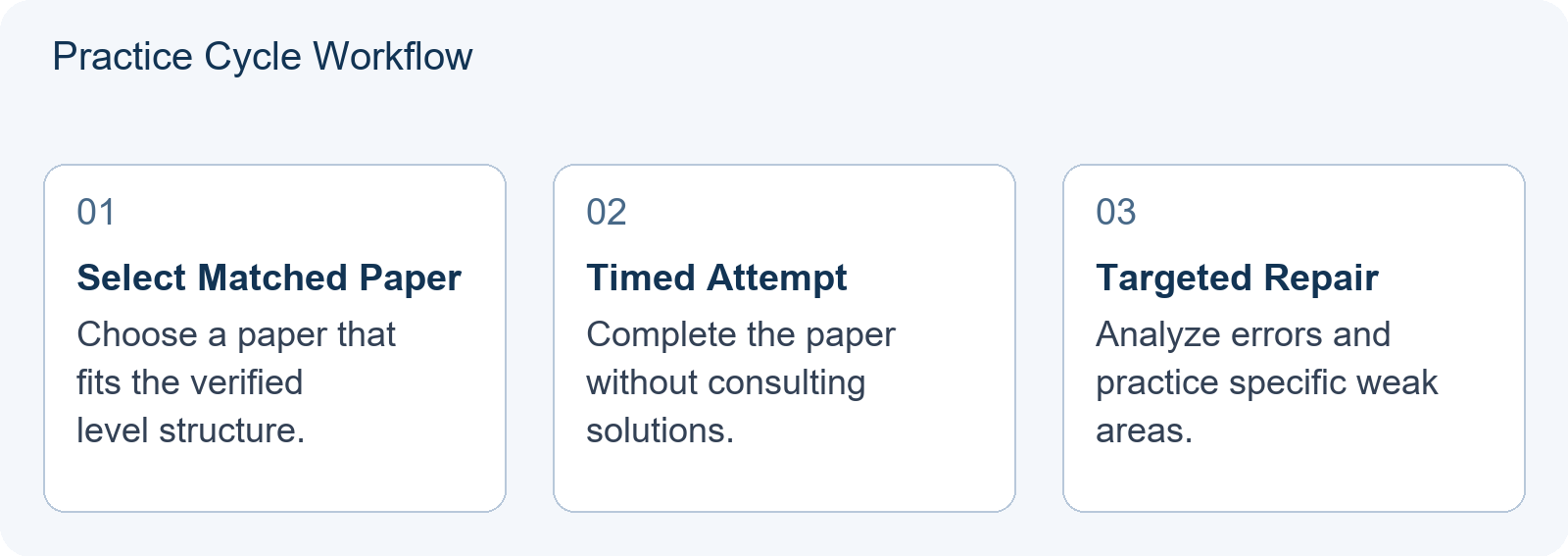
To replace download-and-collect habits, use a three-step cycle for each practice paper.
- Select: Verify the level and format. Confirm whether the paper is Pre-A with 25 questions and 100 marks or A–E with 30 questions and 135 marks. Check that it matches the student’s current level.
- Attempt: Complete the paper without solution access. Use a consistent time limit for practice, and require an answer for every question. The no-penalty rule means blank answers in practice remove diagnostic information.
- Repair: Score the paper and sort errors into careless, conceptual, and pacing categories. Build a short follow-up set from the conceptual and pacing errors. Revisit the same paper after two weeks to test whether the repair held.
A teaching illustration can make the selection step concrete. Suppose a Grade 2 student is preparing for Pre-A. The family finds a 2024 Level A paper. It has 30 questions and a 135-mark total, so it fails the first filter. It should not be used as a Pre-A timed simulation. A better choice is a verified Pre-A paper or a set built to the 25-question/100-mark Pre-A pattern. The same logic applies to a Grade 6 Level C student: a Pre-A paper may be charming and readable, but it cannot test the 30-question stamina or the final-five weighting of Level C.
Conclusion: Fewer Papers, Better Feedback
The goal of using australian amc past papers is not to exhaust an archive. The goal is to create feedback. A level-matched paper gives the student a fair task, gives the parent a meaningful score pattern, and gives the tutor a clear repair target. A mismatched paper gives none of those things reliably.
Start with the structural filter: Pre-A uses 25 questions and 100 marks; Levels A–E use 30 questions and 135 marks. Then apply the level filter: choose the student’s current level, not the newest file or the hardest paper. Finally, protect the attempt. Do not open solutions until every question has an answer.
Families do not need dozens of years. They need a small set of correct-format papers, a repeatable review routine, and the discipline to repair specific errors before moving on. Fewer papers, chosen correctly, produce better preparation than a large folder that mixes levels, formats, and years without a plan.
Frequently Asked Questions
Can I use Level A past papers for Pre-A practice?
No, not directly. Pre-A is a new 2026 level with 25 questions and 100 marks, whereas Level A has 30 questions and 135 marks. The structure and scoring differ significantly, making Level A papers unsuitable for accurate Pre-A simulation.
Are there historical cutoff scores for the Pre-A level?
No. Since Pre-A was introduced in 2026, there are no previous years’ data or official cutoff scores available for comparison. Families should focus on format familiarity rather than benchmarking against non-existent historical awards.
How many past papers should a student practise?
Quality matters more than quantity. Focus on 2-3 level-matched papers per term. Deep analysis of errors from a few papers is more effective than superficial attempts at many unverified or mismatched papers.