
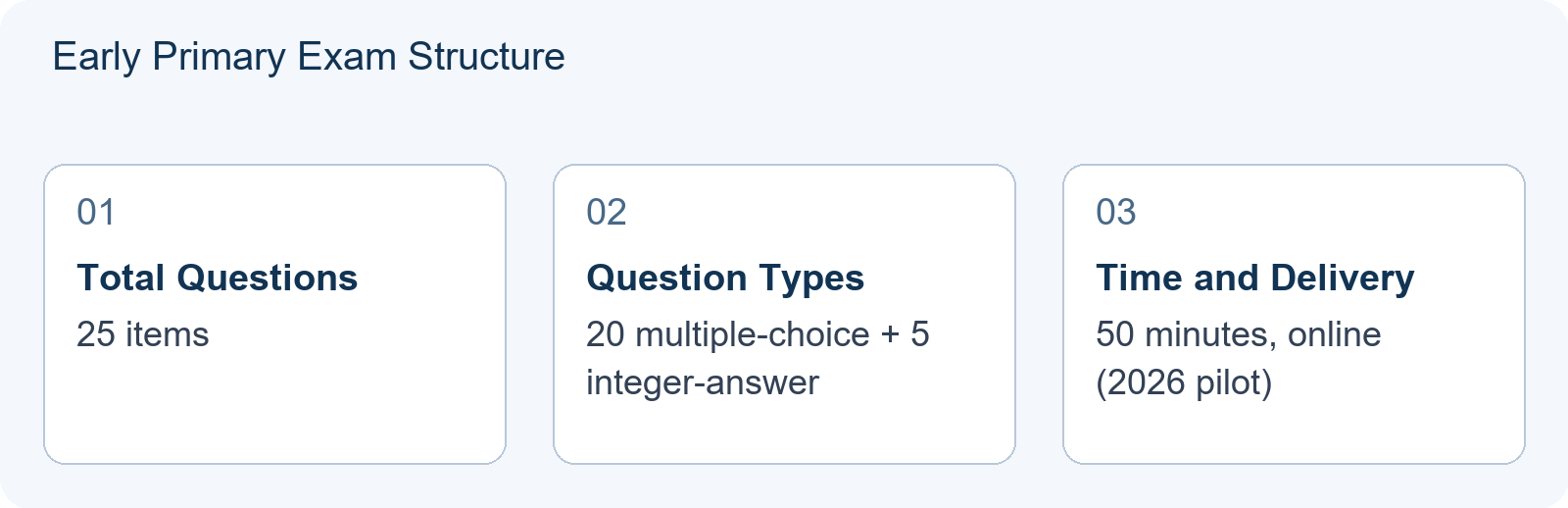
Australian AMC Early Primary is the Australian Maths Trust (AMT) Years 1–2 division for Australian and New Zealand students. The 2026 Early Primary pilot was listed for 12–23 October 2026 and ran as an online assessment: 25 questions, split into 20 multiple-choice and five integer-answer items, in 50 minutes. The AMT’s published overview states that Early Primary joins standard offerings in 2027. It is a separate competition from China’s Pre-A level, even though both serve early-primary learners and both use a 25-question paper.
Search demand for “AMC Early Primary” and “early primary AMC” frequently mixes two distinct programmes. Parents in China see the Chinese region’s Pre-A level described as a Years 1–2 Australian AMC option; parents in Australia and New Zealand see the AMT Early Primary pilot. The formats, administrative rules and scoring evidence differ. This article answers the practical question: how do you prepare a Year 1 or Year 2 child for the Early Primary standard offering as it enters the 2027 season?
What the AMT Overview Confirms About Early Primary
The most authoritative source available at the time of writing (26 October 2026) is the Australian Maths Trust AMC overview. It lists the Early Primary pilot for Australian and New Zealand Years 1–2 with the following confirmed attributes: 25 questions, split into 20 multiple-choice and five integer-answer items; 50 minutes; delivered online. The pilot window was listed as 12–23 October 2026. The same overview confirms that Early Primary joins the standard AMT offerings in 2027.
Two practical consequences follow.
First, the paper is compact but still requires sustained attention for nearly an hour. A Year 1 child sitting a 50-minute online paper has roughly two minutes per question on average, with extra time needed on the integer-answer items, which require reading, computing and typing a number.
Second, integer-answer items are exact-output tasks. There are no options to recognise. For young learners, typing “10” rather than “1O” or “100” is a skill in itself. The preparation goal is not more advanced mathematics — it is dependable reading, correct calculation and clean input under mild time pressure.
The AMT overview does not publish a mark total for the Early Primary pilot. It does state that standard Middle Primary through Senior papers carry 135 marks and no incorrect-answer penalty; that rule is stated for standard papers, not for Early Primary. Families should confirm any scoring rule with the AMT or their registered centre before the 2027 sitting.
Early Primary vs China Pre-A: Two Different Early-Years Papers
China’s Pre-A level, introduced in the China region for 2026, is aimed at Grades 1–2 and uses a 25-question paper worth 100 marks over 50 minutes. The China-region system runs six levels, Pre-A through E, administered on the China calendar. The AMT Early Primary pilot is administered by the AMT for Australian and New Zealand Years 1–2.
| Feature | AMT Early Primary (AU/NZ) | China Pre-A |
|---|---|---|
| Target year or grade | Years 1–2 | Grades 1–2 |
| Season used here | 2026 pilot listed 12–23 Oct; standard AMT offering from 2027 | Introduced in the China region for 2026 |
| Question count | 25 | 25 |
| Question mix | 20 multiple-choice, 5 integer-answer (per AMT overview) | Not itemised in available notes |
| Duration | 50 minutes | 50 minutes |
| Delivery mode | Online (2026 pilot) | Not stated in available notes |
| Mark total | Not specified in the AMT overview | 100 marks |
The key takeaway for parents: register and prepare for the version your child is actually sitting. A child sitting the China Pre-A should not assume the AMT pilot’s online 20-plus-5 structure. A child sitting the AMT Early Primary should not be drilled on Pre-A mark allocations. The two share a broad age band and a 25-question count; almost everything else is administration-specific.
A 50-Minute Practice Sequence for Years 1–2
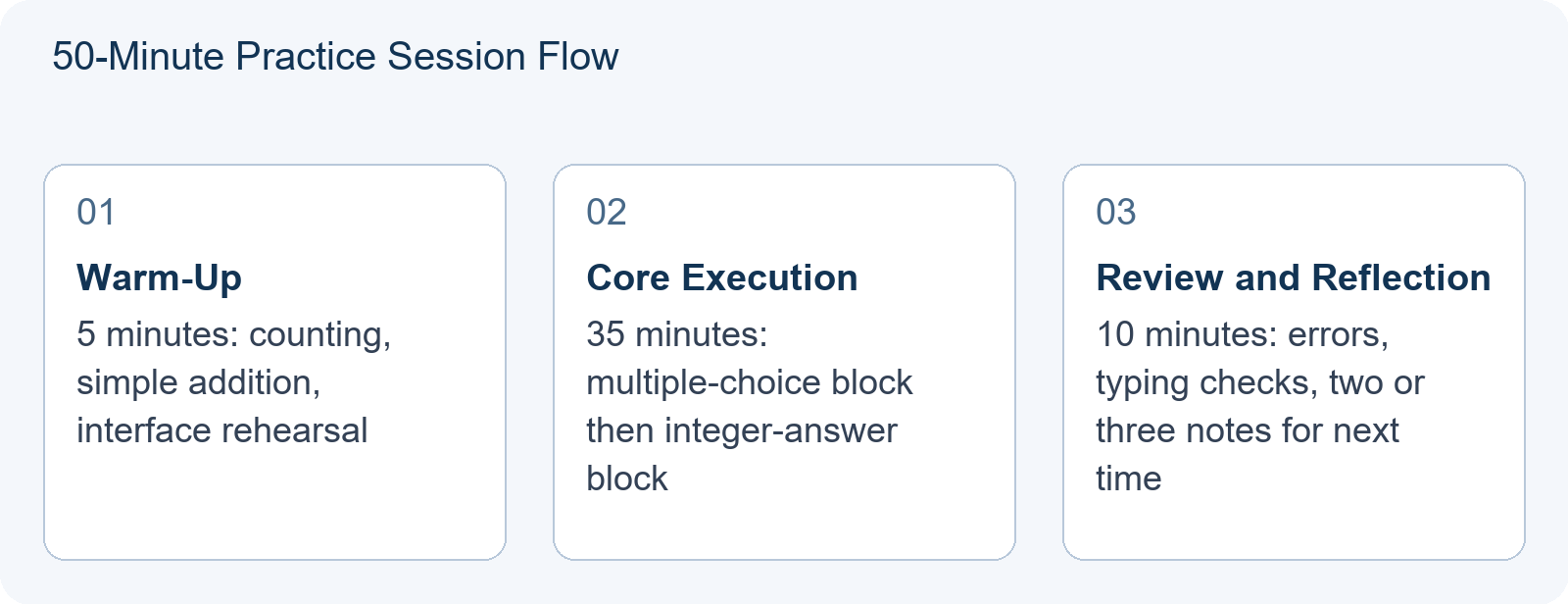
The sequence below is a coaching suggestion, not an official AMT timetable. It is designed to mirror the 50-minute online sitting in manageable pieces. Total practice time is kept at 50 minutes so young children stay engaged and the session has a clear beginning and end.
Phase 1 — Warm-Up (5 minutes)
Begin with familiar counting, simple addition and subtraction within 20, and quick shape or pattern recognition. The goal is activation, not challenge. If the child will sit online, include an interface warm-up: moving the mouse or tapping an option, and typing a two-digit answer into a box. A two-minute device rehearsal before the maths reduces the chance that a click error costs a mark. Young children often know the arithmetic but hesitate at the keyboard.
Phase 2 — Core Execution (35 minutes)
Split the work into two blocks. First, work through a multiple-choice block in sequence. Teach a simple routine: read the question aloud, point at the numbers, choose an option, and move on. Because the AMT overview does not state an incorrect-answer penalty for Early Primary, coaching should encourage attempting every question rather than leaving blanks, but parents should confirm the rule with the AMT before relying on it during the actual sitting.
Second, turn to integer-answer items. The routine here is read, calculate, type the number, then read the number back before submitting. A three-second check catches reversed digits and stray extra digits. Reserve extra time for these items, since a typed number cannot be partially correct.
A useful pacing target for a Year 1–2 child is roughly 1 to 1.5 minutes per multiple-choice item and 2 to 3 minutes per integer item, leaving slack for harder questions. If the child repeatedly runs out of time, cut the number of practice questions and keep the total practice time the same, rather than extending the session. Short repeated practice beats long, tiring sessions, and a child who finishes a 50-minute simulation with dignity is more likely to keep practising next week.
Phase 3 — Review and Reflection (10 minutes)
After the session, look at the paper again together. Ask the child where they felt unsure, which question took longest, and whether any answer was typed differently from what they worked out. This review is more valuable than a second round of questions on the same day. Note two or three issues for the next session rather than a long list. Over a week, those notes form a personalised practice plan that directly reflects the child’s actual error pattern.
Worked Teaching Illustration (Not an Official Contest Problem)
Teaching illustration, not an official AMT or contest problem.
Prompt: Mia has 8 red apples and 5 green apples. She gives 3 apples to her brother. How many apples does she have left?
Worked steps:
- Total apples at the start: 8 + 5 = 13.
- Apples given away: 13 − 3 = 10.
- Final answer to enter: 10 (one zero, not “100” and not “1O”).
The mathematics is deliberately modest. For a Year 1 or Year 2 child preparing for a 50-minute online paper, the hard parts are rarely the arithmetic itself. They are holding the two-step structure in mind, deciding which operation comes second, and then entering the number accurately. Coaches should rehearse all three. If the child can solve this in under a minute and type the answer without error, the same routine can be extended to slightly harder multi-step number stories, always keeping the read-calculate-type-check loop intact.
Diagnostic: Where Marks Actually Disappear
After two or three practice sessions, sort the missed questions into one of three categories. This narrows the next month of practice much faster than a general “work harder” plan, and it is based on the child’s own errors rather than a generic worksheet.
- Reading comprehension: The child chose the wrong operation or missed a key word such as “left”, “each”, or “more”. Fix: read the question aloud together, underline the numbers, then paraphrase before calculating.
- Exact-answer entry: The reasoning was correct but the typed number was wrong — a missing or duplicated digit. Fix: practise ten integer-answer items a week with a short read-back check after typing.
- Time management: The child spent four minutes on one question and then rushed the rest. Fix: set a timer per question and build the habit of moving on and circling back later.
If most errors fall into the first category, the priority is vocabulary and comprehension. If most fall into the second, the priority is interface fluency. If most fall into the third, the priority is pacing. This triage is often the fastest intervention for a child who already knows the underlying maths, and it prevents a common mistake: piling on harder content when the real bottleneck is reading or typing.
For background on how the AMT Early Primary sits alongside the China Pre-A, see The 2026 Early-Primary Pilot Is Not China’s Pre-A: What China Families Should Not Assume. For the corresponding Pre-A score structure, see Australian AMC Pre-A Scoring: 25 Questions, 100 Marks, No Penalty. And for practice aimed specifically at younger Years 1–2 readers, see Preparing for a Read-Aloud Paper: How Pre-A Practice Works for Grades 1-2 (2026).
From Illustration to Action: The Three-Step Repair Loop
The teaching illustration above (Mia’s apples) is not just a math problem; it is a diagnostic tool. If a child solves and correctly but fails the task, the error lies in execution, not arithmetic. Use this specific case to test three distinct failure modes during practice.
Diagnostic Check: Present the Mia problem again. Observe exactly where the breakdown occurs.
- Mode A (Comprehension Gap): The child calculates and stops, or subtracts from 8 instead of 13. Fix: Require the child to circle the word “left” and state aloud, “I need to find what remains after giving some away,” before writing any numbers.
- Mode B (Entry Error): The child works out 10 but types “1O” (letter O), “1”, or “100”. Fix: Practice typing answers on a keyboard or tablet separately from solving. Drill the visual difference between zero and letter O. Make “read-back” mandatory: after typing, the child must look at the screen and say the number aloud before submitting.
- Mode C (Pacing Panic): The child hesitates for over two minutes, fearing the multi-step nature. Fix: Set a visible timer for 60 seconds. If the answer isn’t typed by then, move on. This builds trust in their speed and prevents one question from derailing the 50-minute session.
Next Practice Task: Create three variations of the Mia problem with different numbers but identical structure (e.g., “Tom has 7 blue cars and 4 red cars. He gives 2 to his sister.”). Do not change the logic. Run these back-to-back. If the child completes all three with correct entry and under 90 seconds total, they have mastered the routine. If errors persist, isolate the specific mode (A, B, or C) and drill only that skill for five minutes. This targeted repair is more effective than repeating full mock exams.
General event background is available at Event background.
Frequently Asked Questions
Does the AMT Early Primary pilot change my China Pre-A registration?
No. The two are administered separately. The AMT Early Primary pilot is for Australian and New Zealand Years 1–2 students and was run online during the 12–23 October 2026 window. China Pre-A is a separate China-region level with its own calendar and registration channel.
How many marks is the AMT Early Primary worth?
The AMT overview consulted for this article describes the question count, the question types and the 50-minute duration, but does not publish a mark total for the Early Primary pilot. The 135-mark scheme described there applies to standard Middle Primary through Senior papers, not to Early Primary. Families should confirm any mark total or penalty rule with the AMT or their centre before the 2027 sitting.
Will the 2027 Early Primary keep the 2026 pilot format?
The AMT overview confirms that Early Primary joins standard offerings in 2027. It does not, at the time of writing, publish 2027-specific format refinements. The 2026 pilot — 25 questions, 20 multiple-choice plus five integer-answer, 50 minutes online — is the best available evidence for what the standard Years 1–2 paper will look like.