
Direct answer: Australian AMC integer answers come from the last five questions of Levels A–E. Questions 26–30 carry 6, 7, 8, 9 and 10 marks respectively, they give you no options to eliminate, and there is no penalty for a wrong answer or a blank. The technique that decides those marks is exactness rather than speed: fix a bound on the possible value before you calculate, then use parity or divisibility as a filter on the result you produce.
The structural facts below come from the Australian Maths Trust (AMT) AMC overview checked on 26 October 2026 for the standard Middle Primary to Senior papers, and from Hanlin’s WeChat report published on 11 October 2026 — translated from the original Chinese title, “The 2026 Australian AMC opened today: how many marks this year?” — for the China-region Levels A–E mark schedule.
What the back five actually look like
Pre-A and Levels A–E are different papers, and confusing the two is the first avoidable error a student can make. The mark schedule from the 11 October 2026 Hanlin report is set out side by side here so the boundary is visible.
| Item | Pre-A (China region, 2026) | Levels A–E (China region, 2026) |
|---|---|---|
| Number of questions | 25 | 30 |
| Questions 1–10 | 3 marks each (30) | 3 marks each (30) |
| Questions 11–20 | 4 marks each (40) | 4 marks each (40) |
| Questions 21–25 | Q21–22: 5 marks; Q23–24: 6 marks; Q25: 8 marks (30) | 5 marks each (25) |
| Questions 26–30 | — | 6, 7, 8, 9, 10 marks (40) |
| Paper total | 100 | 135 |
| Wrong answer or blank | No penalty | No penalty |
The AMT’s own AMC overview describes the standard Middle Primary to Senior papers as 30 questions — 25 multiple-choice plus five integer-answer questions — worth 135 marks with no incorrect-answer penalty. Pre-A is a shorter paper, and its 25-question, 100-mark structure is described on the Australian AMC Pre-A Scoring: 25 Questions, 100 Marks, No Penalty page. If a student is sitting Pre-A, the mark arithmetic in the left column applies; nothing below about the five-question exact-answer block transfers to it.
Why the format shift costs more than the difficulty does
Questions 1–25 offer five options. A student who is unsure can estimate, test a plausible value, or reason about which options are internally inconsistent — and the option list itself functions as a checking device. Questions 26–30 remove that device completely. You write a number, and the marking key either accepts it or does not.
Two consequences follow immediately. First, a student whose working habit is “calculate until the answer appears among the choices” loses the feedback loop that habit depended on. Second, an arithmetic slip that option-checking would once have caught — because no option matched — now travels straight through to the answer grid. The risk profile is different, so the working routine has to be different too.
The reassuring half of the story is the scoring rule. According to both the AMT overview and the 11 October 2026 Hanlin report, incorrect answers and blanks in Levels A–E are not penalised. A student who reaches question 30 with a defensible candidate answer should write it on the grid. Leaving the grid empty buys nothing at all.
What that rule does not do is make a careless answer as valuable as a checked one. Since marks are awarded only for an exact value, the productive use of the no-penalty rule is to attempt all five items and then spend the saved time verifying the two or three answers the student is least sure of.
Technique one: set the bound before you calculate
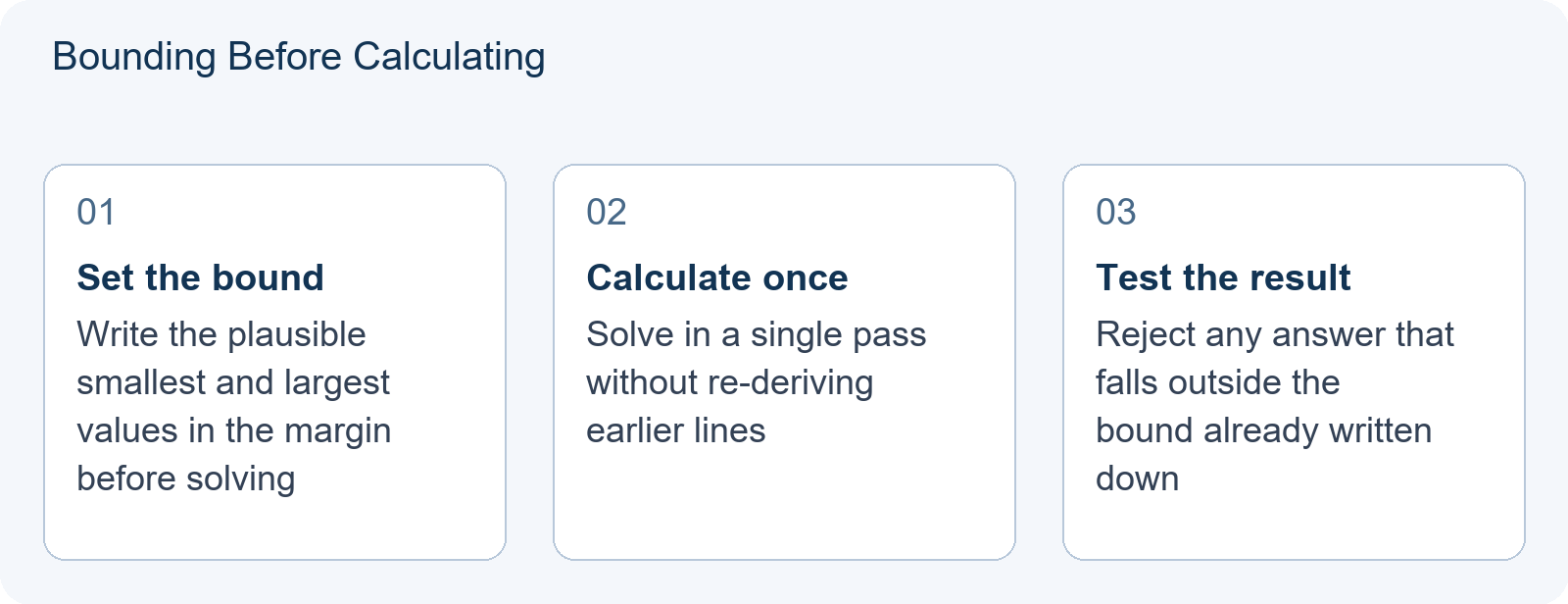
Bounding means writing down, before any detailed arithmetic, the interval the answer must lie inside. Three quick questions produce a bound in under a minute:
- What is the smallest value the quantity could plausibly take?
- What is the largest?
- What kind of number is it — a count of objects, a length, a percentage, an amount of money?
Teaching illustration, written for this article and not a past or official AMC problem. A rectangular board has both sides between 20 cm and 30 cm. The area must therefore lie between 20 × 20 = 400 cm² and 30 × 30 = 900 cm². If a student’s working produces 2,400 cm², the error is caught in three seconds, without re-reading the question and without re-doing the multiplication. The bound did the work that an option list would normally have done.
Counts behave the same way. The number of ways to choose 2 items from 12 is 66, which is comfortably between the crude bounds of 1 and 144 — so a candidate answer of 1,320 is impossible for a two-item selection whatever the arrangement. A student does not need the exact combinatorial formula to know that a two-item choice from twelve items cannot be a four-digit number.
Bounds are cheap. They cost perhaps fifteen seconds and they eliminate an entire class of errors: results that are numerically possible in isolation but inconsistent with the conditions of the problem. Write the bound in the margin next to the question and leave it there until the final answer is on the grid.
Technique two: parity and divisibility filters
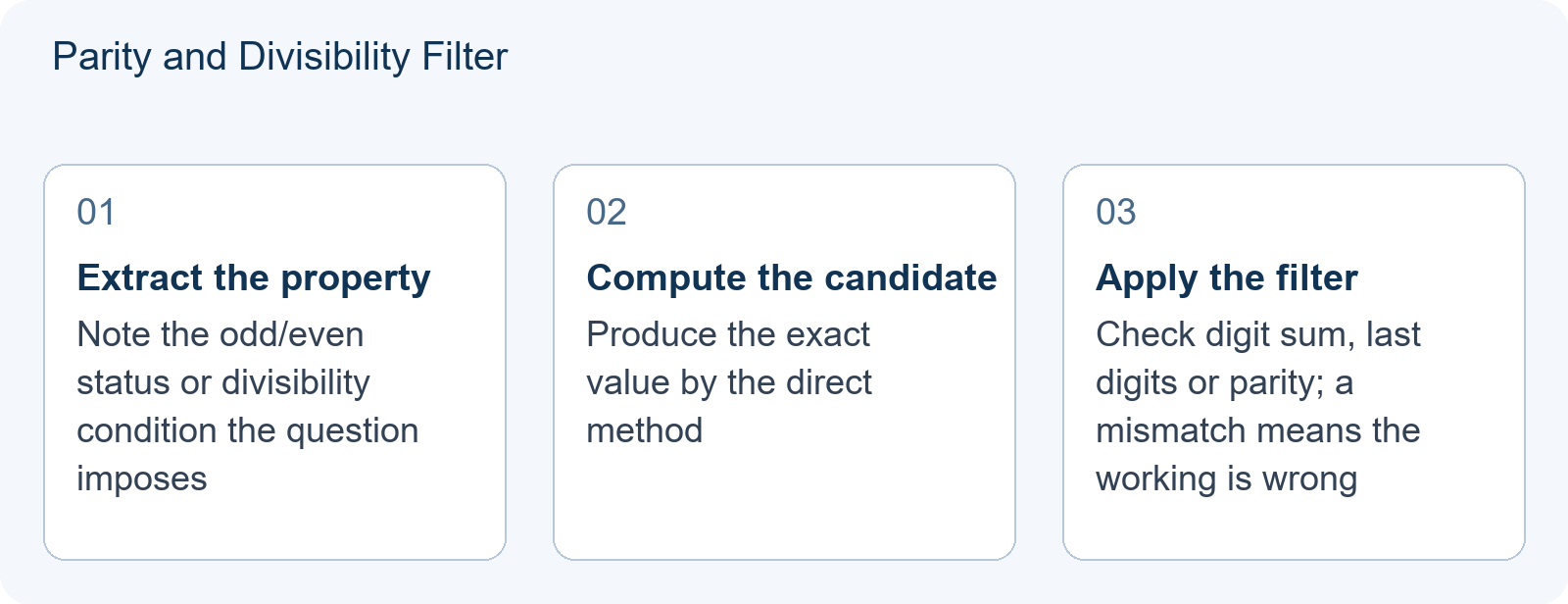
Parity is the odd/even status of a number. Divisibility rules describe when one whole number is exactly divisible by another. Both are filters: they do not find the answer, but they reject wrong candidates quickly and without a full recalculation.
Some filters worth having automatic:
| Property to check | Fast test |
|---|---|
| Even | Last digit is 0, 2, 4, 6 or 8 |
| Divisible by 3 | Digit sum is divisible by 3 |
| Divisible by 9 | Digit sum is divisible by 9 |
| Divisible by 4 | The last two digits form a multiple of 4 |
| Divisible by 8 | The last three digits form a multiple of 8 |
| Divisible by 5 | Last digit is 0 or 5 |
The reasoning behind the filter matters as much as the rule. The sum of two odd integers is always even, so if a problem describes a total as the sum of two odd numbers, an odd candidate answer is wrong by construction. A number that leaves remainder 2 on division by 4 must be even, and cannot itself be divisible by 4. A quantity that has been divided into groups of 3 with none left over must pass the digit-sum test.
These checks are not extra work. They are the verification step that multiple-choice questions used to perform for you, applied at the point where it actually matters — before the number goes on the answer grid.
Worked teaching illustration
Teaching illustration written for this article. It is not a past or official AMC question and is not drawn from any published paper.
Task: find the largest odd integer less than 90 that leaves remainder 1 when divided by 3.
Step 1 — bound the search. The answer must be an integer below 90 and it must be odd, so the search starts at 89 and moves downwards in steps of 2. Listing every integer below 90 would mean 89 candidates; the bound and the parity condition together reduce this to 45 odd candidates, and starting from the top usually ends the search within a few checks.
Step 2 — test 89. Digit sum: 8 + 9 = 17. Since 17 = 3 × 5 + 2, the remainder on division by 3 is 2, not 1. Reject.
Step 3 — test 87. Digit sum: 8 + 7 = 15, which is divisible by 3, so the remainder is 0. Reject.
Step 4 — test 85. Digit sum: 8 + 5 = 13. Since 13 = 3 × 4 + 1, the remainder is 1. Accept.
Answer: 85.
Verification against the original conditions: 85 < 90, so the upper bound holds. 85 is odd, so the parity condition holds. 85 = 3 × 28 + 1, so the remainder condition holds. All three stated premises are satisfied and no larger candidate survived the checks.
Notice what the method bought. The student never needed to build an algebraic scaffold, and never needed to test every number from 89 down to 85 — the bound, the parity step of 2, and a one-line divisibility test did the narrowing. On a live paper the same three moves work on questions about remainders, grouping, digit problems and sequence terms, because all of them impose at least one structural condition on the answer.
Diagnostic: which error did you actually make?
Most back-five losses come from one of four places, and the repair differs for each. Classify the error before deciding what to practise.
| Error class | Typical symptom | Repair |
|---|---|---|
| Bound-setting | An answer outside the plausible interval — a negative count, an area larger than the whole figure, a percentage above 100 where the logic forbids it | Write the bound in the margin before calculating, every single time |
| Arithmetic | The method and the conditions were handled correctly, but a digit slipped in one line | Recheck the final line only, using a different route — digit sum, parity, or an estimate |
| Condition-reading | Solved for the smallest when the question asked for the largest; missed “at least”, “remainder”, or a units label | Underline the conditions on the paper before starting, and restate the target in one sentence |
| Answer-transfer | The right value on the working page, the wrong digits on the grid | Copy the final line character by character, then read the grid back against the page |
A student who misreads conditions will not be helped by more arithmetic drills, and a student with an arithmetic slip will not be helped by more word problems. Sorting one week of attempts into these four columns is usually enough to show which one dominates. For a structured way to convert unresolved items into targeted practice, see Australian AMC Missed Questions: Turn One Unfinished Solution Into a Focused Practice Set.
A short practice routine for the back five
One integer-answer item per session is enough if the session is run the same way each time:
- Write the bound in the margin before touching the calculation. The bound is not optional; it is the replacement for the option list.
- State which filter you will use for verification — usually parity or a divisibility rule — before you start solving.
- Solve in one pass, without stopping to re-derive earlier lines.
- Test the result against the bound and the filter. If either fails, the error is somewhere in the working, not in the answer line.
- Record which of the four error classes the item produced, even when the answer was correct but slow.
The fourth step is the one students skip under time pressure, and it is the one that earns marks. Questions 1–25 train a checking reflex that depends on seeing an answer in a list; the routine above rebuilds that reflex in a form that works with a blank grid. Middle questions still decide most bands, and the context for that is set out in From Credit to Distinction: The Middle Questions Decide Your Australian AMC Band (2026).
Frequently asked
Are wrong integer answers penalised?
No. In Levels A–E, incorrect answers and blanks are not penalised, so an attempted answer is never worse than an empty grid.
How many marks do questions 26–30 carry?
In Levels A–E they are worth 6, 7, 8, 9 and 10 marks respectively, a block of 40 marks inside a 135-mark paper. Pre-A uses a different, shorter schedule of 25 questions and 100 marks.
Is estimation allowed if the final answer must be exact?
The grid requires an exact integer, and an estimate will not be accepted. Estimation and bounding are used before and after the calculation — to reject impossible candidates and to catch a wrong result — not as a substitute for the exact value.
What this means for the next paper
Everything above is format-based, not date-based, so it holds whenever the next sitting falls. The 2026 China sitting took place on 11 October. The AMT’s own AMC overview, checked on 26 October 2026, lists 3–5 August 2027 for its main calendar window; that listing is not confirmation of any China regional date, and any regional arrangement should be confirmed with the organiser or the registered test centre rather than assumed from the AMT calendar. Format knowledge, unlike a calendar date, does not go stale: the last five questions will still be exact-answer items, and they will still reward a bound and a filter over a guess.
General event background is available at Event background.
Frequently Asked Questions
Are wrong integer answers penalised?
No. In Levels A–E of the Australian AMC, incorrect answers and blanks are not penalised, so an attempted answer is never worse than an empty grid.
How many marks do questions 26–30 carry?
In Levels A–E they are worth 6, 7, 8, 9 and 10 marks respectively — 40 marks inside a 135-mark paper. Pre-A uses a different schedule of 25 questions and 100 marks.
Is estimation allowed if the final answer must be exact?
The grid requires an exact integer, so an estimate will not be accepted. Bounding and estimation are used before and after the calculation to reject impossible candidates and to catch a wrong result, not as a substitute for the exact value.