
The Australian Mathematics Competition (AMC) is one of several school maths contests families in China can choose, and the honest way to compare them is as complementary, not competing. The Australian AMC stands out for three things: its full grade span (Grades 1-12, six levels), a single 30-question, no-penalty paper every student can finish, and percentile awards with a certificate for everyone. Run by the Australian Maths Trust (AMT), it is not the American AMC and not the AMO. This guide compares them by grade range, format and purpose.
Start with the name confusion — it costs families the most time
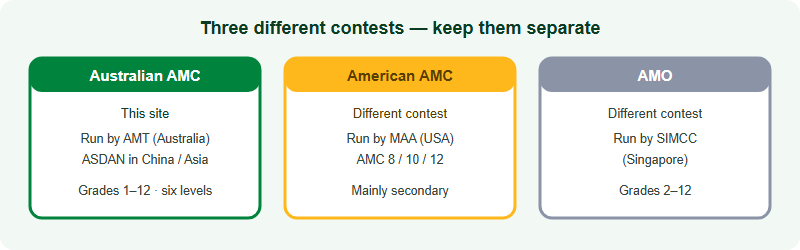
Before comparing grade ranges or formats, untangle the names, because this is where most planning goes wrong. Three well-known contests sound almost identical but are run by three different organisations in three different countries, and a result in one does not carry over to another. The Australian AMC on this site is set by the Australian Maths Trust (AMT) in Australia (founded 1978, the country's largest school maths competition) and administered for the China and Asia region by ASDAN (阿思丹). The “American AMC” is a completely separate competition; the “AMO” is a third. Keep them apart from the first day of planning and everything downstream gets simpler.
| Contest | Who runs it | Origin | Usual short name |
| Australian AMC (this site) | Australian Maths Trust (AMT); ASDAN in China/Asia | Australia · founded 1978 | “AMC” — Australian Mathematics Competition |
| American AMC | Mathematical Association of America (MAA) | United States | “AMC 8 / AMC 10 / AMC 12” |
| AMO | SIMCC | Singapore | “AMO” — American Mathematics Olympiad |
Notice the trap in the last row: the AMO is called the “American” Mathematics Olympiad but is run from Singapore by SIMCC — so “American AMC” and “American Mathematics Olympiad” are also two different things. On this site, “AMC” always means the Australian Mathematics Competition. If you are still working out exactly what that is, start with What Is the Australian AMC, which walks through the levels, the China date and the format in plain terms.
Compare on three things that actually decide your choice
It is easy to drown in detail when comparing contests. In practice, only three questions move the decision, and they are best asked in this order: grade range (is there even a paper for my child?), then format (does the way the paper works suit them?), then purpose (why are we entering at all?). Recognition — how results are reported — is a useful fourth lens. The sections below take each in turn, comparing the Australian AMC against other school maths contests rather than ranking them, because for most families the real answer is “a sensible sequence over the school years,” not “the single best one.”
1 · Grade range: who can actually take part
The most practical first filter is age, and here the Australian AMC is unusually broad. For the 2026 China region it runs six levels covering Grades 1-12: Pre-A (Grades 1-2, new for 2026), A (3-5), B (6-7), C (8-9), D (10-11) and E (Grade 12). A Grade 2 child and a Grade 11 student therefore sit different, age-appropriate papers within the same competition, and you register by your grade at the time of the exam.
By contrast, the American AMC is built mainly for secondary students — its AMC 8 / 10 / 12 structure sits in the middle-and-upper-secondary range and feeds a longer olympiad pathway — while the AMO from SIMCC covers roughly Grades 2-12. Many other school maths contests are narrower again: some are primary-only, others secondary-only. The practical upshot for a family in China is that if you have a younger child, or several children spread across ages, one broad-span contest is far simpler to plan around than stitching together two or three narrow ones. This breadth is also why the Australian AMC works well as a recurring annual fixture rather than a one-off — only the Australian AMC has a level (Pre-A) aimed squarely at Grades 1-2, where most contests have nothing.
2 · Format: how the paper works, and why it matters
Format shapes the experience as much as content does. The Australian AMC keeps one consistent shape at every level: a 30-question paper made of 25 multiple-choice and 5 integer-answer questions, worth 135 marks in total. Questions climb in difficulty and the marks climb with them — early questions are worth fewer points, the hardest are worth the most — and there is no penalty for a wrong answer. Time runs from about 45 minutes at the youngest level to 75 minutes at senior secondary, and papers in the China region are available in English and Chinese, so language need not be a barrier.
That no-penalty design has a quiet but real consequence: because nothing is deducted for a wrong guess, every student can attempt every question and finish the paper, which makes it a gentle, low-stress first contest. Some other contests penalise wrong answers (so part of the skill becomes deciding what to leave blank), and some are built around full written proofs (more demanding to attempt and to mark). Neither approach is “better” — they simply test and feel different. The point is to match the format to the child. The table compares the three same-named contests on shape; for what the questions themselves are like, see Australian AMC Syllabus & Topics Tested: What's on the Paper.
| Feature | Australian AMC (this site) | American AMC / AMO (for contrast) |
| Question style | 25 multiple-choice + 5 integer-answer | Mostly multiple-choice / short-answer; set by their own organisers |
| Questions & marks | 30 questions · 135 marks | Varies by contest — confirm on the official site |
| Wrong-answer penalty | None — attempt every question | Varies by contest — confirm on the official site |
| Time | 45-75 minutes by level | Set by each organiser |
| Languages (China region) | English & Chinese | Set by each organiser |
We have deliberately left the American AMC and AMO cells as “varies / confirm on the official site” rather than guessing exact specifics — those formats are set by the MAA and SIMCC respectively and can change. For the Australian AMC, the verified 2026 China-region figures above are what you can safely plan around. For a closer, like-for-like look at the two AMCs in particular, see Australian AMC vs the American AMC: A Side-by-Side for China Families.
3 · Purpose: what each contest is really for
Grade range and format tell you who can enter and what the day feels like; purpose tells you why you would enter. The honest framing here is complementary — these contests serve overlapping but distinct goals, and many students benefit from more than one across their school years.
- Australian AMC — a broad, encouraging benchmark of mathematical thinking across the whole of school. Its no-penalty design and grade-by-grade levels make it a natural first or annual contest: it rewards reasoning over speed, gives every entrant a certificate, and leaves a recognisable national line on an academic record. Strong for building confidence and a steady problem-solving habit.
- American AMC — built mainly for secondary students and known as the early step on a longer competition pathway in the US system (toward AIME and beyond). It tends to suit students who already enjoy contest maths and want a defined progression.
- AMO (SIMCC) — a separate, Singapore-run contest spanning roughly Grades 2-12, with its own structure and progression. Another option families weigh, distinct from both AMCs.
A reasonable mental model: the Australian AMC is an excellent wide-net contest you can return to every year from Grade 1 through 12, while others may serve as more specialised steps for students aiming at a particular pathway. They are not substitutes for one another, and doing well in one does not “replace” the others.
4 · Recognition: how results are reported
How a contest hands out recognition matters, because it shapes what the result actually says. The Australian AMC reports awards by national percentile, so the bar adjusts to each level and year rather than sitting at a fixed mark. Every entrant receives a certificate; above that come the Proficiency, Credit, Distinction, High Distinction and Prize bands, and a perfect score can earn the O'Halloran Award. Because the bands are percentile-based, a result describes how a student did relative to peers at the same level — easy to interpret and naturally comparable from one year to the next.
Other contests report results in their own ways — some by fixed score thresholds, some by ranking, some by qualification to a next round. None is inherently better; they simply answer different questions. Whatever the contest, treat any specific cut-off you read online with care: exact thresholds move year to year, and for the Australian AMC the precise figures are confirm on the official site.
Putting it together: a simple decision path
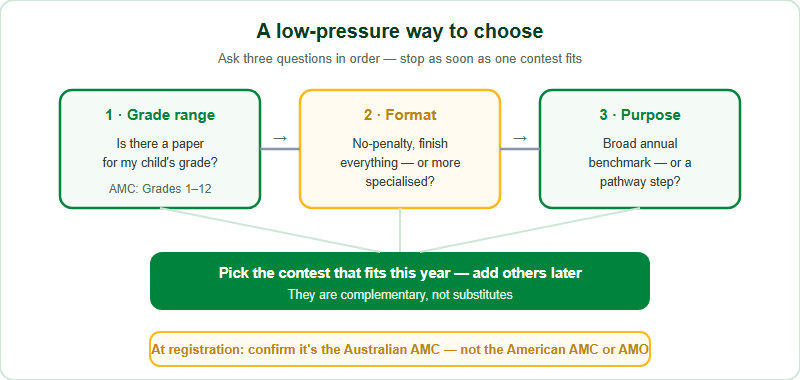
You do not need to crown a single “best” contest — you need the one that fits your child this year, with room to add others later. A calm way through is to walk the same three questions in order: grade range, then format, then purpose. For many families in China, the Australian AMC answers all three well across the entire school journey, which is why it so often becomes the steady annual anchor with other contests layered in as a child gets older and more specialised. The decision tree below shows the path; the one genuine mistake to avoid is confusing the Australian AMC with the American AMC or the AMO at registration.
A quick note on dates, so contests don't collide
One reason these contests sit together so comfortably is that they run at different points in the year, so entering more than one rarely means a clash. For the 2026 China region, the Australian AMC exam is on Sunday 11 October 2026, with registration by 28 September 2026. Other contests set their own calendars (and Australia's own home schedule for the AMC runs at a different time again — this site is the China region, so use the October date). If you are considering two contests, simply check that their windows do not overlap; in most years they comfortably do not. Exact dates, fees and any procedural details are set by the AMT and ASDAN and can change, so for anything beyond the verified figures here — confirm on the official site.
Frequently asked questions
Is the Australian AMC the same as the American AMC?
No. The Australian AMC is run by the Australian Maths Trust (ASDAN in China). The American AMC is a separate MAA contest in the USA, and the AMO is a separate SIMCC contest in Singapore.
Which maths contest covers the most grades?
Among the three, the Australian AMC is broadest: for the 2026 China region it runs six levels covering Grades 1-12, including a new Pre-A level for Grades 1-2.
Can my child enter more than one maths contest?
Yes. These contests are complementary, not substitutes, and usually run at different times. Many students take the Australian AMC as a broad annual benchmark and add others over time.
How does the Australian AMC paper compare on format?
It has 30 questions (25 multiple-choice + 5 integer), 135 marks, 45-75 minutes by level, and no penalty for wrong answers, so every student can attempt the whole paper.
This is the editorial desk for the Australian Mathematics Competition (AMC) China region. The competition is run by the Australian Maths Trust (AMT) and administered in China and Asia by ASDAN (阿思丹); this content desk is operated by Hanlin Education. Dates, fees, levels and rules are set by the AMT and ASDAN and can change each year — always confirm current details on the official channels (amt.edu.au and the ASDAN China-region channels). Confirmed errors are corrected within 7 working days.