
If a child sees two speeds in a word problem and immediately adds them and divides by two, the error can be a model error rather than an arithmetic slip. For the Australian Mathematics Competition — the AMT competition, not the US AMC series — average-speed questions reward one habit: write total distance and total time, then divide once. Average speed is total distance ÷ total time. When two different speeds are involved, the arithmetic mean is legitimate only in the special case where the two speeds are held for equal times. Equal distances at unequal speeds do not qualify.
For the 2026 China-region sitting on 11 October 2026, the method below remains the relevant preparation point for reviewing any speed question already attempted and for building the right habit before the next paper.
Why the word “average” causes the wrong model
In everyday language, “average” often means “add the numbers and divide by how many there are.” That works for heights of children in a class or scores on three tests, because each item is counted once. Speed is different. A speed is already a ratio: distance per unit of time. When two speeds are combined, the time spent at each speed controls how much each speed contributes to the overall journey.
As a teaching illustration, a car that spends three hours at 40 km/h and two hours at 60 km/h has not spent equal time at each speed. The slower speed dominates the journey because it occupies more time. Adding 40 and 60 and halving gives 50 km/h, but that answer pretends the two speeds had equal time weight. The correct average speed is the total distance actually covered divided by the total time actually taken.
This is why the equal-distance case is a trap. Equal distances feel symmetrical, so the arithmetic mean feels fair. But equal distances at unequal speeds produce unequal times. The slower leg takes longer, and the average speed must reflect that longer time.
The formula that prevents the trap
For any journey split into legs, use:
Average speed = (distance of leg 1 + distance of leg 2 + …) ÷ (time of leg 1 + time of leg 2 + …)
If the legs are equal in distance, there is a shortcut. For two equal-distance legs at speeds a and b, the average speed is 2ab ÷ (a + b). This is the harmonic mean of the two speeds, not the arithmetic mean. If the legs are equal in time, the arithmetic mean (a + b) ÷ 2 is correct. If neither distances nor times are equal, do not use either shortcut; return to total distance and total time.
| What the problem gives | Correct average speed | Why |
|---|---|---|
| Equal time at each speed | Arithmetic mean: (a + b) ÷ 2 | Each speed gets the same time weight. |
| Equal distance at each speed | Harmonic mean: 2ab ÷ (a + b) | The slower leg takes more time. |
| Unequal distances and unequal times | Total distance ÷ total time | No shortcut applies without the actual weights. |
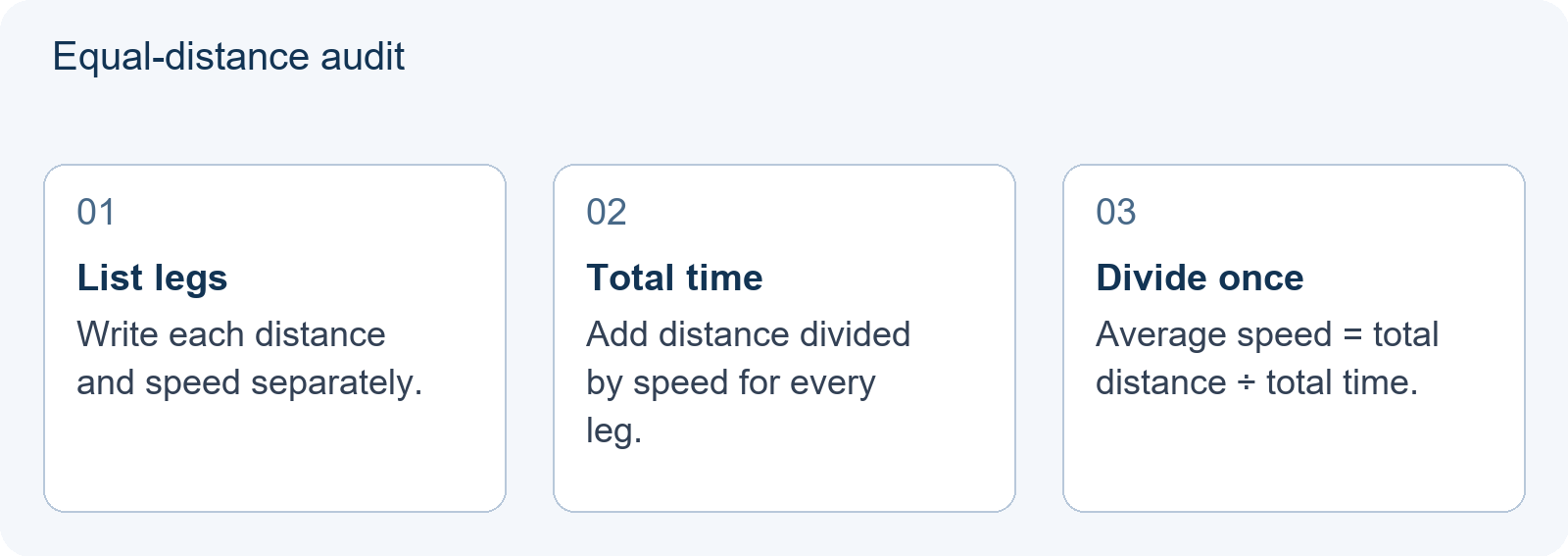
Teaching illustration: the out-and-back journey
The following is a teaching illustration, not an actual contest problem and not official scoring guidance. A car travels 120 km from town to a lake at 60 km/h, then returns along the same road at 40 km/h. What is the average speed for the whole journey?
The outbound leg takes 120 ÷ 60 = 2 hours. The return leg takes 120 ÷ 40 = 3 hours. Total distance is 120 + 120 = 240 km. Total time is 2 + 3 = 5 hours. Average speed is 240 ÷ 5 = 48 km/h.
The tempting answer is (60 + 40) ÷ 2 = 50 km/h. It is wrong because the car spends three hours at the slower speed and only two hours at the faster speed. The slower leg has more time weight. The harmonic-mean shortcut gives 2 × 60 × 40 ÷ (60 + 40) = 4800 ÷ 100 = 48 km/h, confirming the table calculation.
| Leg | Distance | Speed | Time |
|---|---|---|---|
| Outbound | 120 km | 60 km/h | 2 h |
| Return | 120 km | 40 km/h | 3 h |
| Total | 240 km | — | 5 h |
The key diagnostic question is not “What two numbers can I average?” It is “What are the total distance and total time?” Once those are written, the division is safe.
The equal-time contrast: same speeds, different answer
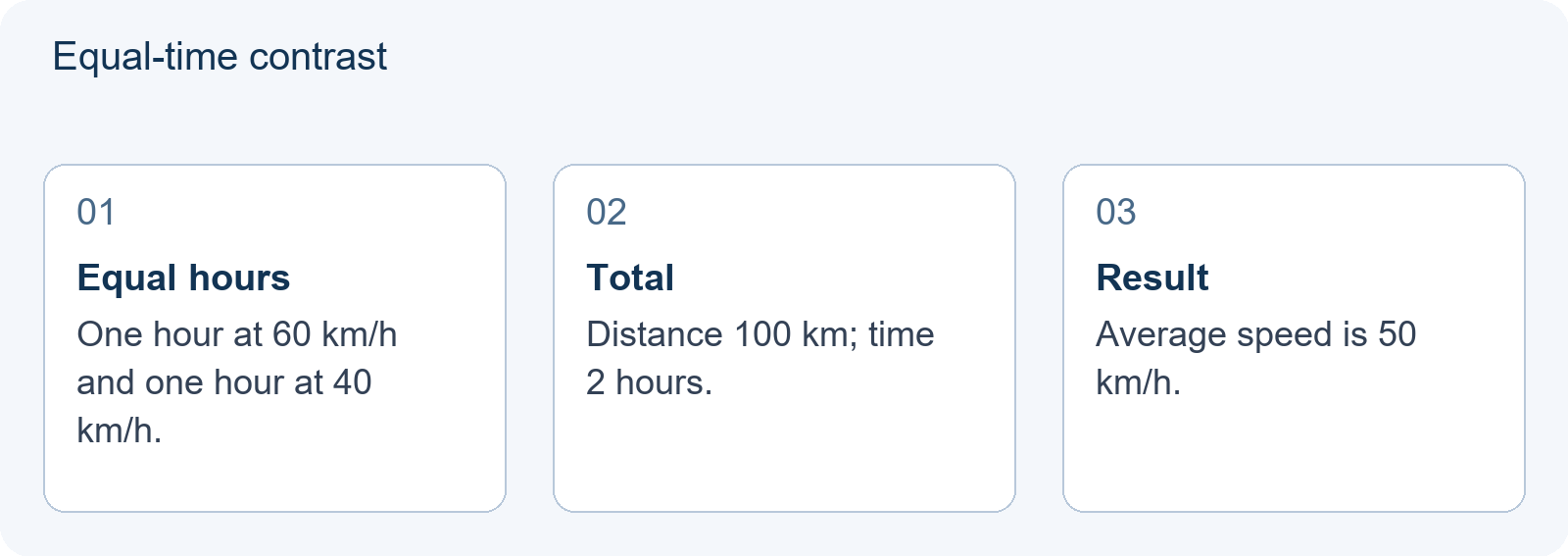
Now keep the same two speeds but change the condition in a second teaching illustration. A car travels for one hour at 60 km/h and one hour at 40 km/h. The first hour covers 60 km; the second covers 40 km. Total distance is 100 km and total time is 2 hours, so average speed is 50 km/h. Here the arithmetic mean is correct because each speed is held for exactly the same time.
The contrast is the lesson. The same two speeds produced 48 km/h under equal distances and 50 km/h under equal times. Therefore, two speeds alone do not determine the average speed. The problem must also tell us how the distances and times are structured, or give enough information to reconstruct them.
A student who writes “60 and 40, so 50” has not checked the time structure. A student who writes “equal distance, so harmonic mean” has checked the structure but should still be able to show total distance and total time. The table is the safer explanation because it works in every case.
A three-question diagnostic before calculating
Use this sequence when a speed problem feels ambiguous:
- Are the distances equal, the times equal, or neither? Mark the condition explicitly. Do not infer it from the word “average.”
- Can I write total distance and total time without using a shortcut? If yes, the problem is solvable by the definition. If no, the data may be insufficient.
- Do the units match before I divide? Convert minutes to hours or metres to kilometres first. A correct model with mismatched units still produces a wrong answer.
If the answer to the first question is “equal times,” the arithmetic mean is allowed. If it is “equal distances,” use the harmonic mean or the full table. If it is “neither,” do not average the speeds; build the table. This diagnostic separates a conceptual error from a calculation error. A child who can state the correct model but slips on 120 ÷ 4 needs arithmetic practice. A child who keeps choosing 50 for the out-and-back journey needs work on the equal-distance/equal-time distinction.
A table method for mixed legs and unit consistency
For a two-leg journey, draw a table with rows for each leg and a final total row. Columns should be distance, time and speed. Fill only the two quantities you know in each row, calculate the third, then add the distance column and the time column. Leave the average-speed cell empty until the total row is complete.
Unit consistency is part of the model, not an afterthought. If a speed is in km/h, time must be in hours before division. If a leg is given in minutes, convert first. This is the same measurement discipline that the site’s Metres, Minutes and Money: The Australian AMC’s Measurement Questions, Decoded (2026) describes for Australian AMC word problems. A useful rule is: convert at the top of the table, not in the middle of the final division.
For three or more legs, the same table extends. Add rows, keep the columns consistent, and sum only at the end. Do not average leg averages unless the legs have equal time. Do not average leg speeds unless the structure makes the arithmetic mean legitimate.
Three wrong turns to check after the method is understood
The first wrong turn is averaging after a unit conversion without checking whether the times remain equal. For a teaching illustration, 30 minutes at 40 km/h and 30 minutes at 60 km/h are equal-time intervals, so the arithmetic mean is 50 km/h. But 30 minutes at 40 km/h and 1 hour at 60 km/h are not equal-time intervals; the arithmetic mean is no longer valid.
The second wrong turn is treating the harmonic mean as a universal “two-speed formula.” It applies only to equal distances. For unequal distances, use the total-distance/total-time definition. The third wrong turn is rounding intermediate times. If a leg takes 2.5 hours, keep 2.5 until the final answer; rounding to 3 hours can change the average speed enough to eliminate a correct option.
After a practice set, use the site’s Australian AMC Answer Review: Check Your Reasoning Before Watching a Worked Solution to classify each error. Was the model wrong, the table incomplete, or the arithmetic slipped? The classification determines the next practice task.
Course-fit and resource-request preparation
If a family is considering outside help, the useful question is not “Can you teach speed?” but “Can you diagnose whether the problem is model selection or arithmetic execution?” Prepare three things before asking: two attempted speed problems with the student’s table, a one-sentence explanation of the equal-distance versus equal-time difference, and a short list of arithmetic slips. This gives a tutor or teacher concrete evidence instead of a general impression.
A resource request can be equally specific. Ask for a small set of mixed speed problems that includes equal-distance, equal-time and neither cases, with answers that show total distance and total time. Do not ask for a large undifferentiated worksheet; volume does not repair a model error. For paper context, the Hanlin Courses WeChat account’s 11 October 2026 notice, “2026 Australian AMC Starts Today! How Many Marks Can You Score This Year? Past Papers + Answers + Explanations Reservation…,” states that Levels A–E have 30 questions and 135 marks, Pre-A has 25 questions and 100 marks, and wrong or blank answers are not penalised. That scoring context does not change the mathematics of average speed, but it helps a family interpret the paper the student actually sat.
Finally, connect the speed work to the student’s existing error log. The site’s Australian AMC Missed Questions: Turn One Unfinished Solution Into a Focused Practice Set is a practical way to avoid repeating the same model error under new numbers. The goal is a transferable decision: before calculating, identify whether the problem gives equal distances, equal times, or neither.
General event background is available at Event background.
Frequently Asked Questions
Is averaging two speeds ever correct in an Australian AMC speed problem?
Yes, but for two different speeds it is correct only when the two speeds are held for equal times. If a car travels one hour at 60 km/h and one hour at 40 km/h, the average speed is 50 km/h. If it travels equal distances at those speeds, the arithmetic mean is wrong; the average is 48 km/h for 120 km each way.
What should a student write first when a speed problem gives two speeds?
Write total distance and total time before choosing any shortcut. If the problem gives equal times, the arithmetic mean is allowed. If it gives equal distances, use total distance ÷ total time or the harmonic mean. If it gives neither and the speeds differ, the two speeds alone are not enough to determine the average speed.
How can a parent tell whether the child needs speed tutoring or arithmetic practice?
Check the written model first. If the child sets up total distance and total time correctly but makes division or unit slips, short accuracy practice is the better fit. If the child keeps adding the two speeds and halving them even after the table is shown, target the equal-distance versus equal-time distinction before increasing drill volume.