
If your child has just reattempted an Australian AMC paper and you are holding nothing but an answer key, the key can do exactly one job: tell you which letters were right. It cannot tell you whether a correct letter came from a method or a lucky elimination, and it cannot tell you why a wrong one happened. The productive next move is not a longer search for solutions but a marking protocol: sit the paper blind, mark it with the key without correcting anything, then classify every loss and every unverified correct answer before anyone opens a worked explanation. The method below is written for the 2026 sitting cycle and works with a bare key, a key with brief solutions, or a video explanation. The protocol is an editorial teaching tool, not an official AMT or Hanlin marking service.
Why an answer key cannot finish the job
Marking with a key is a comparison, not a diagnosis. The key tells you that question 14 was C and your child wrote B; it does not record that on question 9 the child eliminated two options, guessed between the remaining two, and happened to land on the right one. On the page those two events, a landed guess and a reasoned answer, look identical, yet they lead to opposite decisions: one needs review, the other needs nothing.
Blanks have the same problem in reverse. Hanlin’s 11 October 2026 course notice states that a wrong answer and an unanswered question both earn zero for that question at every level, with no negative marking, so a blank costs exactly what a wrong attempt costs, while giving up the chance a guess would have. On a marking sheet a blank is a zero that carries information about pacing, or about a method the student could not start. A key alone cannot recover any of this. Two extra columns can.
Three kinds of past papers with answers
Families searching for Australian AMC past papers with answers may encounter one of three resource forms, and the marking job is different in each case.
| Resource | What it gives you | Best use in marking | Limit |
|---|---|---|---|
| Answer key only | The correct letter or value for each question | Whole-paper batch marking and error counting | Cannot separate method from guess |
| Key with brief solutions | The intended route in a line or two | Checking whether your route matches the intended one | May omit the exact step that failed |
| Video or worked explanation | A narrated full method | Rebuilding a reason that pass three could not recover | Can encourage passive watching if opened before reconstruction |
The mistake in all three cases is order. If a family opens the video first, the paper stops being a diagnostic and becomes a demonstration: the student recognises the solution instead of producing it. The sequence for reviewing one difficult question is set out in Australian AMC Answer Review: Check Your Reasoning Before Watching a Worked Solution; this article covers the batch step that comes before it.
The four-column marking sheet
Use one row per question and four columns: the question number; the answer written on the script; the student’s confidence, recorded before the key is consulted (sure, fairly sure, guess); and an error label added after marking. The confidence column is the one families skip, and the one that makes the sheet worth keeping. Ask the student to put a single letter beside each answer as they finish the paper, before anything is checked. Without that record, a correct answer cannot be separated from a lucky one after the fact, and confidence reconstructed later is not a reliable record.
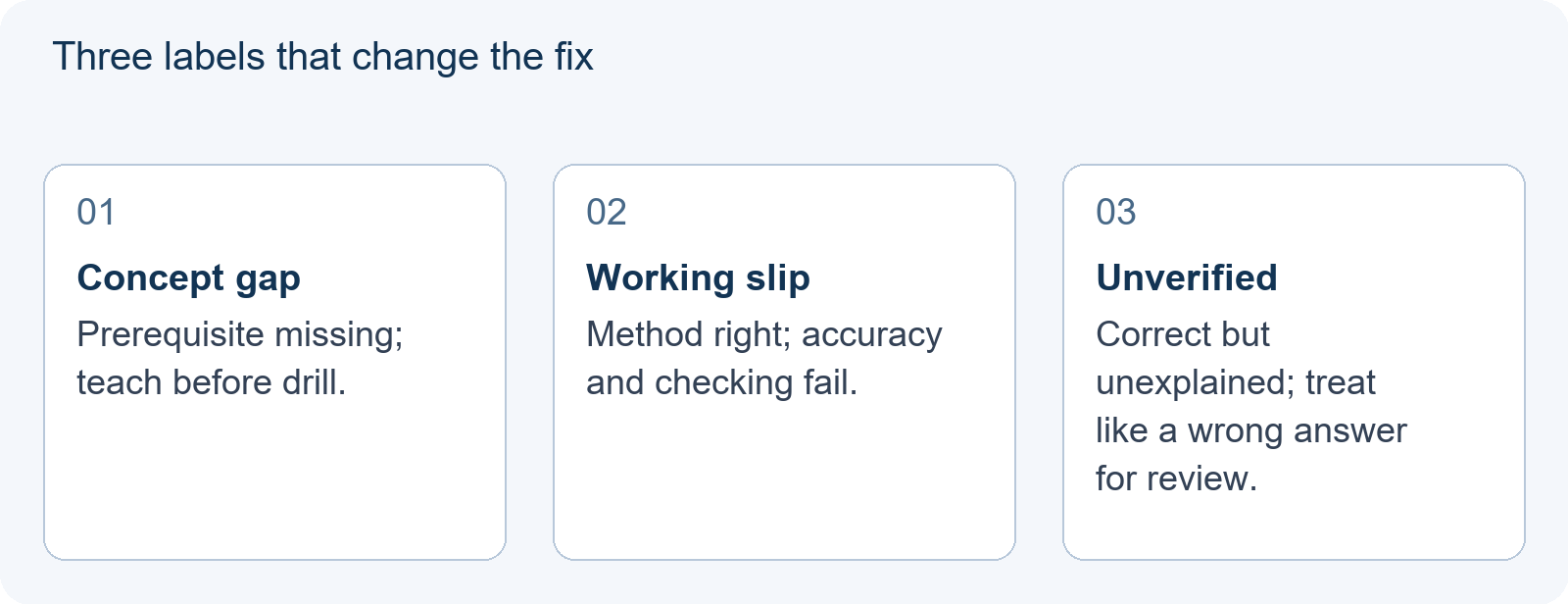
Keep the labels to five: concept gap, method gap, working slip, timing or blank, and unverified, meaning a correct answer the student cannot explain. Fewer labels produce vague repair plans; more produce a filing exercise. A sheet that says ‘nine wrong, mostly careless’ has told you nothing you can act on.
Three passes, in this order
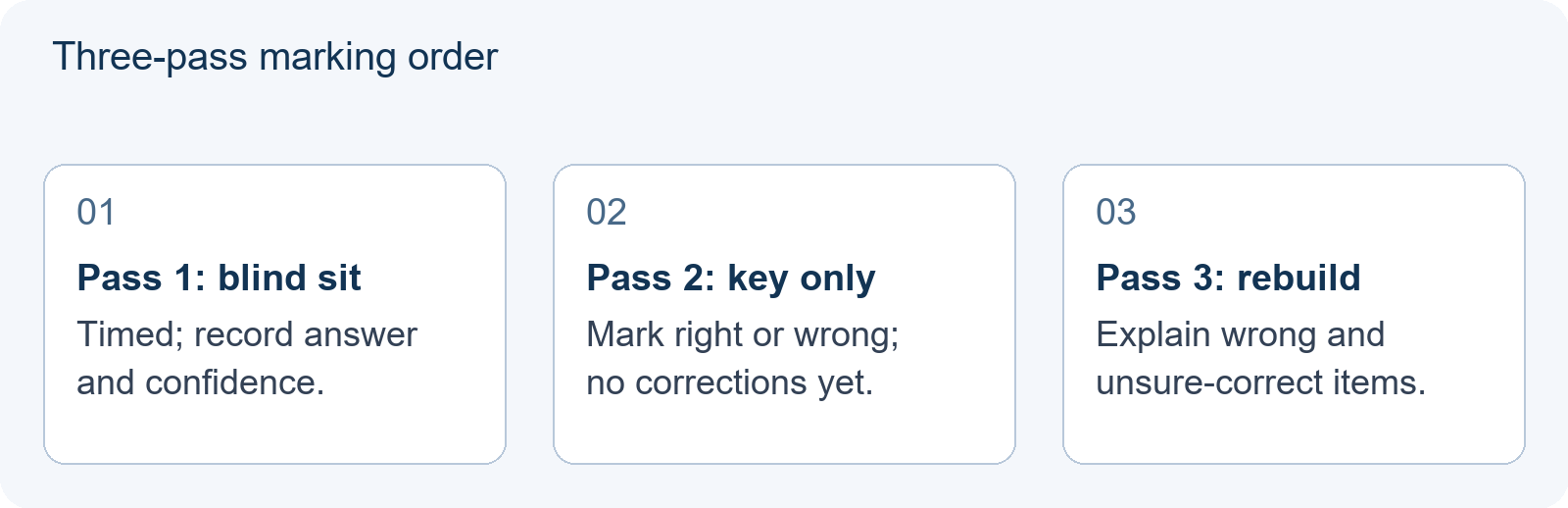
Pass one is the sitting itself: timed, closed book, with the confidence marks added at the end of the allotted time rather than during it, so the clock is not disturbed.
Pass two is the key check. Mark each row right or wrong and then stop. Do not write corrections on the script, do not cross out working, and do not annotate the paper with the right answer. The original script is the record of what the student actually did, and rewriting it destroys the evidence you are about to interpret.
Pass three is reason reconstruction, and it covers two groups: every wrong answer, and every correct answer marked ‘guess’. For each, ask the student to state the method out loud in one sentence. If they cannot, label the item unverified and route it to review. Only after pass three should you look for a worked explanation, and only for the items that survived it. Skipping pass two’s discipline destroys the evidence: a family corrects in red while marking, and by the last page the student owns a tidy set of right answers and no idea which ones were theirs.
A worked illustration: six questions, two students, one score
The slice below is a teaching illustration written for this article, not a past-paper question set. Each item is worth 3 marks, matching the first band at every level in the 11 October 2026 Hanlin notice, so the slice totals 18 marks.
| Item | Correct answer | Student X | X label | Student Y | Y label |
|---|---|---|---|---|---|
| Eight rows of seven counters | 56 | 56 (sure) | Mastery | 56 (sure) | Mastery |
| Fraction equal to 0.35 | 7/20 | 7/50 | Concept gap | 7/20 (sure) | Mastery |
| Area of a square, side 9 cm | 81 cm² | 36 | Concept gap | 81 cm² (sure) | Mastery |
| Third angle of a triangle, given 65° and 48° | 67° | 67° (sure) | Mastery | 77° | Slip |
| 15% of 240 | 36 | 36 (guess) | Unverified | 3.6 | Slip |
| 180 km in 2.5 hours, in km/h | 72 | Blank | Timing | 7.2 | Slip |
| Total | — | 9/18 | — | 9/18 | — |
Reading the two sheets
Both students scored 9/18. The totals suggest identical needs; the labels say otherwise.
X’s nine marks include one correct answer marked as a guess, so only 6 marks are demonstrated reasoning. X’s losses are two concept gaps, fraction equivalence and area confused with perimeter, which is where the 36 came from, plus one pacing loss. The repair is teaching, not volume: rebuild equivalent fractions from tenths and hundredths, contrast area and perimeter on the same square, then re-run six parallel items under time and re-explain the 15% item, which X could not verify.
Y’s nine marks are all demonstrated. The three losses differ in detail but share one broad signature: the method was right and the execution was not. Y computed 15% correctly but moved the decimal the wrong way, gave the speed as 7.2 instead of 72, and subtracted the angle incorrectly to get 77 instead of 67. The first two are the same decimal error twice; the angle error is a separate arithmetic slip. That is an accuracy problem, and the repair is a checking habit: estimate before computing, since 15% of 240 must lie between 24 and 48, read every answer back against the question’s units, and check that the three angles sum to 180°. Y does not need a concept lesson; X does. A shared total would have sent both to the same worksheet.
When a bare key is not enough
Pass three will fail on some items, and that is a result rather than a dead end. Three quick tests separate ‘needs a solution’ from ‘needs a teacher’. First, can the student state the method in one sentence, without numbers? ‘Multiply the two sides of a rectangle’ is a stateable method; ‘square the side’ is not, and no number of worked examples will install the distinction between length and area if it is missing. Second, can the student repeat the method on a parallel item with different numbers within a couple of minutes? A method that cannot be repeated is still being copied. Third, does the error disappear when the arithmetic is removed, for instance when the numbers are made easy? If it does, the gap was arithmetic, not reasoning.
Two failed items in the same topic is enough to justify a worked explanation; one isolated failed item is not enough to establish a topic gap. If three or more fail across different topics, consider whether a prerequisite from an earlier level is missing, and request a diagnostic conversation rather than a longer video list.
What the 2026 answer materials actually cover
In its course notice ‘2026 Australian AMC Sits Today! How Many Marks Can You Score This Year? Past Papers + Answers + Explanations Booking Channel Opens’ (Hanlin Courses WeChat account, 11 October 2026; title translated from the Chinese), Hanlin said its teachers were preparing 2026 Pre-A and Levels A-C question papers, answer keys and video explanations, to be released after the examination silence period, with families able to register interest in advance.
That sentence is specific in one direction and silent in another. It names Pre-A and Levels A-C; it says nothing about Levels D or E. It describes a release after the silence period, not a fixed publication date, and it does not describe a complete historical archive. The item is a course announcement from Hanlin Courses, not an Australian Maths Trust document, so it should be read as a statement of what a provider was preparing rather than as official publication policy. Because the 2026 sitting has already taken place, the practical step is to confirm current availability rather than assuming the materials are already out or that every level is covered.
Turning the sheet into a request
Three routes follow from the labels, and they are not interchangeable. If concept gaps dominate, the next block of work is teaching with a small number of problems, not a new paper. If slips and unverified correct answers dominate, the next block is accuracy work on items the student can already do: estimate first, check the unit, and re-answer three questions a day for a week. If timing and blanks dominate, the fix is pacing, which is covered separately in the post-sitting score audit by question band and in Australian AMC Past Papers: Choosing Practice Years by Level, Not Volume. Adding another paper does not by itself fix any of the three.
If a family decides to ask for help, the marking sheet keeps the request short and specific. Bring the level and sitting year; the question numbers with the student’s written working; the labels from pass three; what has already been tried; and whether the request is for a key, a worked explanation, or a teaching session. That list is a way of keeping an enquiry precise; it is not a form the site requires. It also guards against a mismatch: asking for a solution when the sheet shows the student already had the method and lost the marks to a decimal point. Families working below Level A can pair the same protocol with Australian AMC Pre-A Past Papers: A Practice Plan Without a Long Archive.
What the sheet cannot tell you
A practice slice is not the live paper, and a practice percentage is not an award prediction. The award bands in the same 11 October 2026 notice describe positions in the cohort: Prize at the top 0.3%; High Distinction at the top 3% for Pre-A to D and top 5% for E; Distinction at the top 20% and top 25%; Credit at the top 55% and top 60%, not marks on a worksheet. The notice also treats historical cut-off lines as a reference rather than as the standard for the current year. Six questions marked at home have no cohort behind them, and the same 9/18 can mean different things for a Grade 4 student in Level A and a Grade 10 student in Level D. Use the sheet to choose the next teaching step and leave the band question to the official score report.
General event background is available at Event background.
Frequently Asked Questions
Can I mark an Australian AMC reattempt with only an answer key?
Yes for right and wrong, but not for why. Add a confidence mark before checking and an error label after, and treat any correct answer the student cannot explain as part of the same review pile as a wrong one. The key confirms letters; the labels tell you what to teach next.
Does Hanlin’s 2026 answer-material plan cover every level?
The 11 October 2026 Hanlin course notice named 2026 Pre-A and Levels A-C question papers, answer keys and video explanations, to be released after the examination silence period. It did not mention Levels D or E, and it did not describe a complete archive, so confirm current availability rather than assuming coverage.
Can I convert a practice score into an expected award?
No. The award bands described in the same notice are cohort positions, not marks on a practice slice, and the notice itself treats historical cut-off lines as reference rather than as the current standard. Use the marking sheet to choose the next teaching step and leave the band question to the official score report.