
Past papers are the most useful Australian AMC preparation tool you have, and the most commonly wasted. Most students sit one, mark it, feel something, and move on. The four-pass method below turns a single 30-question paper into roughly a month of usable training, and gives you two scores instead of one so you can see exactly which marks are recoverable and which are not.
The China-region timing makes this urgent rather than theoretical. Registration closes on 28 September 2026 and the exam is sat on 11 October 2026. Starting in early August, that is roughly nine weeks – enough for four or five full papers run properly, and not enough for twenty run badly. If you are still deciding whether the competition is right for your child at all, start with our overview of what the Australian AMC is and how it works in China, then come back to method.
What counts as Australian AMC practice material
The Australian Mathematics Competition has been run by the Australian Maths Trust (AMT) since 1978, and AMT publishes sample problem sets with solutions for its divisions alongside its own paid past-paper collections. What is currently in print and in what format changes from year to year, so confirm the live catalogue on amt.edu.au rather than relying on a list you found on a forum.
Our editorial desk keeps a separate practice bank organised for China-region students – grouped by level and by topic rather than by year, with worked solutions for many of the papers we have compiled. Coverage is not complete for every year, and we say so plainly: the honest position is that solutions exist for a good share of the bank and we keep extending it, not that every question ever set has a write-up attached.
Two structural warnings before you download anything:
- Australian division names do not map one-to-one onto the China-region levels. AMT's Australian structure runs Middle Primary, Upper Primary, Junior, Intermediate and Senior across Years 3-12. The China region runs six levels, Pre-A to E, across Grades 1-12. If you pick up material labelled by an Australian division, match it by content difficulty, not by the label on the cover.
- Pre-A has almost no paper history. Pre-A was introduced for Grades 1-2 in the 2026 China-region cycle, so there is no deep archive behind it. Grade 1-2 families should build practice from gentler early-primary problem solving and from the lower reaches of the next level up, and should treat any “Pre-A past paper” claim with suspicion.
The four-pass method
One paper, four passes, spread across about three weeks. The point is that a paper you have already seen is still worth marks – as a solution text, as an error diary, and as a retest – long after the first sitting is over.
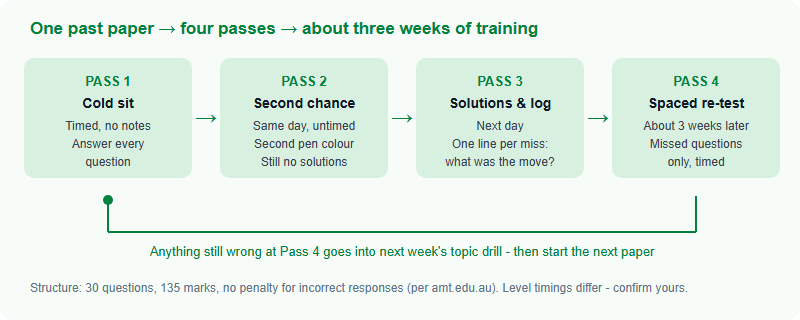
| Pass | When | Conditions | What you record |
|---|---|---|---|
| 1 – Cold sit | Day 1 | Full paper, timed, no notes, no calculator unless the rules for your level allow one | Cold score out of 135 |
| 2 – Second chance | Day 1, after a short break | Same paper, untimed, second pen colour, still no solutions | Second-chance score out of 135 |
| 3 – Solutions and log | Day 2 | Read the worked solution for every question you missed in both passes | One line per miss: the single move you did not see |
| 4 – Spaced re-test | About 3 weeks later | Only the questions you missed, timed at roughly two minutes each | Which misses have actually been fixed |
Pass 2 is the pass almost nobody runs, and it is the one that produces the diagnosis. A question you get right when the clock is off but wrong when the clock is on is a speed and nerve problem. A question you get wrong both times is a knowledge problem. Those two need completely different fixes, and a single score cannot distinguish them.
Score it twice, and score it the way the competition does
Marking a past paper as “24 out of 30” throws away information, because the questions are not worth the same. AMT publishes the mark structure below, and marking to it is the only way your practice score resembles the number you will actually receive.
| Questions | Type | Marks each | Marks in the block | What it means for practice |
|---|---|---|---|---|
| 1-10 | Multiple choice | 3 | 30 | Accuracy block. Losing marks here is the most expensive habit in the paper. |
| 11-20 | Multiple choice | 4 | 40 | The largest single block. Most realistic improvement lives here. |
| 21-25 | Multiple choice | 5 | 25 | Where speed banked earlier gets spent. |
| 26-30 | Integer answer | 6, 7, 8, 9, 10 | 40 | No options to work backwards from. Treat as a separate skill. |
| Total | 25 multiple choice + 5 integer | – | 135 | Mark scheme per amt.edu.au; confirm current details before exam day. |
One rule follows directly from the published marking policy: AMT states there is no penalty for incorrect responses. A blank multiple-choice answer on a practice paper is therefore a self-inflicted zero, and a bad habit to rehearse. On Pass 1, every one of the 25 multiple-choice questions gets a letter, even if the letter is a guess made in the last ninety seconds. Train the behaviour you want on 11 October.
Reading the gap: four diagnoses from two scores
Subtract the cold score from the second-chance score. That gap is the marks you already know how to earn but could not reach in the time available. Combined with the cold score itself, it sorts students into four very different training problems.
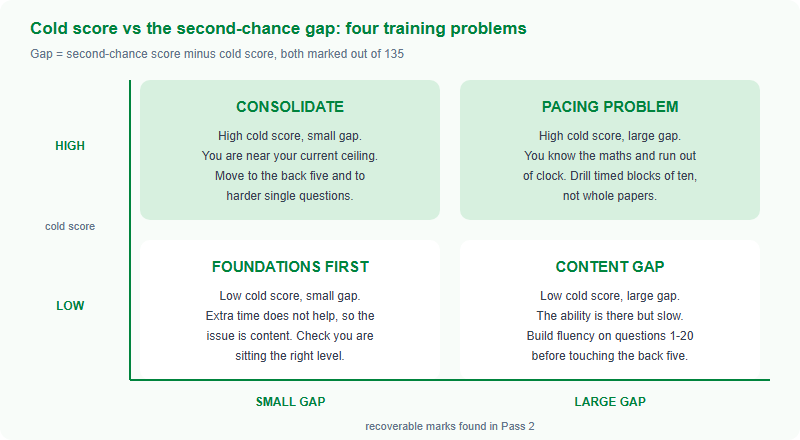
The practical consequence is that two students with the same score of, say, 66 out of 135 should spend the next fortnight doing completely different things. The one with a 24-mark gap needs timed blocks and a decision rule for when to move on. The one with a 4-mark gap needs topic teaching, and possibly a conversation about whether the level is right – which is a registration decision, not a revision decision, and one you can still act on before 28 September.
Building a year bank without burning the archive
Past papers are a finite resource with a use-by date. Once a student has seen a paper, its value as a calibration instrument is gone forever – they will score higher on a re-sit for reasons that have nothing to do with progress. Spend them deliberately:
- Four to six full papers across the nine weeks is the right order of magnitude for most students. Between them, work single questions by topic. Volume is not the constraint; the quality of Pass 3 is.
- Hold back two recent papers. Sit one about a fortnight out and one about five days out. These are your calibration papers, and they should be the only two you have not touched before.
- Work one level below for fluency. If questions 1-10 are costing you marks, a paper from the level below run at speed is better training than another paper at your level run in a panic.
- Only borrow upwards for the back five. Pulling questions 26-30 from a harder level is a reasonable stretch exercise. Sitting a whole paper from a level above rarely teaches anything except discouragement.
- Never substitute a different competition. The Australian AMC (run by AMT) is not the American AMC (run by the MAA) and not AMO (run by SIMCC). The papers differ in style, length, marking and intent, and practising the wrong one trains the wrong instincts.
Five things past papers will not tell you
This is where honest preparation separates from wishful preparation. A past-paper score is a useful signal, not a prediction, and here is exactly where the signal breaks down.
- It does not convert into an award. Recognition is distributed by how a cohort performs, and the boundaries reset each cycle – so a score that reached a particular band in an earlier year tells you very little about this year. Confirm the current award structure on the official listing rather than back-calculating from old results.
- Difficulty drifts between years. Two papers from the same level can feel a full band apart. This is why you take a trend across several papers seriously and a single result lightly.
- Australian archive material is in English. The China-region paper is bilingual, and reading a question in two languages is a skill of its own. Archive material sourced from Australia will not rehearse it.
- Timings differ by level. AMT publishes 60 minutes for its primary divisions and 75 minutes for its secondary divisions in Australia. The China-region Pre-A to E levels run to their own published durations – confirm the exact time allowance for your level with ASDAN before you set a timer for Pass 1.
- The integer questions behave differently under pressure. With no options on screen, there is nothing to eliminate and nothing to reverse-engineer. Students who look strong on multiple choice in practice often lose the whole 40-mark block on the day, which is why Pass 4 should always include at least one integer question.
Run properly, four papers between early August and 11 October will teach a student more than twenty run as a scoring ritual. If you are still setting up the year rather than the term, our Australian AMC overview for students in China covers the levels, the structure and the China-region calendar in one place.
Questions we get asked
How many past papers should I do before 11 October 2026?
Four to six full timed papers is plenty for most students, with single-question work in between. The review quality matters far more than the count.
Is it worth guessing on multiple-choice questions I cannot finish?
Yes. AMT states there is no penalty for incorrect responses, so a blank multiple-choice answer only guarantees zero marks.
Can I practise with American AMC or AMO papers instead?
No. The Australian AMC is run by AMT, the American AMC by the MAA and AMO by SIMCC. Style, level and marking all differ.
Can I use a paper labelled with an Australian division name?
Yes, but match it by content difficulty. Australian divisions do not map one-to-one onto the China-region Pre-A to E levels.
Published by the Australian AMC editorial desk, operated by Hanlin Education for China-based international-school students. The Australian Mathematics Competition is run by the Australian Maths Trust (AMT, Australia, since 1978) with ASDAN as the China-region operator. Official rules are set by the competition and change yearly – confirm current details, dates and level timings on amt.edu.au and the ASDAN China-region listing. Any factual error reported to us is corrected within 7 working days.