
Grades 10-12 students sit the senior end of the Australian AMC ladder – Levels D and E – and they sit it in the worst month of their school year. The exam falls on 11 October 2026, inside the same four weeks as UK application deadlines, US early rounds, internal assessments and school mocks. This is a triage article: how to decide whether to sit it at all, and if you do, how to prepare on three hours a week without damaging anything that matters more.
Where Levels D and E sit, and what the paper is
The China region runs six levels – Pre-A, A, B, C, D and E – across Grades 1-12, with D and E at the top of the ladder covering the senior grades. Confirm your exact grade-to-level mapping on the ASDAN China-region listing for 2026 before you register, because banding is set by the operator and can be adjusted between cycles. If you want the full ladder in one place, our Australian AMC overview for students in China lays it out.
The paper itself does not get longer at the senior end – it gets deeper. Every level sits 30 questions for a maximum of 135 marks, split by AMT into 25 multiple-choice questions and 5 integer-answer questions, with no penalty for incorrect responses. What changes at D and E is the demand inside each question. AMT publishes 60 minutes for its primary divisions and 75 minutes for its secondary divisions in Australia; the China-region levels run to their own published timings, so confirm the duration for your level before you plan any timed practice.
One thing worth saying plainly to Grade 11 and 12 students: this is the Australian AMC, run by the Australian Maths Trust since 1978. It is a different competition from the American AMC 10/12 run by the MAA, and different again from AMO run by SIMCC. If you are already committed to an American AMC pathway, sitting the Australian AMC is a complement, not a substitute, and you should not assume any of the three converts into the others.
The October collision: what else is in your calendar
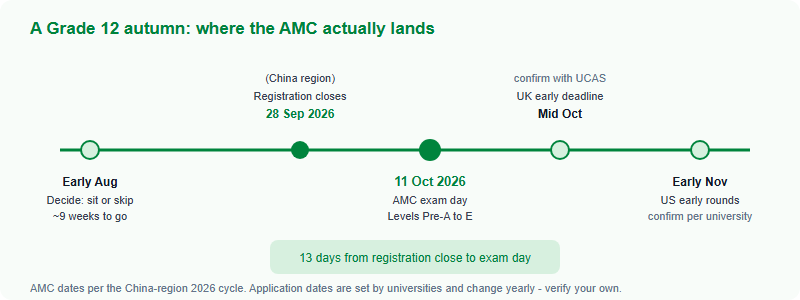
The reason this article exists is that 11 October 2026 is not a free Sunday for a senior student. Map the real calendar first, then decide. Dates below that belong to universities and examination bodies change every cycle – treat them as prompts to check your own timetable, not as a schedule.
| Window | What a Grade 12 student is usually doing | AMC implication |
|---|---|---|
| Aug (weeks 1-4) | Essay drafting, summer research write-ups, start of term | The only genuinely free block. Do most of your AMC work here. |
| Sept (weeks 5-8) | Recommender chasing, first internal assessments, test dates | Register before 28 September. Prep drops to maintenance level. |
| 1-11 Oct | Final application edits, possible national-day break | Two short calibration sittings only. No new material. |
| 12-31 Oct | UK early deadline (mid-Oct, confirm with UCAS), predicted grades | AMC is finished. Do not schedule anything AMC-related here. |
| Nov onwards | US early rounds, DP2 or Y13 mocks at many schools | Results timing is published by the operator – confirm, do not assume. |
The single most useful observation for Grade 12: the AMC costs you almost nothing in the two weeks that matter most, because it is over before the UK mid-October deadline. The cost is entirely in August and September. If your August is already spent, that is a real argument for skipping – and skipping is a legitimate answer.
What actually transfers between your syllabus and the paper
Senior students often assume that because they are doing IB HL Analysis or A-Level Further Maths, the AMC will be straightforward. That is half right. The overlap is real but uneven, and the mismatch is where marks go missing.
| Skill | How much your course trains it | How much the paper rewards it |
|---|---|---|
| Fast, accurate arithmetic without a calculator | Low – most senior courses assume a calculator | High, especially in the early mark bands |
| Algebraic manipulation and substitution | High | High – transfers almost directly |
| Plane geometry, angles, similar figures | Variable – often thin after Grade 10 | Meaningful, and a common weak point at D and E |
| Counting, arrangements and elementary probability | Moderate | Meaningful, and rewards structure over formulae |
| Calculus machinery and long structured proofs | Very high | Not what a 30-question timed paper is built around |
| Choosing a method fast and abandoning it faster | Low – school papers reward persistence | Decisive across the whole paper |
The published topic outline for the competition sits on the official site and is the authority on scope – confirm it on amt.edu.au rather than inferring the syllabus from a course you happen to be taking. The practical reading of the table above is this: your course has trained the machinery and undertrained the speed. That is a good position to be in, because speed is the cheaper of the two to fix in nine weeks.
Triage: should you sit it this year?
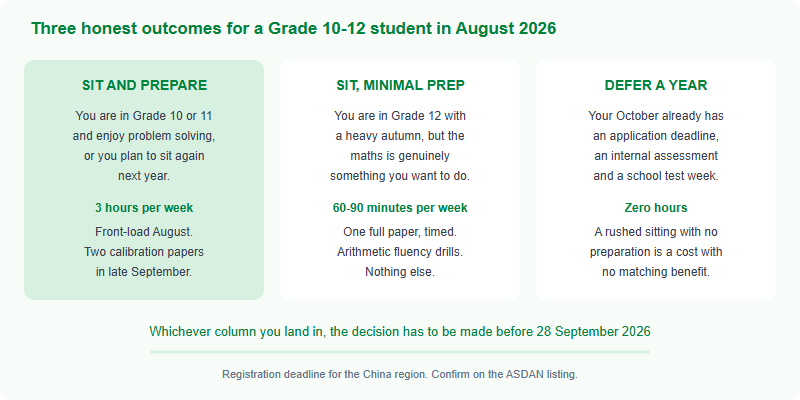
There are three honest answers, and one of them is no. Work down the questions in order and stop at the first one that resolves.
A nine-week plan at three hours a week
If you land in the first or second column, here is what three hours a week actually buys between early August and 11 October. The plan is deliberately front-loaded, because September will not go the way you imagine it in August.
- Weeks 1-3 (August). Two hours on untimed problem sets by topic, one hour on calculator-free arithmetic and algebraic manipulation. This is the block where content gaps close. Geometry first if it has been two years since you last did any.
- Weeks 4-5 (late Aug to early Sept). First full timed paper. Mark it to the 3 / 4 / 5 / 6-10 mark structure rather than as a raw question count, so the number resembles a real result. Spend the following week only on what it exposed.
- Week 6 (mid-Sept). Integer-answer questions only. The five questions at the back carry 40 of the 135 marks and give you nothing to eliminate, so they are the block senior students most often lose while assuming they are safe.
- Week 7 (by 28 Sept). Register. Then one timed block of ten questions, nothing more – September is when your school workload arrives.
- Weeks 8-9 (1-11 Oct). Second and final calibration paper about five days out, then stop. No new material inside the last 72 hours. Confirm your venue details and timing for your level, and put the whole thing down.
One rule overrides all of it: nothing on this list outranks a school deadline or an application deadline. If a week has to be cut, cut it, and cut it without renegotiating the rest of the plan upward to compensate.
What it does, and does not do, for applications
Honest version: a maths competition result is one small, verifiable data point about how you spend your time. It is not an admissions instrument, no result guarantees or improves any outcome at any university, and nobody should sit an October exam in Grade 12 on the theory that it will move an application decision.
Where it does have a defensible role is coherence. A student applying for mathematics, engineering, economics or computer science who has been sitting the same competition since Grade 8 has a consistent record rather than a last-minute one – and that record was built in Grades 8 to 11, not in the autumn of Grade 12. That is the strongest argument in this entire article for the Grade 10 and 11 reader, and the strongest argument against panic-registering in Grade 12.
If you are building that multi-year record from the start of senior school, our overview of the Australian AMC and its six China-region levels is the place to begin.
Questions we get asked
Which level do Grades 11 and 12 sit?
The senior end of the China-region ladder, Levels D and E. Confirm the exact grade-to-level mapping for 2026 on the ASDAN listing before registering.
Is the senior paper longer than the junior one?
No. Every level sits 30 questions for 135 marks. Time allowances differ by level, so confirm the duration for yours before timing any practice.
Does the Australian AMC count towards American AMC 10 or 12?
No. AMT runs the Australian AMC, the MAA runs the American AMC. They are separate competitions with separate pathways.
Is it worth sitting in Grade 12 with no preparation time?
Often not. A rushed October sitting during application season carries real cost and little benefit. Deferring is a reasonable decision.
Published by the Australian AMC editorial desk, operated by Hanlin Education for China-based international-school students. The Australian Mathematics Competition is run by the Australian Maths Trust (AMT, Australia, since 1978) with ASDAN as the China-region operator. Official rules are set by the competition and change yearly – confirm current details, dates and level timings on amt.edu.au and the ASDAN China-region listing. University and examination-board deadlines are set by those institutions and must be confirmed independently. Any factual error reported to us is corrected within 7 working days.