
Extra time and large-print papers both exist in the Australian AMC's rules, and neither is automatic. The Australian Maths Trust's 2026 handbook for competition coordinators says a student who requires additional time can have the standard time extended, and that large-print AMC papers are available on request. In the China region ASDAN administers the sitting, so the request goes through them — and the sensible last day to make it is Monday 28 September 2026, when entries close.
What AMT's handbook actually provides
AMT publishes a Competition handbook for coordinators and supervisors — the document schools use to run its competitions, last updated in January 2026. Its accessibility section is brief. It starts from the principle that every student should be able to take part, and then names two variations. On time, a coordinator whose student needs longer can contact AMT to have the standard competition time extended. On format, AMT's wording is short enough to give exactly: “We can provide large-print PDFs of AMC competition papers on request.”
Two details in that wording decide how a family should act. First, both variations are arranged in advance, by whoever runs the sitting contacting AMT — nothing in the handbook suggests either can be switched on at the door. Second, the handbook is written for coordinators. In the China region that coordinating role sits with ASDAN, which handles registration, invigilation, marking and certificates while the papers and standards remain AMT's. So the useful question is not “is extra time allowed?” but “can ASDAN arrange it for this seat, and what do they need from us?” The handbook itself is published on amt.edu.au.
| Provision | What AMT's 2026 handbook provides | Who it applies to | What to confirm with ASDAN |
|---|---|---|---|
| Additional time | The coordinator contacts AMT to have the standard time extended | A student who requires it, by request | Whether it can be arranged for a China-region seat, what supporting information is needed, and where the student sits once the standard session ends |
| Large-print paper | Large-print versions of AMC papers, provided on request | AMC papers, by request | Whether large print is available for your level and paper language, and how answers are recorded on it |
| Leaving the room | A student may leave the room only with a supervisor | Every student | Whether a known medical need, such as a likely mid-paper break, should be flagged beforehand |
| Phones and smart watches | Collected and stored safely; none may be kept during the competition | Every student | Any medical device that relies on a phone or a watch |
| Language dictionaries | Printed language dictionaries or readers are allowed in every competition | Every student | How it is applied at your seat — this is a language provision, not an access arrangement |
Notice what the handbook does not list: a scribe, a separate room or rest breaks. That does not make them impossible; it means they are not published, so they cannot be assumed. If a child needs something outside the two listed variations, describe the need plainly and let ASDAN say what can be done.
Who should be asking — and who should not
The test is not whether a child would like more time. Almost every child would. AMC awards are relative: AMT gives a Distinction to the top 20% of students in the same year and region, a Credit to the top 55%, and so on, and every student in that year sits the same paper in the same session. An access arrangement exists to take a barrier away from one student, not to hand that student an advantage over the rest of their grade.
With that in mind, these are the situations in which we would expect a family to write to ASDAN:
- The child already has an arrangement at school. Extra time in internal assessments, enlarged papers, or a learning-support plan. A school arrangement does not travel to an outside competition on its own; the competition only knows what it is told.
- A documented need affecting reading, processing or writing speed. The paper runs inside a fixed session, so a student whose difficulty is the speed of reading or recording is exactly the student the time variation describes.
- A vision need that makes standard print hard to read. This is what the large-print variation is for.
- A temporary injury to the writing hand or arm. The handbook lists no scribe, so the question to ask is what, if anything, can be arranged.
- A medical condition that may mean leaving the room or keeping a device close. Under AMT's rules a student who leaves is accompanied by a supervisor, and phones and smart watches are stored away. Both are worth raising before the day rather than at the door.
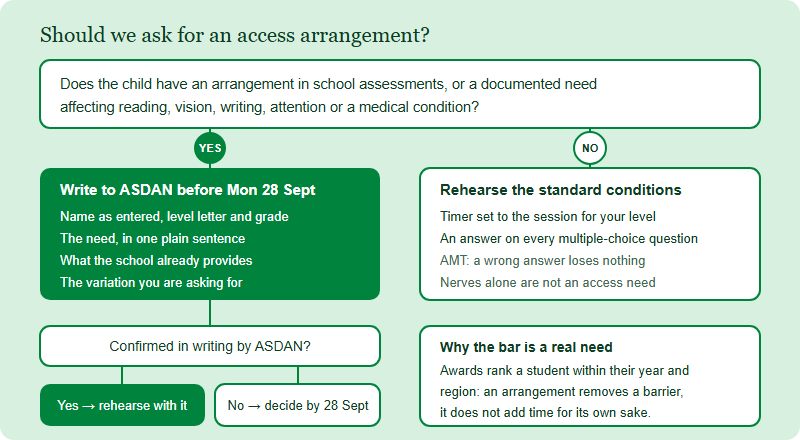
And these are the situations in which we would not: a student who is anxious about the clock, a student who is slower than classmates without an identified need, or a strong student who would simply like breathing room. For them the honest tools are rehearsal under the real session length and the no-penalty rule — AMT applies no penalty for a wrong answer, so a considered answer to every multiple-choice question costs nothing. If the competition itself is new to your family, our overview of what the Australian AMC is sets out the paper and the six levels first.
Why the request belongs in September, not October
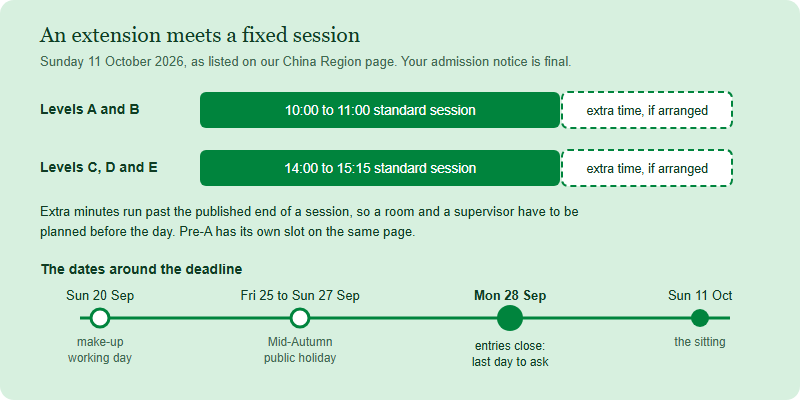
Arrangements that change timing or paper format have to be built into the day before it happens, and the calendar between now and 28 September is shorter than it looks. Four dates and rules shape it.
| What | When, or the rule | Why it matters for a request |
|---|---|---|
| The sessions | Levels A and B 10:00–11:00, Levels C, D and E 14:00–15:15 on Sunday 11 October, per the timetable on our China Region page; Pre-A's slot is listed there too | An extension runs past the end of a published session, so a room and a supervisor have to be planned for the extra minutes — AMT's handbook requires in-person supervision throughout |
| Mid-Autumn Festival | Friday 25 to Sunday 27 September, a public holiday under the State Council's 2026 holiday notice | The last weekend before the deadline is a holiday, so anything that needs a school office or learning-support coordinator to confirm is best finished by Thursday 24 September |
| Make-up working days | Sunday 20 September and Saturday 10 October, under the same notice | Schools that follow the national calendar may hold lessons on those dates; check your own school's published calendar |
| The entry deadline | Monday 28 September 2026 | After it, the entry list turns into the day's logistics; and per the terms on our registration page, a cancellation before the deadline is refunded with a 25% administration deduction, with no refund afterwards |
That last row is the reason to ask early rather than hopefully. If an arrangement your child genuinely needs cannot be confirmed in time, whether to go ahead this year is a decision best made while the cancellation terms still allow it. In our view a child is better served sitting next year with the right support than sitting this year without it.
What to put in the message
One message, written once, saves a week of back-and-forth. Put these seven things in it, in this order.
- The student's name exactly as entered, with the level letter and the grade shown on the entry.
- Any sitting details you have already been given, and the paper language chosen at registration. Our registration page notes that English or Chinese is chosen when you register.
- The need, in one plain sentence. “She has a diagnosed reading difficulty and receives extra time in all school assessments” is enough. Medical detail beyond what is needed to understand the request is not.
- What the school already provides, and whether the school can confirm it in writing if asked.
- The specific variation: additional time, or a large-print paper. Naming it the way the handbook does lets the request be matched to what AMT actually offers.
- Two practical questions: where does the student sit once the standard session ends, and how are answers recorded on a large-print paper?
- A request for written confirmation, so the arrangement can be shown on the day if anyone at the venue has not been told.
Rehearse with the arrangement you actually have
An arrangement only helps if the student has practised with it. In our coaching experience, a child who has always worked to the standard clock and is suddenly given more time often spends it badly — re-checking easy questions rather than using the minutes where the marks are.
- If additional time is confirmed, set the practice timer to the confirmed total, not the standard one, and re-plan the paper block by block. AMT's mark scheme puts 3 marks on each of questions 1–10, 4 on questions 11–20, 5 on questions 21–25 and 6 to 10 on the last five, so questions 11 to 25 carry 65 of the 135 marks. Our advice is to give most of the extra minutes to that middle block and to a final check that every multiple-choice question has an answer, not to the hardest question at the back.
- If a large-print paper is confirmed, practise from enlarged copies at a similar size. The change is physical: bigger pages to turn, diagrams that no longer fit in one glance, and working that has to sit somewhere sensible. AMT's supervisor script also reminds students that diagrams are not drawn to scale, and enlarging a figure does not make it measurable.
- If nothing can be confirmed in time, rehearse under standard conditions and decide in advance which questions the student will leave until last. That is a real plan, not a consolation prize.
- If ASDAN confirms an online seat, note that AMT's troubleshooting guidance lets coordinators request extra time while technical problems are being resolved. That is a response to a failure on the day, not an access arrangement; the student's only job if a screen misbehaves is to raise a hand straight away.
Language support is a different conversation
Families sometimes fold language support into an access request. Keep the two apart, because they work differently.
- The paper language is chosen at registration, and every China-region level is offered in English or Chinese, with identical questions. For a child who reads far more comfortably in one language than the other, which language sits on the entry is itself worth checking before 28 September.
- Printed language dictionaries or readers are allowed in every competition under AMT's supervisor script, and the same script lets a student ask a supervisor what a word on the paper means. Neither is a variation you apply for.
- Pre-A, per our operator briefing, is picture-led and text-light and comes with a read-aloud facility. A Grade 1 or 2 child with a hearing difficulty is precisely the case to describe to ASDAN, because a read-aloud facility is built around listening.
One last check: make sure every arrangement you have read about belongs to this competition. The Australian AMC is run by the Australian Maths Trust; the American AMC is run by the MAA, and AMO by SIMCC in Singapore, and their rules do not transfer here. For the structure of the paper your child will actually sit, see our guide to the Australian AMC and its six levels.
Frequently asked questions
Can a student get extra time in the Australian AMC?
AMT's 2026 handbook allows an extension to the standard time by request. For a China-region seat, ask ASDAN before entries close on 28 September.
Are large-print Australian AMC papers available?
AMT says large-print AMC papers can be provided on request. Confirm with ASDAN whether one is available for your level and paper language.
Why ask before 28 September rather than in October?
An extension or a large-print paper has to be planned before the sitting, and cancellation terms change once entries close on 28 September.
Is a printed dictionary an access arrangement?
No. AMT allows printed language dictionaries or readers in every competition. It is a language provision, not a variation you apply for.
Published by the Australian AMC editorial desk, operated by Hanlin Education for China-based international-school students. The Australian Mathematics Competition is run by the Australian Maths Trust (AMT), with the China region administered by ASDAN. Official rules are set by the competition and change yearly — confirm current details on amt.edu.au. Errors are corrected within 7 working days.