
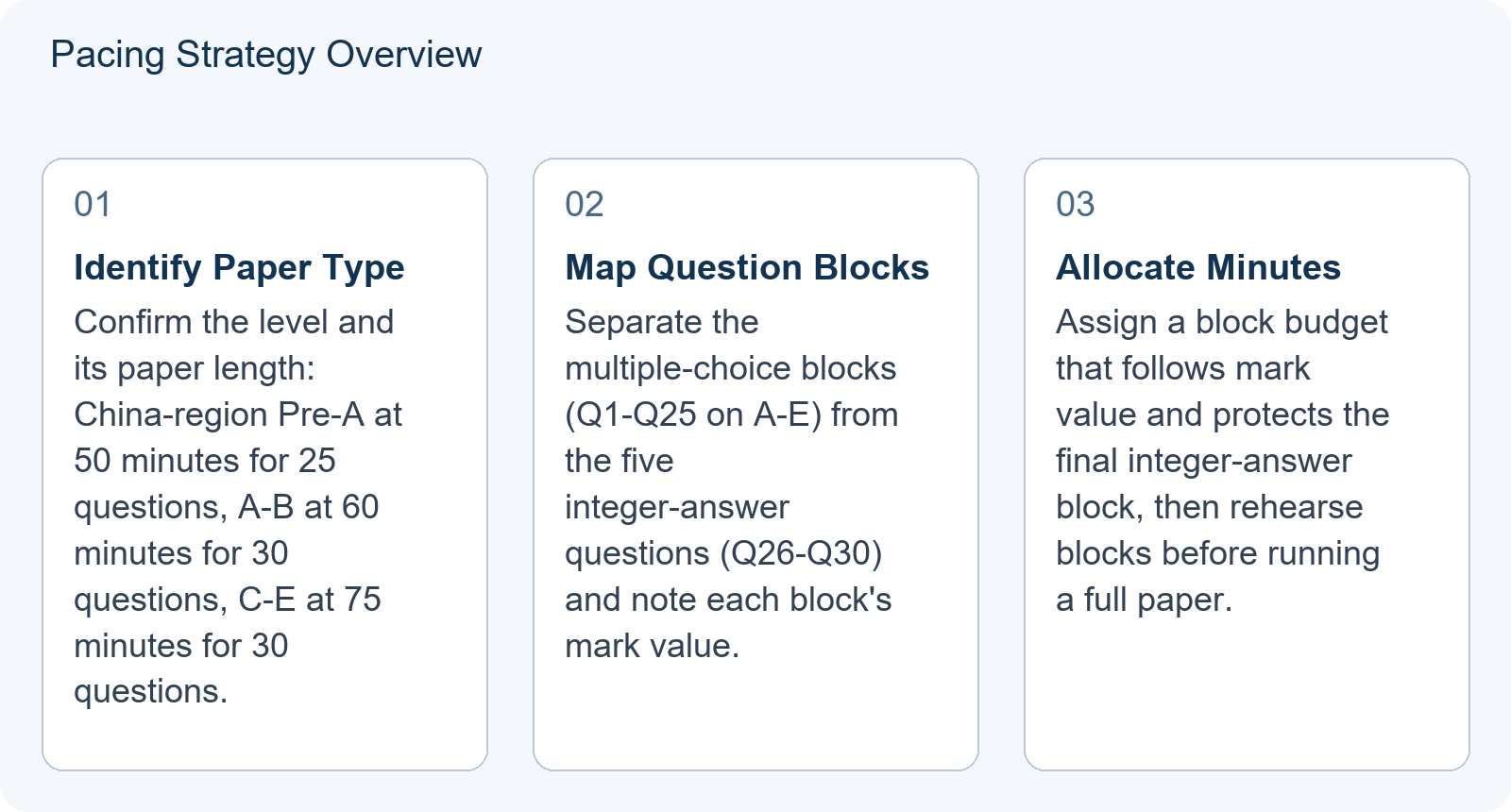
Australian AMC pacing is not one universal timer. The minute budget a student should rehearse depends on which paper that student sits in 2027. According to the Hanlin report “How to Choose Math Competitions for Grades 3-8? AMC8/Kangaroo/Australian AMC/SASMO…” (Hanlin, 2 October 2026), the China-region structure reported for the Australian Mathematics Competition is: Pre-A for Grades 1-2 at 50 minutes for 25 questions; Levels A-B for Grades 3-6 at 60 minutes for 30 questions; and Levels C-E for Grades 7-12 at 75 minutes for 30 questions, with no incorrect-answer penalty. Separately, the Australian Maths Trust (AMT) official overview, checked 26 October 2026, states that Primary divisions take 60 minutes, Secondary divisions take 75 minutes, and standard Middle Primary through Senior papers carry 30 questions (25 multiple-choice and five integer-answer questions) worth 135 marks. For 2027 preparation, the useful task is to turn those paper lengths into question-block budgets, especially for the five integer-answer questions at Levels A-E.
Why Paper Length Changes the Pacing Plan, Not Just the Clock
A longer paper does not automatically mean a more relaxed paper. The extra time in a 75-minute setting is usually absorbed by the harder middle and final blocks, not by the opening questions. A student who simply spreads the same habits across more minutes tends to spend the surplus on the questions they already find comfortable, then arrives at the integer-answer block with the same pressure as before. Effective australian amc pacing requires recognizing that time allocation must shift dynamically based on the difficulty curve of the specific level being sat.
Three structural facts drive the plan. First, the mark weight rises across the paper. On Levels A-E, questions 1-10 are worth 3 marks each (30 marks), questions 11-20 are worth 4 marks each (40 marks), questions 21-25 are worth 5 marks each (25 marks), and questions 26-30 are worth 6, 7, 8, 9 and 10 marks respectively (40 marks), for a 135-mark total. Second, the final five items are integer-answer rather than multiple-choice, so they do not reward elimination in the same way. Third, there is no incorrect-answer penalty, which removes the fear of a wrong guess but also removes the temptation to leave a blank.
Official AMT Facts and China-Region Reported Practice: A Scope Table
The two sources describe overlapping but differently named structures. Keeping them separate is part of honest pacing preparation. Families must be aware that terminology differs between the global AMT framework and the specific reporting used by China-region organizers like Hanlin.
| Setting | Source and status | What is stated |
|---|---|---|
| AMT Primary divisions | AMT official overview, checked 26 October 2026 | 60 minutes; standard Middle Primary through Senior papers have 30 questions, 25 multiple-choice and five integer-answer, 135 marks, no penalty for incorrect answers |
| AMT Secondary divisions | AMT official overview, checked 26 October 2026 | 75 minutes; same 30-question, 135-mark standard paper description |
| China-region Pre-A (Grades 1-2) | Hanlin, 2 October 2026 (paper length and no-penalty rule) and Hanlin, 11 October 2026 (per-question mark scale) | 50 minutes; 25 questions; reported mark scale of 3 marks for Q1-10, 4 for Q11-20, then 5, 5, 6, 6 and 8 for Q21-25, totalling 100 marks; no incorrect-answer penalty |
| China-region Levels A-B (Grades 3-6) | Hanlin, 2 October 2026 (paper length, question count and no-penalty rule) and Hanlin, 11 October 2026 (135-mark scale including 6–10 marks for Q26–Q30) | 60 minutes; 30 questions; no incorrect-answer penalty; 135-mark paper with a rising mark weight per question |
| China-region Levels C-E (Grades 7-12) | Hanlin, 2 October 2026 (paper length, question count and no-penalty rule) and Hanlin, 11 October 2026 (135-mark scale including 6–10 marks for Q26–Q30) | 75 minutes; 30 questions; no incorrect-answer penalty; 135-mark paper with a rising mark weight per question |
Terminology note: the AMT divisions and the China-region level letters are different naming systems. The AMT overview also lists an Early Primary pilot for Australian and New Zealand Years 1-2 at 50 minutes, 25 questions (20 multiple-choice and five integer-answer, online), with Early Primary joining standard offerings in 2027. That pilot description should not be relabelled as the China-region Pre-A rules, because the sources describe them separately. Families preparing for 2027 should also note that the AMT overview lists a main calendar window of 3-5 August 2027; this is not confirmation of any China regional date, which should be checked with the regional organiser when it is announced.
A Diagnostic Minute Budget for the 30-Question Papers (Levels A-E)
The following table is a coaching budget, not an official timing rule. It is built so that each block receives time roughly proportional to its mark weight, with a deliberate reserve for the final integer-answer block. This approach ensures that australian amc pacing strategies prioritize high-yield sections without neglecting foundational accuracy.
| Question block | Marks | 60-minute plan (A-B) | 75-minute plan (C-E) |
|---|---|---|---|
| Q1-Q10 | 30 | 15 minutes | 18 minutes |
| Q11-Q20 | 40 | 20 minutes | 24 minutes |
| Q21-Q25 | 25 | 15 minutes | 18 minutes |
| Q26-Q30 | 40 | 10 minutes | 15 minutes |
| Total | 135 | 60 minutes | 75 minutes |
The 75-minute column is not the 60-minute column with extra breaks inserted. It adds 3 minutes to the opening block, 4 minutes to the middle block, 3 minutes to Q21-Q25 and 5 minutes to the integer-answer block, so every section gains a little verification room and the highest-value block gains the most. In practice, even two additional minutes on the final block can change how many of Q26-Q30 are attempted seriously rather than abandoned.
A Diagnostic Minute Budget for the 50-Minute, 25-Question Pre-A Paper
The Pre-A paper is shorter, but it is not simply a scaled-down version of a 30-question paper. On the Hanlin-reported 100-mark scale, questions 1-10 carry 3 marks each, questions 11-20 carry 4 marks each, questions 21-22 carry 5 marks each, questions 23-24 carry 6 marks each, and question 25 carries 8 marks. A 50-minute rehearsal plan could therefore look like this.
| Question block | Marks | 50-minute plan (coaching budget) |
|---|---|---|
| Q1-Q10 | 30 | 12 minutes |
| Q11-Q20 | 40 | 18 minutes |
| Q21-Q22 | 10 | 6 minutes |
| Q23-Q24 | 12 | 8 minutes |
| Q25 | 8 | 6 minutes |
| Total | 100 | 50 minutes |
Younger candidates often lose time before the mathematics begins: reading a full question twice without a purpose, changing an answer after every hesitation, or waiting for a read-aloud cue to repeat. The Pre-A budget above assumes the student has already rehearsed the room routine, including how a read-aloud paper is delivered in the student’s centre, so that procedural time is not quietly taken out of mathematical time.
Worked Teaching Illustration: Turning a 60-Minute Plan into a 75-Minute Plan
Consider a hypothetical student who sits a 60-minute paper and uses the 15/20/15/10 split above. When that student moves up to a 75-minute paper, the weakest possible adjustment is to keep the first three blocks unchanged and let the extra 15 minutes accumulate at the end. That turns the final block into an unstructured 25-minute stretch, which is rarely where the marks are won.
Coaching judgment, not official timing: a more useful transfer is to run the rehearsal with the 75-minute target shape from the start: 18 minutes for Q1-Q10, 24 minutes for Q11-Q20, 18 minutes for Q21-Q25, and 15 minutes for Q26-Q30. If the first session shows that the student finishes Q1-Q20 in 38 minutes, the response is not to celebrate the spare 4 minutes but to require the student to use them for a deliberate check of Q11-Q20 working. If the student finishes Q1-Q20 in 46 minutes, the response is to train the decision to leave a question and return, because the final block is worth 40 marks and needs protected time.
The point of the transfer is behavioural, not arithmetic. A 75-minute paper rewards a student who can hold a second look at a middle question instead of rushing to the end, and a 60-minute paper rewards a student who has already practised the same block discipline under tighter constraints.
Common Pacing Errors That Cost Marks
- Over-investing in one early question. Spending five minutes on a 3-mark question buys a small return and removes time from the 40-mark final block.
- Treating the middle block as optional revision. Q11-Q20 carry 40 marks and usually decide whether a student moves from a middle band into a stronger one.
- Leaving no review time. A plan that finishes exactly at the bell leaves no capacity to catch a misread unit, a copied digit or a dropped condition.
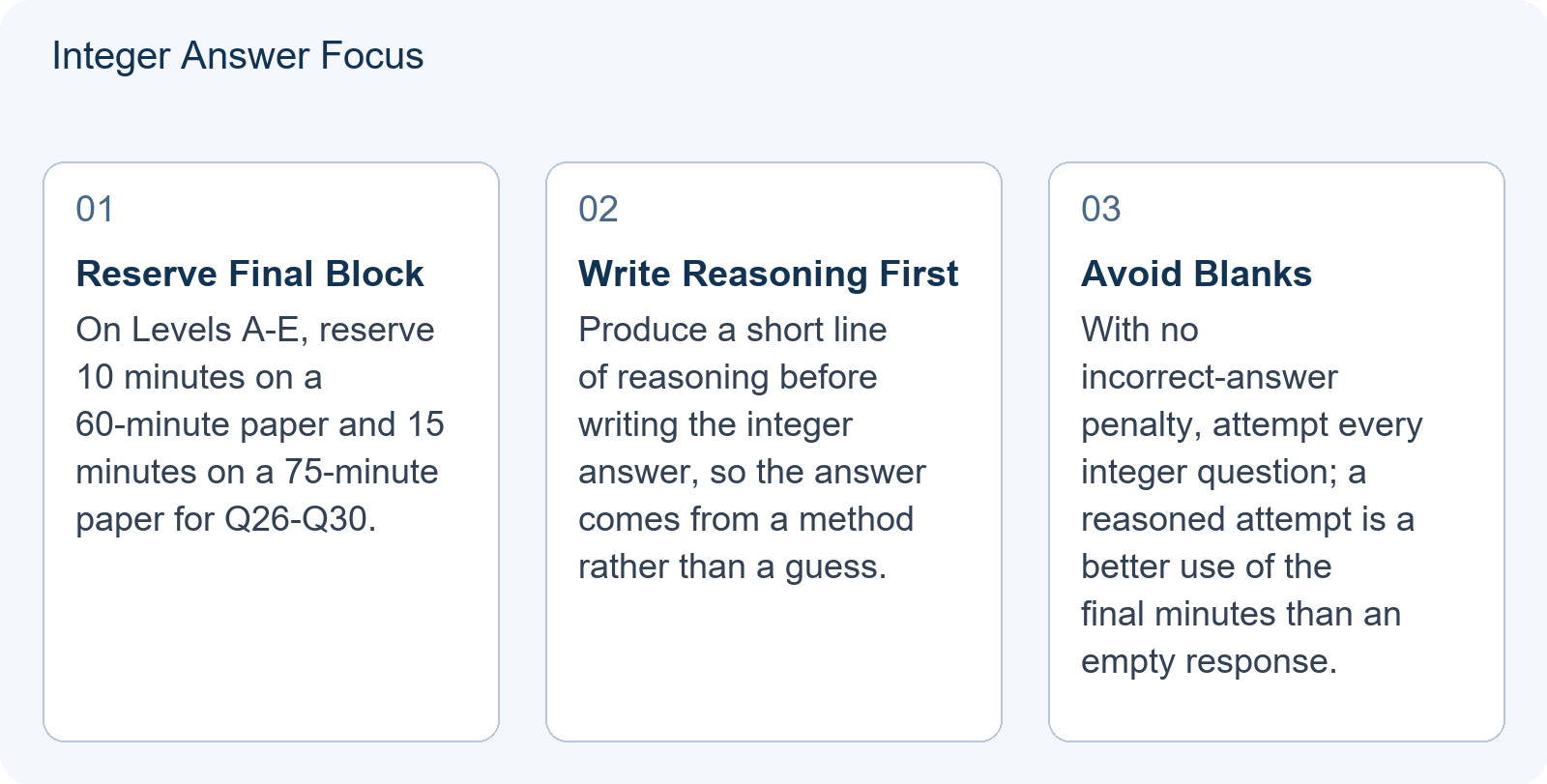
- Abandoning integer answers. With no incorrect-answer penalty, an attempted integer answer with visible working is a better use of the final minutes than a blank, even when the student is not fully certain.
- Rehearsing only full papers. Full-paper practice is useful late, but block rehearsal is what builds the minute boundary in the first place.
Seven-Day Pacing Drill for 2027 Preparation
This is a suggested teaching routine, not an official scoring requirement, and it does not promise any result. It is designed to instill muscle memory for australian amc pacing decisions.
- Days 1-2: Rehearse only the opening block. Use a 15-minute target on a 60-minute paper or an 18-minute target on a 75-minute paper, and stop the clock at the boundary whether or not the block is finished.
- Days 3-4: Add the middle block. Practise the transition from Q10 to Q11 and from Q20 to Q21 without a pause, because most lost time sits in transitions rather than in the questions themselves.
- Day 5: Rehearse Q21-Q25 under the strict block limit, then compare the student’s working with the mark value of each item.
- Day 6: Rehearse Q26-Q30 alone. Require the student to write a short line of reasoning before the final answer, so that an integer answer is produced by a method rather than by a guess.
- Day 7: Run one complete paper using the full minute budget, then record which block overran and by how much. The record, not the score, is the output of the drill.
For a Pre-A candidate, the same seven days can be adapted to the 25-question structure: Days 1-2 on Q1-Q10 (12 minutes), Days 3-4 on Q11-Q20 (18 minutes), Day 5 on Q21-Q22 (6 minutes), Day 6 on Q23-Q25 (14 minutes combined), and Day 7 on a full 50-minute run.
Using the Diagnostic Before a Consultation
Families who want level-specific pacing support can prepare more useful questions by bringing three pieces of evidence: the level the student will sit in 2027, the paper length that level uses in the student’s region, and the block-by-block overrun record from the seven-day drill. A conversation about pacing becomes specific when it starts from the block that repeatedly runs over rather than from a general request for time-management help. For related preparation reading, see the existing guides on The First Ten Questions: The 30 Marks You Lose to Handling, Not Difficulty (2026), The Long Runway: An Eight-Week Australian AMC Plan from Mid-August to 11 October (2026), and Online or on Paper: How Delivery Mode Changes Your Australian AMC Preparation (2026).
General event background is available at Event background.
Frequently Asked Questions
Does the Australian AMC penalise wrong answers?
No. The Hanlin note states that no incorrect or blank response is penalised at any level it describes, and the AMT overview describes the standard 135-mark paper as being without incorrect-answer penalties. That makes a reasoned attempt better than a blank, though an integer answer still requires an actual value.
Is the 50-minute Pre-A paper the same as the AMT Early Primary pilot?
They are described separately and should be kept separate. The AMT overview lists an Early Primary pilot for Australian and New Zealand Years 1-2 at 50 minutes, 25 questions (20 multiple-choice and five integer-answer, online), with Early Primary joining standard offerings in 2027. The China-region Pre-A structure is reported by Hanlin. Families should confirm their own region’s current rules rather than merging the two descriptions.
How much time should the last five questions receive on a 75-minute paper?
The coaching budget above reserves 15 minutes for Q26-Q30 on a 75-minute A-E paper and 10 minutes on a 60-minute A-B paper. That reserve is deliberately larger than a simple mark average, because integer answers reward careful working rather than quick elimination.