
For the 2026 Australian Mathematics Competition (AMC) in the China region, the two updates families should know are simple: there is a new Pre-A level for Grades 1-2 — the first time the youngest primary students have their own paper — and the exam sits on Sunday, 11 October 2026, with registration closing 28 September 2026. Everything else parents value (a 30-question, no-penalty paper and a certificate for every entrant) stays the same. Here is what genuinely changed, and what it means.
The headline change: a new Pre-A level for Grades 1-2
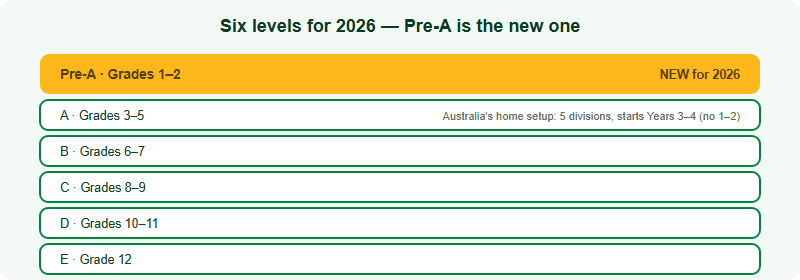
The most meaningful update for 2026 is the addition of Pre-A, a level designed for Grades 1-2. Until now, the youngest students simply did not have an age-appropriate entry point in the China region — the first level began higher up. With Pre-A, a child in Grade 1 or Grade 2 can sit the Australian AMC on the same day as older students, at a paper pitched for their stage. This is a genuine widening of access, not a cosmetic relabel.
It is worth being precise about why this is notable. In Australia's own home competition, the structure is five divisions that start at Years 3-4 (Middle Primary, Upper Primary, Junior, Intermediate, Senior) — there is no Grade 1-2 paper at all. The China region's six-level structure, with Pre-A at the bottom, is therefore broader at the young end than the Australian home schedule. If you have read about "five divisions" elsewhere, that describes Australia's domestic setup, not the China region this site covers. For the full picture of the competition itself, see What Is the Australian AMC.
For families, the practical effect is straightforward: if you have a younger child, or several children at different ages, there is now somewhere for everyone to begin. A Grade 2 child and a Grade 10 sibling can both take part this October, each at a level built for them. Note that exactly what the Pre-A paper looks like at the question level — its precise length and difficulty calibration — is set by the organisers; for those specifics, confirm on the official site.
The dates: an October exam window with a late-September deadline
The second thing to fix in your calendar is the timing. In the China region, the 2026 Australian AMC is sat on Sunday, 11 October 2026, and registration closes on 28 September 2026. Both dates fall comfortably inside a normal school term, which makes planning easy: there is a clear two-week buffer between the registration deadline and exam day.
This October window is a frequent point of confusion, so it is worth stating plainly: Australia runs its home competition in August, but the China region sits in October. If you see an August date quoted, that is Australia's domestic schedule — not the schedule that applies to students registering through the China region. Working backwards from 11 October and registering before 28 September is the correct plan for families here. For how registration and exam-day logistics are handled in China, see How ASDAN Runs the Australian AMC in China.
| Item | 2026 China region (verified) | Why it matters |
| Exam day | Sunday, 11 October 2026 | A single Sunday within term — minimal disruption to school |
| Register by | 28 September 2026 | Sign up before this date; about two weeks before the exam |
| Levels | Six: Pre-A (1-2, new) / A (3-5) / B (6-7) / C (8-9) / D (10-11) / E (12) | Every grade from 1 to 12 now has a level |
| Australia's home schedule | August; five divisions (Years 3-12) | Different month and structure — do not plan around it |
| Entry fee & exact venue/portal steps | Confirm on the official site | Set by the organisers; verify before paying |
What did NOT change: the paper and the awards
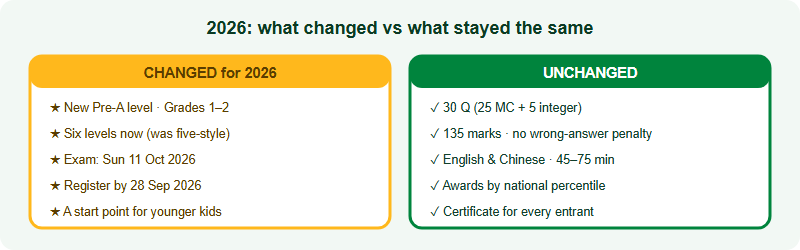
Just as important as what changed is what stayed the same — because the parts families rely on are unchanged for 2026. The paper is still the familiar format across every level: 30 questions made up of 25 multiple-choice and 5 integer-answer, worth a total of 135 marks, taking roughly 45 to 75 minutes depending on the level, and available in English and Chinese. Crucially, there is still no penalty for a wrong answer — a blank and a wrong answer both score zero, so a student can attempt every question without risk.
The mark structure is also unchanged and worth understanding, because it shapes how the paper feels. Questions rise in both difficulty and value: the opening questions are worth fewer marks each and the closing questions are worth the most. (In the competition's established design, the first batch of questions carry 3 marks each, rising step by step to 10 marks for the very hardest at the end.) That gentle-to-hard slope is exactly why one paper can suit a nervous beginner and stretch a strong finisher at the same time.
Recognition is unchanged too. Awards are given by national percentile — Prize, High Distinction, Distinction, Credit and Proficiency — every entrant receives a certificate, and a perfect score can earn the O'Halloran Award. None of this is new for 2026; it is the stable backbone the new Pre-A level and the October date sit on top of. For an honest read on what these awards do and do not signal, see Australian AMC Prestige & Academic Value: An Honest Assessment.
What these updates mean for families planning 2026
Put together, the 2026 updates change who can take part and when, but not the experience itself. Here is how to act on them, calmly and without over-thinking it:
- If your child is in Grade 1 or 2, this is the first year they can enter. The new Pre-A level is built for them. Treat it as a gentle introduction to thinking through problems — not a high-stakes test — and let a certificate for taking part be the win.
- Register by the child's current grade. Place each child at the level matching their grade at the time of the competition (Pre-A for Grades 1-2, A for 3-5, and so on up to E for Grade 12). If you have several children, they can all sit on the same Sunday at their own levels.
- Anchor your plan to October, not August. The China-region exam is 11 October 2026; aim to register before 28 September. Ignore any August dates you see — those belong to Australia's home schedule.
- Don't expect format changes to prepare for. Because the paper, the marks and the no-penalty rule are unchanged, last year's understanding of the format still applies. Preparation is about reasoning, not adapting to new rules.
- Verify the money and the mechanics. Exact entry fee, payment and venue/portal steps are set by the organisers and can change — confirm on the official site before you pay or commit.
There are no guaranteed outcomes here, and no update makes the AMC a shortcut to any admission or scholarship. The honest summary is that 2026 opens the door a little wider — to Grades 1-2 — and sets a clear October date, while keeping the friendly, low-pressure paper that made the competition worth doing in the first place.
A quick reminder: three different "AMC/AMO" competitions
Whenever the 2026 changes come up, it is worth re-stating the one thing families most often confuse. The Australian AMC — set by the Australian Maths Trust (AMT), founded 1978, and administered in China and Asia by ASDAN (阿思丹) — is the competition this article is about. It is not the American AMC (the AMC 8/10/12, run by the MAA in the USA), and it is not the AMO (American Mathematics Olympiad, run by SIMCC in Singapore). Three separate contests with similar-sounding names; a new Pre-A level and an October date apply only to the Australian AMC in the China region. When you register, read the organiser name carefully so you sign up for the right one.
Frequently asked questions
What actually changed for the 2026 Australian AMC?
The main updates are a new Pre-A level for Grades 1-2 and a confirmed China-region exam date of Sunday 11 October 2026, with registration by 28 September 2026.
Can a Grade 1 student really enter now?
Yes. The new Pre-A level is designed for Grades 1-2, giving the youngest primary students an age-appropriate paper for the first time in the China region.
When is the 2026 exam, and why October not August?
The China-region exam is Sunday 11 October 2026. August dates refer to Australia's separate home schedule, which does not apply to students here.
Did the paper or scoring change?
No. It is still 30 questions (25 multiple-choice + 5 integer), 135 marks, with no penalty for wrong answers and awards by national percentile.
This is the editorial desk for the Australian Mathematics Competition (AMC) China region. The competition is run by the Australian Maths Trust (AMT) and administered in China and Asia by ASDAN (阿思丹); this content desk is operated by Hanlin Education. Dates, fees, levels and rules are set by the AMT and ASDAN and can change each year — always confirm current details on the official channels (amt.edu.au and the ASDAN China-region channels). Confirmed errors are corrected within 7 working days.