
How prestigious is the Australian Mathematics Competition (AMC), and what does it really signal? Honestly: it carries genuine, durable standing — run by the Australian Maths Trust (AMT) since 1978 and now one of the world's largest school mathematics competitions, sat by students across dozens of countries. That standing makes a result a credible, independent signal of mathematical reasoning — but never a guaranteed outcome. This 2026 assessment separates the two for parents.
Where the Australian AMC's prestige actually comes from
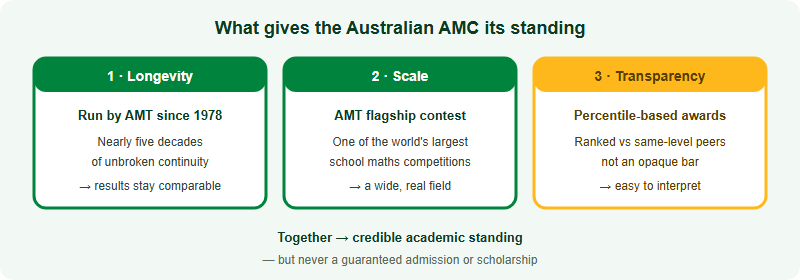
Prestige in academic competitions is not about marketing; it comes from longevity, scale, and a stable, well-run institution behind the paper. The Australian AMC scores on all three. It has been run continuously by the Australian Maths Trust (AMT) since 1978 — a span of nearly five decades during which the same body has set, marked and reported the competition. That institutional continuity is what lets a reader trust that a result this year means roughly what it meant last year, and what it will mean next year.
The second pillar is scale. The Australian AMC is the AMT's flagship and is widely described as Australia's largest school mathematics competition, and one of the largest of its kind anywhere — taken by a very large number of students across dozens of countries each year. A result is therefore not measured against a small local pool; it sits a paper that students worldwide also sit. The third pillar is transparency of recognition: awards are reported by national percentile, so a band describes precisely how a student did relative to same-level peers, rather than against an opaque or shifting bar. Together, a long-lived institution, a very wide field, and percentile-based reporting are exactly the ingredients that give a competition real, defensible standing. For the basics of the contest itself, see What Is the Australian AMC.
What the AMC can signal academically — and what it cannot
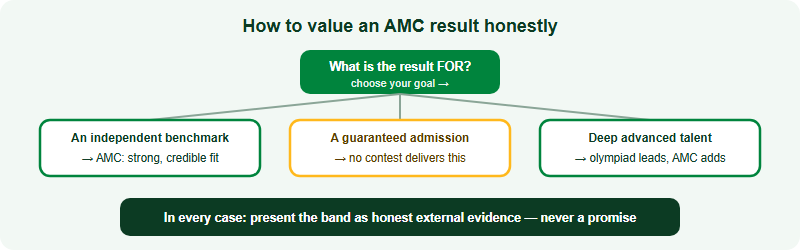
This is the heart of an honest assessment, because prestige is easy to over-read. A strong Australian AMC result can signal several real things. It is independent, third-party evidence that a student can read an unfamiliar problem, choose a method, and reason under modest time pressure. Because the recognition is a national percentile band — Prize, High Distinction, Distinction, Credit or Proficiency — it communicates standing relative to peers in a way a reader can interpret at a glance and trust across years. And because every entrant receives a certificate, even a modest result is a verifiable, recognisable line on an academic record.
What it cannot do is equally important. No AMC result guarantees admission to any school or university, triggers an automatic scholarship, or stands in for the rest of an application. A percentile band is a snapshot of one paper on one Sunday — it is not a full picture of a student, and any site that promises a guaranteed outcome is misleading you. It also does not transfer: a result in the Australian AMC says nothing about the American AMC or the AMO, which are entirely separate competitions. The honest framing, then, is that the AMC supplies one solid, credible data point that supports a story about mathematical curiosity — it is not the story, and not a key that unlocks a result on its own.
| The AMC CAN signal | The AMC CANNOT do |
| Independent evidence of mathematical reasoning | Guarantee admission anywhere |
| Standing vs same-level peers, as a clear percentile band | Trigger an automatic scholarship |
| A recognisable, verifiable line on an academic record | Replace the rest of an application |
| Comparable progress when sat year after year | Predict a result from a single sitting |
| Engagement with a globally recognised, long-running contest | Transfer to the American AMC or the AMO |
Putting the prestige in perspective: a calm comparison
Prestige is relative, so it helps to place the Australian AMC alongside the academic markers families already know. The point of the table below is not a ranking — it is to show what kind of signal each one is, so the AMC is neither over- nor under-valued. Different markers answer different questions, and the AMC's honest niche is a broad, low-pressure, internationally recognised benchmark of reasoning that spans Grades 1 to 12.
| Academic marker | What it mainly signals | How to read it honestly |
| School grades / report card | Sustained performance in a known curriculum | Core, but internal to one school — not externally standardised |
| Australian AMC band / percentile | Independent maths reasoning vs a wide, same-level field | A credible external data point; one of many, not decisive |
| A specialised olympiad track | Deep, advanced talent in a narrow domain | High ceiling, but narrow — the AMC complements rather than replaces it |
| Standardised tests (e.g. school-leaving exams) | Broad readiness against a fixed benchmark | Different purpose; the AMC measures reasoning, not curriculum coverage |
Read this way, the Australian AMC's prestige is real but specific: it is a respected, wide-net signal of mathematical thinking, valuable precisely because it is independent of any single school and reported transparently. It does not out-rank a deep olympiad result for raw difficulty, nor replace school records or standardised exams — and it is not meant to. Its value is being a clear, trustworthy line that almost any motivated student can earn. For how it sits against similar entry-level contests, see Australian AMC vs AMO vs Math Kangaroo: Telling the Young-Learner Contests Apart.
Reading the 2026 China-region facts behind the standing
A competition's prestige only holds if the details are real and current, so plan around the verified 2026 China-region facts rather than Australia's home schedule, which differs (Australia runs in August with five divisions for Years 3-12; the China region runs in October with six levels spanning Grades 1-12). The structure below is the same well-defined paper that underpins the contest's comparability year to year.
| Item | 2026 China region |
| Set & administered by | Australian Maths Trust (AMT, since 1978); administered in China & Asia by ASDAN (阿思丹) |
| Exam date | Sunday, 11 October 2026 |
| Register by | 28 September 2026 |
| Levels | Six: Pre-A (Grades 1-2, new for 2026) / A (3-5) / B (6-7) / C (8-9) / D (10-11) / E (Grade 12) |
| Paper | 30 questions (25 multiple-choice + 5 integer) · 135 marks · no penalty for wrong answers · 45-75 min by level · English & Chinese |
| Recognition | By national percentile: Prize / High Distinction / Distinction / Credit / Proficiency; a certificate for every entrant; O'Halloran Award for a perfect score |
| Entry fee & exact cut-off scores | Confirm on the official site |
Two clarifications protect the value of the result. First, the addition of the Pre-A level means the 2026 contest now reaches Grades 1-2 with an age-appropriate paper; for what that change involves, see Pre-A for Grades 1-2: The New 2026 Australian AMC Division for Young Learners. Second, and essential to assessing prestige correctly: the Australian AMC (AMT / ASDAN) is not the American AMC (run by the MAA in the USA) and not the AMO (run by SIMCC in Singapore). Three separate competitions with similar names — their reputations and results do not carry across, so the standing discussed here belongs to the Australian AMC alone.
An honest bottom line for parents
If you want the assessment in one paragraph: the Australian AMC has genuine, well-earned standing — a 1978-founded AMT contest, one of the world's largest school maths competitions, with transparent percentile recognition. That makes a result a credible, independent signal of mathematical reasoning and a recognisable line on a record. It is not a guarantee of admission, a scholarship, or a substitute for the rest of a student's file, and it does not transfer to the American AMC or the AMO. Valued as one strong data point among many — especially when a student sits it across several years and a trajectory emerges — it is well worth the modest effort. Valued as a magic key, it will disappoint. Honest expectations are what turn real prestige into real, usable value.
Frequently asked questions
How prestigious is the Australian AMC?
It has real standing: run by the Australian Maths Trust since 1978 and one of the world's largest school maths competitions, with transparent percentile-based recognition.
Will a strong AMC result get my child into a top school?
No. It is a credible, independent signal of maths reasoning and a verifiable line on a record, but never a guaranteed admission or scholarship on its own.
Is the Australian AMC as prestigious as a specialised olympiad?
It is a different signal — a broad, internationally recognised benchmark of reasoning, not a narrow advanced-talent measure. It complements an olympiad rather than out-ranking it.
Is this the same prestige as the American AMC or the AMO?
No. The Australian AMC is run by AMT (ASDAN in China). The American AMC (MAA) and the AMO (SIMCC) are separate contests with their own, separate reputations.
This is the editorial desk for the Australian Mathematics Competition (AMC) China region. The competition is run by the Australian Maths Trust (AMT) and administered in China and Asia by ASDAN (阿思丹); this content desk is operated by Hanlin Education. Dates, fees, levels and rules are set by the AMT and ASDAN and can change each year — always confirm current details on the official channels (amt.edu.au and the ASDAN China-region channels). Confirmed errors are corrected within 7 working days.