
Every year after the Australian Mathematics Competition, parents face the same question: should we keep preparing on our own, or does my child need structured support? The answer depends on understanding what actually caused a child to stumble. School maths covers the content, but competition questions test how that content is packaged and applied. This article offers a framework to identify whether your child’s gaps are likely to respond to school-level work or whether targeted Australian AMC tutoring might help.
What School Preparation Already Provides
Most students who sit the Australian AMC have already encountered the core mathematical concepts in class. For Levels A through E, the paper contains 30 questions with a total of 135 points, while the Pre-A level uses 25 questions worth 100 points. School programmes typically deliver the arithmetic, basic geometry, and early algebra that underpin the earlier, lower-point questions.
Where school preparation often falls short is in two areas: the unfamiliar presentation of known concepts, and the multi-step reasoning required for later questions. A child who scores well on classroom tests may still struggle when the same concept appears in a word problem with distracting context or in a diagram that requires spatial interpretation.
Preparation guidance notes that graphics and space questions are a common stumbling block for students with limited exposure to visual problem types. Similarly, logic and application problems reward careful condition-stripping rather than rapid calculation. These skills are not always prioritised in standard curricula.
Separate Unfamiliar Wording From Missing Mathematical Reasoning
Not all gaps are equal. Before considering any external support, it helps to distinguish between two distinct failure modes:
| Gap type | What it looks like | Typical response |
|---|---|---|
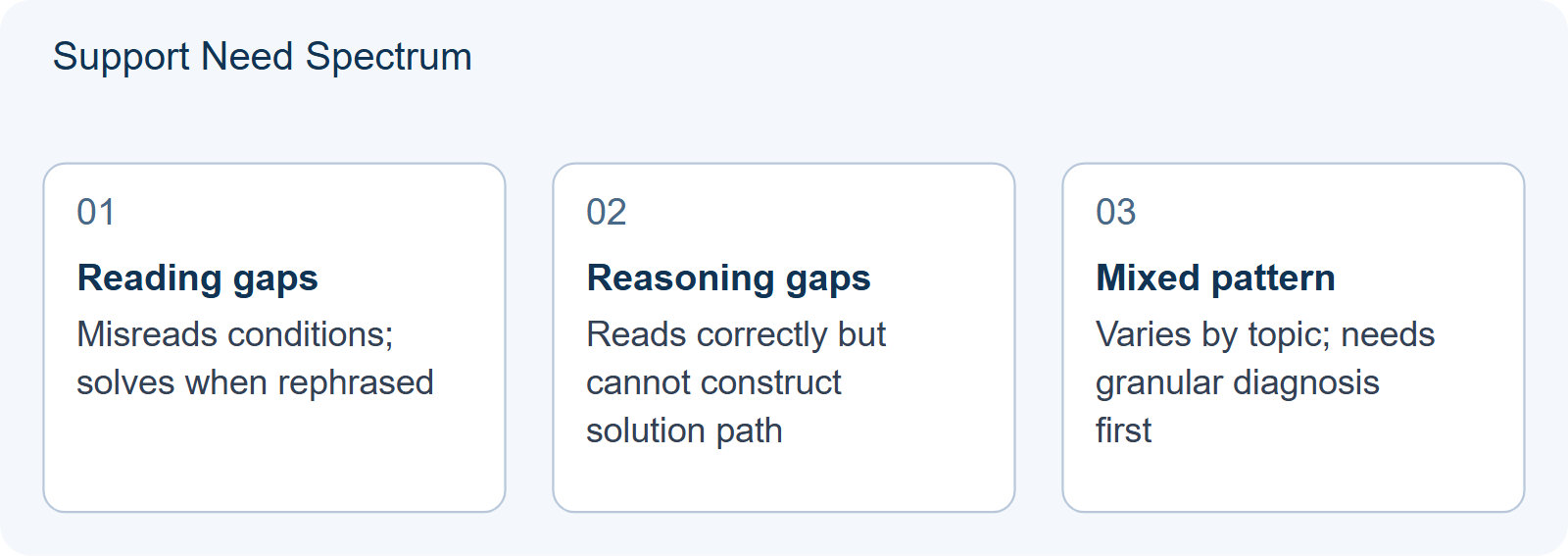
| Reading and interpretation | Child understands the maths but misreads constraints, misses conditions, or cannot decode the question structure | Often improvable with practice and vocabulary exposure |
| Reasoning depth | Child understands what is asked but cannot construct the multi-step argument or select the right technique | May benefit from structured modelling and feedback |
The first gap is about access; the second is about execution. A child with reading gaps may solve a problem correctly once it is explained aloud. A child with reasoning gaps may read perfectly yet still lack a pathway to the solution.
Preparation guidance for the Australian AMC identifies permutation, combination, and probability problems in the final section of the paper as particularly demanding of deeper reasoning. These questions are concentrated in the last 10 problems across Levels A–E, where point values escalate from 6 to 10 marks.
Use a Short Attempted Question Set to Identify Support Needs
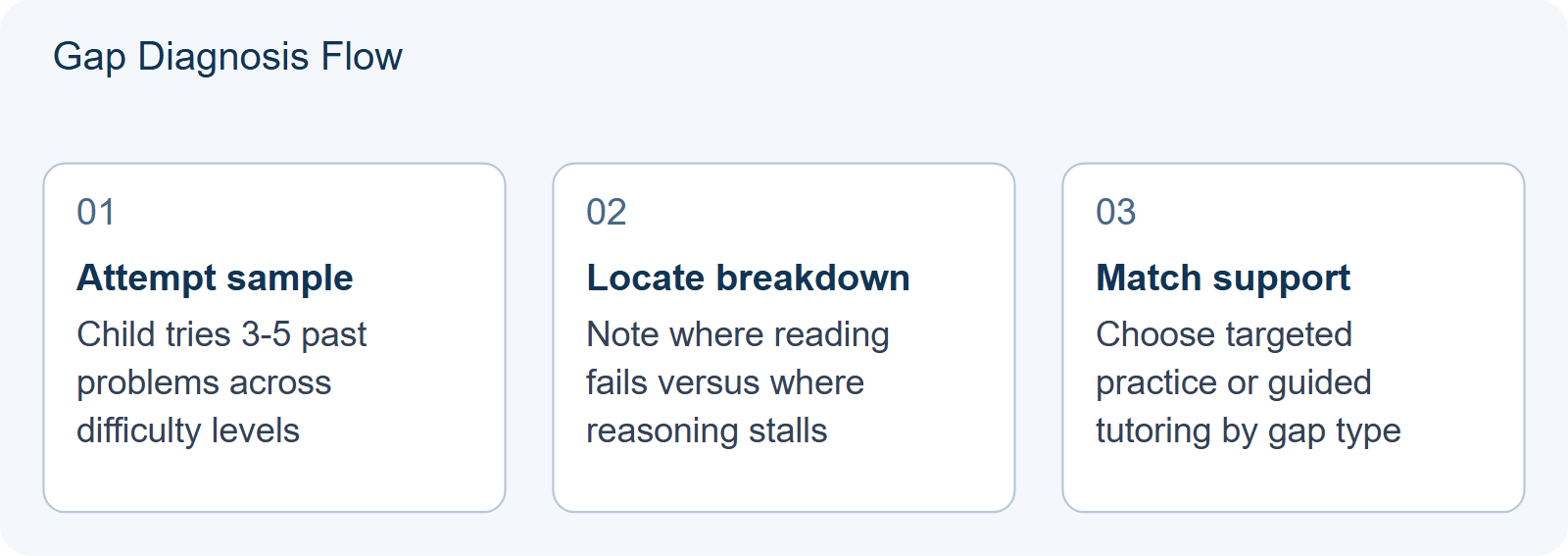
Rather than relying on overall score alone, parents can use a focused sample to diagnose. The goal is not to replicate exam conditions exactly, but to observe where breakdowns occur.
Suggested approach: select 3–5 problems from a past paper spanning easy, medium, and hard difficulty. Ask the child to attempt them with standard time pressure, then review together without hints. Note:
- Where did they stop or hesitate?
- Did they misread any condition, or did they read correctly but choose the wrong approach?
- Could they explain their steps, or was the work fragmented?
This informal diagnostic reveals more than percentage correct. A child scoring 60% through careless reading needs different support than one scoring 60% through stalled reasoning.
What Feedback to Request Before Choosing Tutoring
If you are considering Australian AMC tutoring, the quality of initial assessment matters. Useful programmes should be able to articulate:
- Which specific question types caused difficulty, not just “weak in geometry”
- Whether the issue is pattern recognition, step sequencing, or foundational knowledge
- How sessions would address that gap rather than repeat general content
Be cautious of any service that cannot describe its diagnostic process or that promises uniform improvement regardless of starting point. The Australian AMC’s structure—with its clear difficulty gradient and varied question formats—allows for precise targeting, but only if the tutor uses that structure.
Preparation resources, including past paper collections, are available for independent use. Some families find that structured practice with detailed review is sufficient; others benefit from external accountability and expert questioning. There is no universal correct choice.
What Information to Prepare for a Course-Fit Discussion
Whether you contact a tutoring provider or discuss options within your school, prepare the following:
- Recent performance data: Australian AMC level, score if known, and which sections felt hardest
- School maths profile: grades, any acceleration, known strengths (calculation speed, spatial reasoning, etc.)
- Practice observations: results from the 3–5 question diagnostic above, with notes on where the child got stuck
- Goals and constraints: timeline to next sitting, available weekly hours, whether the aim is confidence building, award threshold, or preparation for a subsequent competition
This preparation turns a generic enquiry into a productive conversation about fit. It also protects against being sold a standardised package that does not address your child’s actual pattern of need.
For families still deciding whether to commit to external support, reviewing what the 2026 early-primary pilot means for China families can help set realistic expectations about level placement and when to gather data. Those preparing younger children may find room rules to rehearse before sitting day for six- to ten-year-olds valuable for reducing handling errors that mask true ability. Parents comparing competition pathways can consult access arrangements and what to ask before the registration deadline to understand how accommodations and timing decisions affect preparation planning.
Ultimately, Australian AMC tutoring is most valuable when it addresses a clearly identified gap that independent practice has not closed. The framework above helps families make that identification before investing time and resources.
Frequently Asked Questions
How early should we start preparing for the Australian AMC if we want to avoid last-minute tutoring?
Preparation guidance identifies the months before the October sitting as a concentrated preparation window. Families typically benefit from beginning structured practice several months ahead, which allows time to surface and address gaps without pressure. Starting after results are released gives a full year to the next sitting.
Can a child who scores poorly on the first 20 questions benefit from tutoring, or is that a sign they are not ready?
Difficulty with the first 20 questions usually signals gaps in foundational knowledge or reading comprehension rather than competition-specific reasoning. These gaps may respond to school support, targeted practice, or tutoring depending on severity and the child's learning context. The key is identifying whether the issue is understanding the mathematics or accessing the question format.
How do we evaluate whether a tutoring programme understands the Australian AMC specifically?
Ask how they diagnose gap types across the paper's difficulty gradient, not just overall score. A programme familiar with the competition should be able to reference specific question structures, explain how they differ from school assessments, and describe how sessions progress from foundational to advanced problem types without overpromising outcomes.