
Short answer: a long Australian AMC Pre-A past-paper archive does not exist because Pre-A was newly added for 2026 and targets Grades 1–2. For the 2026 China sitting, the paper date has already passed—11 October 2026—so the useful question is not “which ten years should we print?” but “what do we use as the first full Pre-A reference, and how do we borrow early Level A questions without pretending they are a Pre-A mock?” The 2026 Pre-A paper is the first full Pre-A reference when it becomes available through a verified channel. Before that, short sets drawn from the early part of Level A can serve as a teaching diagnostic, clearly labelled as adapted practice rather than an official Pre-A paper.
This is the Hanlin preparation perspective for families who searched for Australian AMC Pre-A past papers and found very little. The scarcity is structural, not a sign that the family has missed a hidden download. The Hanlin Courses WeChat report “2026 Australian AMC Opens Today: How Many Marks Can You Get? Past Papers, Answers and Analysis Preview” (11 October 2026) states that Pre-A was newly added for 2026 and targets Grades 1–2. That single fact changes the practice plan.
What exists, and what does not
The same 11 October 2026 report describes six China levels in 2026: Pre-A through E, covering Grades 1–12. Pre-A is the new entry level. A family looking for older Pre-A papers is therefore looking for papers from years before the level existed. No amount of searching creates a 2023 Pre-A archive.
The report also says Hanlin was preparing 2026 Pre-A and Level A–C papers, answers and video explanations for release after the exam silence period. That is a statement about an intended release, not proof that a public download is available today. Families should ask what is currently available and inspect the source. A page title that mentions “past papers” is not the same as a verified 2026 Pre-A paper with a matching answer key.
The practical resource base is therefore narrow but not empty:
- the 2026 Pre-A paper itself, once available, as the first full Pre-A reference;
- the published Pre-A structure—25 questions, 100 marks and 50 minutes—for timing and review planning;
- early Level A questions as adapted teaching material, not as a substitute paper;
- shorter read-aloud and stamina routines for a Grade 1–2 child.
For the general question of choosing practice years by level, see Australian AMC Past Papers: Choosing Practice Years by Level, Not Volume. For the Pre-A mark scheme in detail, see Australian AMC Pre-A Scoring: 25 Questions, 100 Marks, No Penalty.
Pre-A versus Level A: the format gap that matters
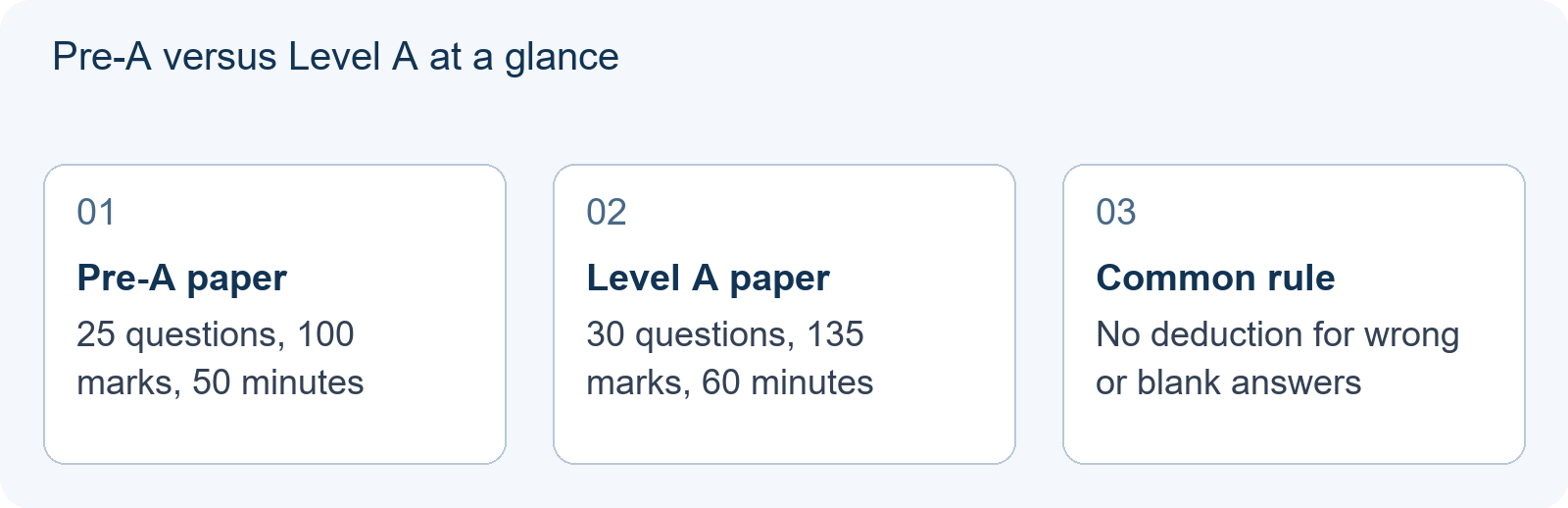
The 11 October Hanlin Courses report gives exact paper structures. Pre-A has 25 questions and 100 marks; Levels A–E have 30 questions and 135 marks. All levels award no marks for a wrong or blank answer, so there is no penalty for leaving a question unanswered. A second Hanlin Courses article, “How to Choose Among Grade 3–8 Maths Competitions: AMC8, Math Kangaroo, Australian AMC, SASMO and Others” (2 October 2026), adds the timing: Pre-A is 50 minutes for 25 questions; Levels A–B are 60 minutes for 30 questions; Levels C–E are 75 minutes for 30 questions.
| Feature | Pre-A (Grades 1–2) | Level A |
|---|---|---|
| Questions | 25 | 30 |
| Total marks | 100 | 135 |
| Time | 50 minutes | 60 minutes |
| Wrong or blank answer | No deduction | No deduction |
| Q1–Q10 | 3 marks each (30) | 3 marks each (30) |
| Q11–Q20 | 4 marks each (40) | 4 marks each (40) |
| Q21–Q25 | 5, 5, 6, 6, 8 marks (30) | 5 marks each (25) |
| Q26–Q30 | — | 6, 7, 8, 9, 10 marks (40) |
The first 20 questions carry 70 marks on both papers. That is the useful overlap. The difference lies after Question 20: Pre-A places 30 marks in five questions; Level A places 65 marks in ten questions. So a full Level A paper does not simply add “five more questions.” It adds a much heavier back section after the first 20 questions.
Why a full Level A paper is a poor Pre-A mock
A full Level A paper changes four things at once: five extra questions, ten extra minutes, 35 extra total marks and a heavier post-Q20 section. That makes it a poor stand-in for a Pre-A mock, especially for a Grade 1–2 reader.
Teaching illustration, not an official paper: imagine a child who can complete the first 20 questions of a Level A paper with reasonable accuracy. On both Pre-A and Level A, those first 20 questions represent 70 marks. But if the same child tires or slows after Question 20, Pre-A offers 30 remaining marks in five questions, while Level A offers 65 remaining marks in ten questions. The child has not simply met “a longer paper.” The child has met a different endgame.
Timing arithmetic also needs care. Pre-A gives 50 minutes for 25 questions, an average of 2 minutes per question. Level A gives 60 minutes for 30 questions, also an average of 2 minutes per question. Equal averages do not make the papers interchangeable. On Level A, the extra ten minutes are attached to five additional questions and a larger high-value tail. A family that treats Level A as “Pre-A plus five spare questions” may misread both pace and stamina.
A full Level A paper can still be used for an older child or for a broad enrichment check. It should not be scored as if it were Pre-A, and it should not be used to predict a Pre-A award band. The marks are out of 135, not 100; the question count is 30, not 25; the time is 60 minutes, not 50.
How to adapt early Level A questions honestly
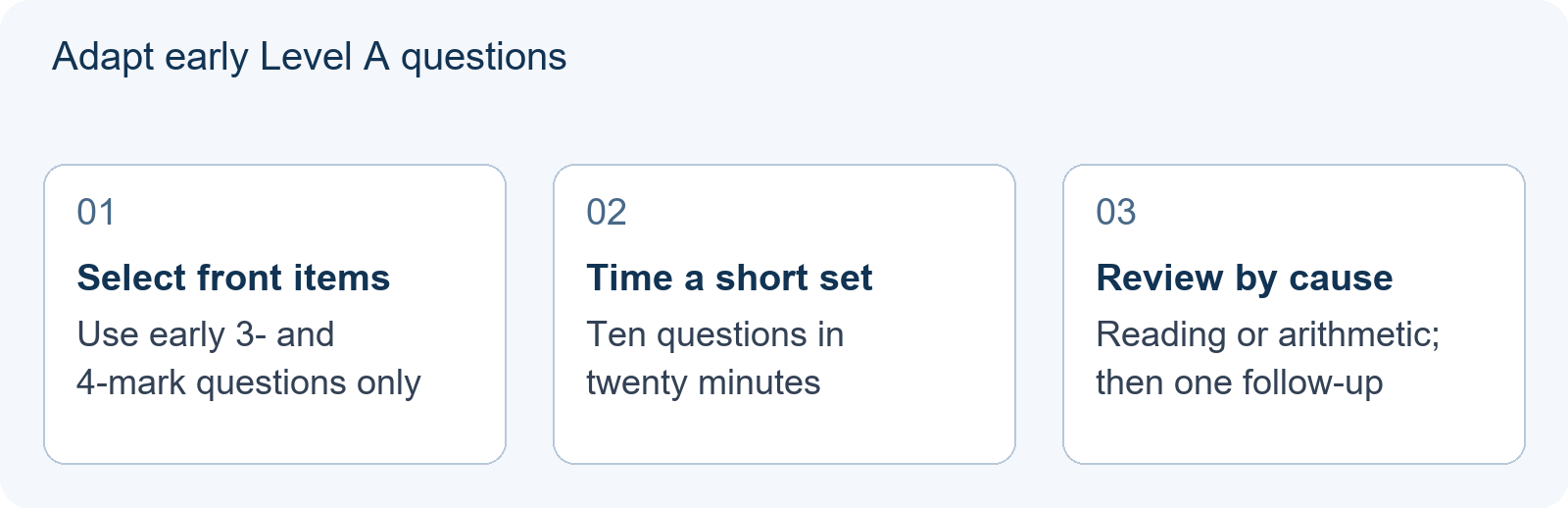
Use only the early Level A questions—the 3-mark and selected 4-mark section—and say why. Do not print all 30 Level A questions and call the result a “Pre-A mock.” Do not rewrite the paper’s title or present an adapted set as an official Pre-A paper.
A defensible protocol is:
- Select a short front section. Choose 10 early Level A questions for a first diagnostic, from the 3-mark band and, if the child is comfortable, a few 4-mark questions.
- Keep the reading visible. For Grades 1–2, ask the child to read each question aloud or restate it before calculating. A misread is a comprehension event, not automatically an arithmetic weakness.
- Stop before the heavy tail. Do not use Level A Q21–Q30 as part of a Pre-A-style timed block. Those questions belong to a 30-question, 135-mark paper with its own pacing.
- Record causes, not just a score. Mark completion, reading hesitations, arithmetic slips and blanks separately.
This is an adaptation for teaching, not an official equivalence. The question wording comes from a different level, so the result cannot be converted into a Pre-A mark out of 100. It can still tell a parent whether the child can start, read, choose and finish a short set.
A short diagnostic, clearly not an official test
Teaching illustration: give 10 early Level A questions in 20 minutes. Record the result out of 10, not as a projected Pre-A score. Suppose a child answers 6 correctly, leaves 2 blank and needs 2 questions read twice. If all 10 questions were 3-mark questions, the raw total would be 18 out of 30—but that is a fact about this adapted set, not a Pre-A result. The useful information is the pattern: 6 correct, 2 blanks, 2 reading hesitations.
The follow-up should be short and caused by the pattern:
- If the main problem is misreading, use a 15-minute “read and restate” set with no new arithmetic.
- If the main problem is arithmetic slips, use a 15-minute number-fact and checking set.
- If the main problem is blank answers near the end, use a 10-question untimed completion set before adding a clock.
- If the child finishes early with high accuracy, move to a 15-question block rather than jumping to a full 30-question Level A paper.
This diagnostic is a Hanlin teaching suggestion. It is not an official Australian AMC test, not a readiness certificate and not a score prediction. Its purpose is to choose the next 15 minutes.
Using the 2026 Pre-A paper when it is available
When a verified 2026 Pre-A paper becomes available, treat it as the first full reference, not as one year in a long sequence. Use it once as a full timed experience: 25 questions, 100 marks, 50 minutes, with no deduction for wrong or blank answers. A full sitting teaches the child how to move through the paper and how to leave a blank without panic.
Then split it for review by mark band:
- Q1–Q10: 30 marks; check starting, reading and early accuracy.
- Q11–Q20: 40 marks; check whether the child can sustain attention through the middle.
- Q21–Q22: 10 marks; check the first high-value pair.
- Q23–Q24: 12 marks; check two-step reasoning and checking.
- Q25: 8 marks; check the final question under the real paper’s close.
Do not use the only Pre-A paper as daily practice. Once the child has seen it, a second “timed mock” measures memory and familiarity as much as solving. Keep the full paper for a baseline, then reuse individual questions later for explanation, oral reading and error repair. If the family needs a longer sequence, build it from short front-section Level A sets, read-aloud routines and review of the 2026 Pre-A items—not from invented “Pre-A” papers.
Stamina and read-aloud routine for Grades 1–2
Begin with 10-question blocks, not 25-question blocks. A 10-question block can be completed, reviewed and explained in one short session. Once the child can handle two consecutive 10-question blocks without losing the thread, move closer to the Pre-A shape: 25 questions in 50 minutes.
The read-aloud habit matters because the paper is a reading task as well as a mathematics task. Ask the child to say what the question is asking before choosing an operation. If a word is unfamiliar, teach the child to point to it and restate the sentence in simpler words. Do not turn every session into a vocabulary lesson; the goal is to prevent a reading hesitation from being mistaken for a mathematical gap.
For a fuller early-primary routine, see Australian AMC Early Primary 2027: A 50-Minute Online Prep Plan for Years 1-2.
Preparing a useful consultation request
Because the Pre-A archive is short, a consultation should not begin with “send me all the Pre-A past papers.” A more useful request is: “Please check our child’s reading and completion pattern with a short Pre-A-style diagnostic, tell us whether the 2026 Pre-A paper is currently available through a verified channel, and propose a short practice sequence that does not turn Level A into a false Pre-A mock.”
Ask three concrete questions before booking:
- Will the diagnostic separate reading hesitations from arithmetic errors?
- Will the practice sequence use only confirmed Pre-A material and clearly labelled adapted Level A questions?
- Will the child’s first full 25-question sitting be reserved as a baseline rather than consumed as daily homework?
No provider should promise a Pre-A download that is not confirmed to exist. The honest position is narrower and more useful: Pre-A is new in 2026, the 2026 paper is the first full reference when available, and early Level A questions can support short teaching diagnostics without being relabelled as Pre-A papers.
General event background is available at Event background.
Frequently Asked Questions
Are there older Australian AMC Pre-A past papers?
A long Pre-A archive does not exist because Pre-A was newly added for 2026 and targets Grades 1–2. The 2026 Pre-A paper is the first full Pre-A reference when it becomes available through a verified channel; families should confirm current availability rather than assume a download exists.
Can we use a full Level A paper as a Pre-A mock?
No. Level A has 30 questions, 135 marks and 60 minutes, while Pre-A has 25 questions, 100 marks and 50 minutes. The first 20 questions carry 70 marks on both, but Level A adds ten post-Q20 questions worth 65 marks. Use only early Level A questions as short adapted diagnostics, not as a full Pre-A replacement.
What should we ask before booking Pre-A preparation?
Ask for a short diagnostic that separates reading hesitations from arithmetic slips, a practice sequence built from confirmed Pre-A material and clearly labelled early Level A questions, and a plan that keeps the one full 25-question Pre-A sitting as a baseline rather than daily practice.