
Australian AMC 2026 China Results: The 6–8 Week Window, Score Report and Who to Ask
After sitting the Australian Mathematics Competition (AMC) in China, families face a predictable but often anxious wait. The ASEEDER organiser page confirms the 2026 China event date as 11 October 2026 and states that results and rankings are announced 6–8 weeks after the activity. This article explains how to plan around that window, what information appears on an AMT performance report, and the correct channel to pursue if your result does not arrive.
Why the Result Window Is Estimated, Not Fixed
The 6–8 week figure is an official planning estimate, not a guaranteed release date. Calculating from the 11 October 2026 exam date produces an approximate window of 22 November to 6 December 2026. However, ASEEDER has not published a specific day. This distinction matters because families sometimes interpret “6–8 weeks” as a promise for the sixth week, leading to unnecessary concern when results process across the full range.
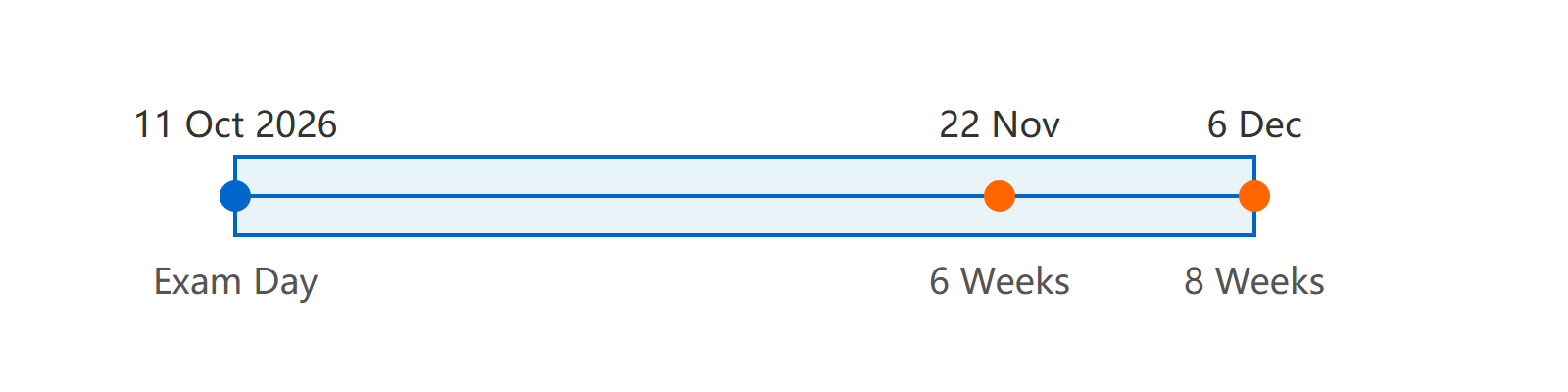
Treat 22 November–6 December as your planning window, not a deadline. The source does not specify a fixed release day.
Who to Contact If Results Do Not Arrive
For China, ask your registration contact or school how the 2026 results will be communicated. If the estimated window passes without results:
- Start with the school or centre that registered you — ask how it plans to share the 2026 result.
- Second, consult ASEEDER’s public page at https://www.seedasdan.asia/amc/ for any announcements or updates.
When making enquiries, provide: student name (as registered), school name, and year level.
Reading the AMT Performance Report
AMT’s official explanation describes the result report printed on the back of performance certificates. The following fields are published by AMT:
| Field | What It Means | How to Use It |
|---|---|---|
| Total Score | Points accumulated across all questions | Track progress year-over-year; not comparable across paper levels |
| Breakdown (3 parts) | Score distribution across the paper’s three sections | Identify strength/weakness patterns in problem types |
| Approximate Percentile | Ranking within same year level and region | Contextualise performance against peers; not an exact rank |
| Question Responses | Your answer vs. correct answer per question | Targeted review for future preparation |
| Topic-Area Summary | Performance grouped by mathematical topic | Guide focused study on weaker domains |
| Region Average Comparison | Your score vs. regional mean for your year level | Benchmark against local cohort performance |
The format and distribution of a China family’s report have not been confirmed from current public evidence. Ask your registration contact which report format and delivery method apply to you.
How Award Bands Are Determined
A common source of confusion: students expect a fixed raw score to guarantee a specific award. AMT’s AMC information clarifies that award cutoffs compare students in the same year level and region, and vary with paper difficulty. The process follows this pattern:
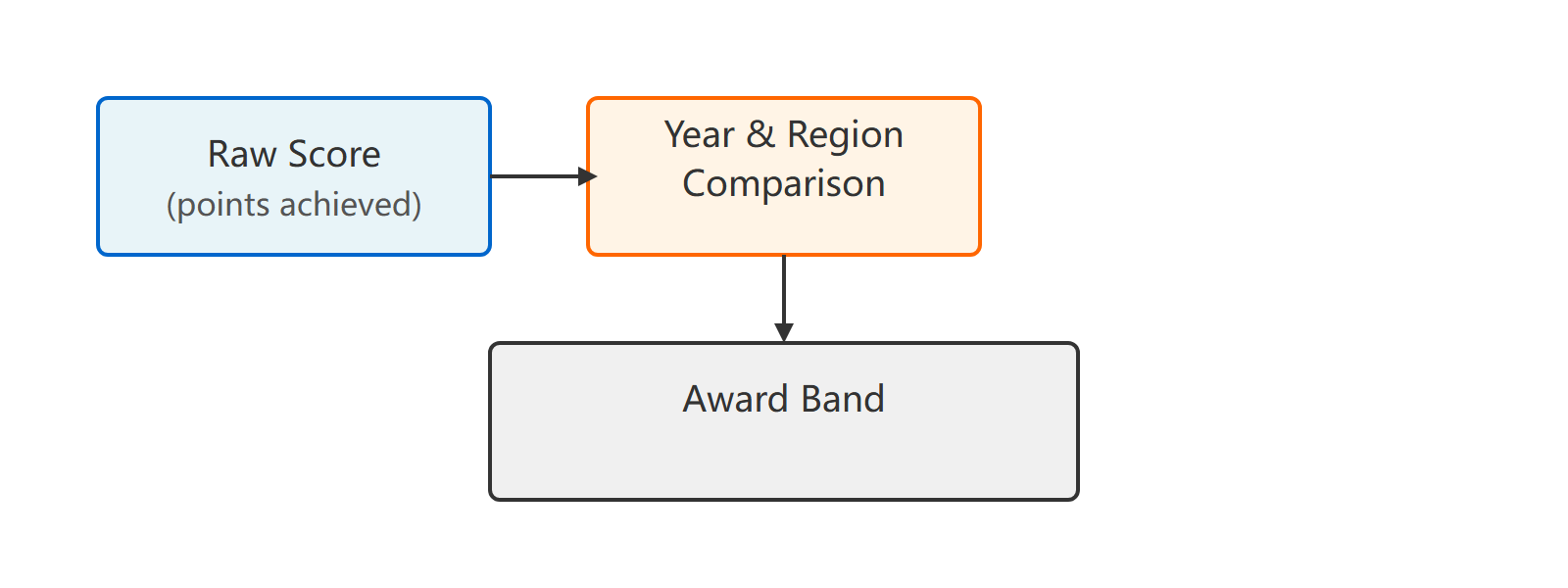
This means:
- A given raw score may earn different awards in different years, depending on overall cohort performance and paper difficulty
- Year-level boundaries differ; students in different year levels with identical raw scores may receive different awards
Understanding Percentile
Your report shows an “approximate percentile” comparing your performance to others in the same year level and region. AMT describes this as approximate, not exact. It indicates roughly what proportion of the comparison group scored below you, not an exact rank. Percentiles are useful for understanding relative standing, but they do not translate to a precise rank position.
Result-Day Checklist for Families
- □ Confirm you are within the 6–8 week window from 11 October 2026 (earliest: 22 November; latest: 6 December)
- □ Verify contact details with your school coordinator before the window opens
- □ Locate your registration confirmation with student name and year level
- □ Review the report fields using the table above to prepare questions
- □ Compare current results to prior years if applicable, using percentile and topic summary rather than raw score alone
- □ Contact school coordinator first; consult ASEEDER’s public page for updates
For students preparing future attempts, our guides on Credit to Distinction progression and grade and level entry verification provide complementary preparation context. Those comparing paper structures may also review Australia pilot versus China Pre-A differences.
Frequently Asked Questions
Is 22 November a guaranteed release date?
No. The 6–8 week window from 11 October 2026 produces an earliest estimate of 22 November and a latest of 6 December, but ASEEDER has not committed to any specific date. The source gives a window, not a guaranteed date.
Who should I ask about my China result?
Contact your school coordinator or registration contact first. Ask how the result will be shared. Consult ASEEDER’s public page for official announcements.
What is on AMT’s performance report?
AMT publishes six fields on its standard performance report: Total Score, three-part Breakdown, Approximate Percentile, Question Responses, Topic-Area Summary, and Region Average Comparison. The format and distribution method for China families in 2026 have not been confirmed from public sources.
Source Note (checked 28 September 2026)
Sources: ASEEDER organiser page (11 Oct 2026 event; results/rankings 6–8 weeks later): https://www.seedasdan.asia/amc/; AMT knowledgebase (performance certificate report fields): https://amt.edu.au/knowledgebase/we-have-received-my-childs-performance-certificate-can-you-explain-the-information-on-the-back; AMT AMC main page (award year/region comparison): https://amt.edu.au/amc.
This is an independent information resource. For definitive guidance, consult ASEEDER and AMT directly.